
Photography of Birds – Set # 114
Set # 114
Ruby-throated Hummingbird (Fem.)
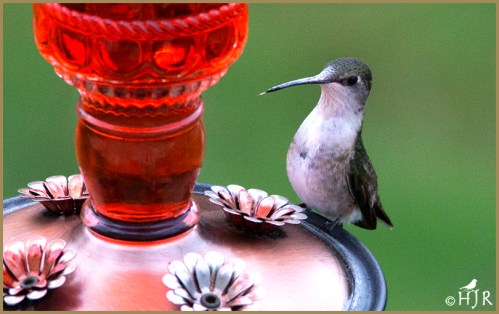
Ruby-throat-Hummingbird (Fem.)
Ruby-throated Hummingbird (Male)

Ruby-throated Hummingbird (Male)
The species is sexually dimorphic. The adult male has a gorget (throat patch) of iridescent ruby red bordered narrowly with velvety black on the upper margin and a forked black tail with a faint violet sheen. The red iridescence is highly directional and appears dull black from many angles. The female has a notched tail with outer feathers banded in green, black, and white and a white throat that may be plain or lightly marked with dusky streaks or stipples. Males are smaller than females and have slightly shorter bills. Juvenile males resemble adult females, though usually with heavier throat markings. The plumage is molted once a year on the wintering grounds, beginning in early fall and ending by late winter.
© HJ Ruiz – Avian101
Share this:

Book Review # 58 – Understanding Bird Behavior
Understanding Bird Behavior
An illustrated guide to what birds do and why
Author:
Wenfei Tong – With a foreword by Ben C. Sheldon
Publisher:
Princeton University Press
Brief Review:
Reading this guide written by Wenfei Tong, I realized how similar and intricate is social life for different bird species, as much as our own social humans.
Bird’s behavior is explained as it touches different factors such as:

More Info.
- Birds finding food
- Birds in a social life
- Birds when is time for courtship
- Birds in a family life
- Birds dealing with danger and predators
- Birds coping with climate
Author Wenfei Tong describes every situation in a comprehensive way, using precise samples of birds that the reader immediately will get the proper information of the chapter in question. All these, accompanied of amazing color illustrations and photos in a total of 150. This guide is a hard cover 224 pages.
I found this guide to be interesting, since I am always observing and photographing birds, I also pay great attention to their fascinating behavior.
Reviewed by:
H.J. Ruiz -Avian101.Wordpress.com – August 17th, 2020
© HJ Ruiz – Avian101
Share this:

Photography of Birds – Set # 113
Set # 113
Carolina Wren (Juv.)
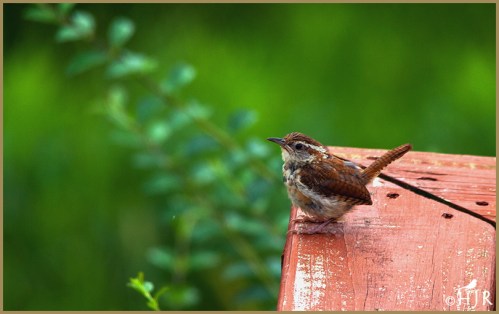
Carolina Wren
Carolina wrens sing year round and at any point during the daytime, with the exception of performing during the most harsh weather conditions. The birds are also the only species in the family Certhiidae that neither sings in duet nor has their song control regions affect repertoire size. Males alone sing, and have a repertoire of at least twenty different phrase patterns and on average, thirty two. One of these patterns is repeated for several minutes, and although the male’s song can be repeated up to twelve times, the general number of songs range from three to five times in repetition. While singing, the tail of the birds is pointed downward.
Males are capable of increasing their repertoire through song learning, but due to their sedentary nature and territorial defense habits, the song learning must occur within the first three months of life. Geographic barriers affect song repertoire size from male wrens, as one study indicated that distances separated as close as 3 km (1.9 mi) by water barriers can have the same effect as that of a distance of 145 km (90 mi) in the mainland with no barriers.
Northern Mockingbird (Juv.)
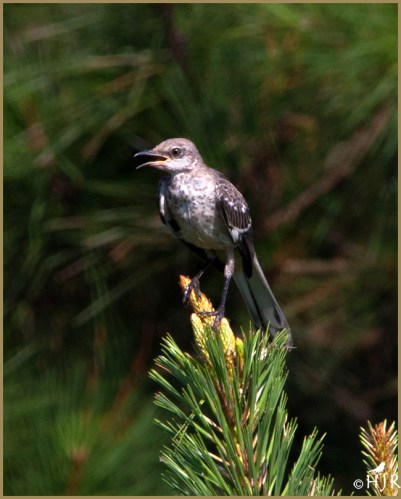
Northern Mockingbird
Both the male and female of the species reach sexual maturity after one year of life. The breeding season occurs in the spring and early summer. The males arrive before the beginning of the season to establish their territories. The males use a series of courtship displays to attract the females to their sites. They run around the area either to showcase their territory to the females or to pursue the females. The males also engage in flight to showcase their wings. They sing and call as they perform all of these displays. The species can remain monogamous for many years, but incidents of polygyny and bigamy have been reported to occur during a single bird’s lifetime.
© HJ Ruiz – Avian101
Share this:

Photography of Birds – Set # 112
Set # 112
House Finch (Fam.)

House Finches
Nests are made in cavities, including openings in buildings, hanging plants, and other cup-shaped outdoor decorations. Sometimes nests abandoned by other birds are used. Nests may be re-used for subsequent broods or in following years. The nest is built by the female, sometimes in as little as two days. It is well made of twigs and debris, forming a cup shape, usually 1.8 to 2.7 m (5.9 to 8.9 ft) above the ground.
Brown-headed Cowbirds (Fam.)
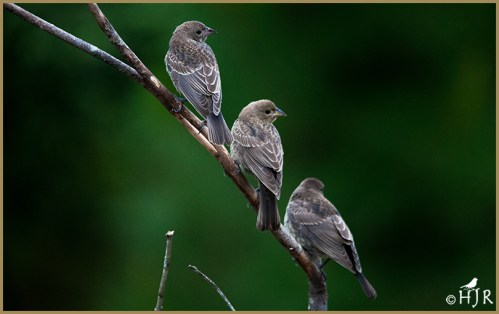
Brown-headed Cowbirds
The species lives in open or semi-open country and often travels in flocks, sometimes mixed with red-winged blackbirds (particularly in spring) and bobolinks (particularly in fall), as well as common grackles or European starlings. These birds forage on the ground, often following grazing animals such as horses and cows to catch insects stirred up by the larger animals. They mainly eat seeds and insects.
Before European settlement, the brown-headed cowbird followed bison herds across the prairies. Its population expanded with the clearing of forested areas and the introduction of new grazing animals by settlers across North America. Brown-headed cowbirds are now commonly seen at suburban birdfeeders.
© HJ Ruiz – Avian101
Share this:

Read Past Reviews

Book # 69
Quote from the Author
“A good chuckle is healthy, it helps you break the monotony of a serious life.” ~ H.J. Ruiz
 H.J. Ruiz - Avian101
You must be logged in to post a comment.