Framed Memories – # 11
Photo Gallery
-
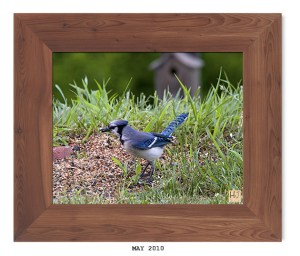
- Blue Jay
-
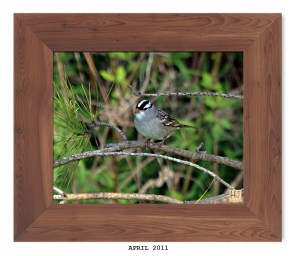
- White-crowned Sparrow
© HJ Ruiz – Avian101
Share this:

Photography of Birds – Set # 119
Set # 119
Eastern Towhee (Juvenile)
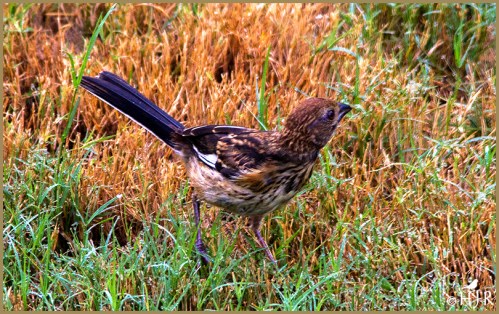
Eastern Towhee (Juv.)
Although eastern towhees generally prefer young successional sites, variation between habitat types and years has been observed. Krementz and Powell found higher relative abundance of eastern towhee in young (2–6 years old) stands of loblolly and longleaf pine than mature (32–98 years old) stands when investigated in 1995. However, in stands compared in 1996, the 95% confidence intervals of eastern towhee relative abundance on the 2 sites had a substantial degree of overlap. The degree to which eastern towhee responds to succession is influenced by habitat.
Common Grackle (Juvenile)
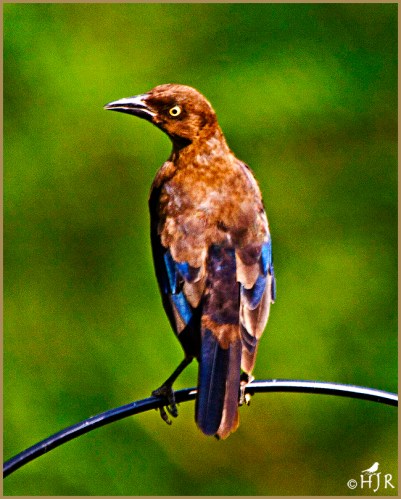
Common Grackle (Juv.)
Adult females, beyond being smaller, are usually less iridescent; their tails in particular are shorter, and unlike the males, do not keel (display a longitudinal ridge) in flight and are brown with no purple or blue gloss. Juveniles are brown with dark brown eyes.
© HJ Ruiz – Avian101
Share this:

Photography of Birds – Set # 118
Set # 118
Common Grackles (Feeding chick)
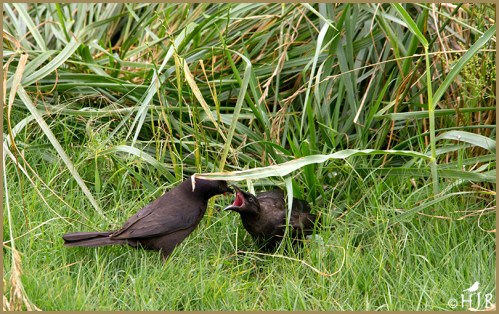
Common Grackles
This bird is a permanent resident in much of its range. Northern birds migrate in flocks to the Southeastern United States. The distribution of the common grackle is largely explained by annual mean temperature, and the species has expanded its range by greater than three-fold since the last glacial maximum, approximately 22,000 years ago.
Carolina Chickadees (Feeding chick)

Carolina Chickadees
Their breeding habitat is mixed or deciduous woods in the United States from New Jersey west to southern Kansas and south to Florida and Texas; there is a gap in the range at high altitudes in the Appalachian Mountains where they are replaced by their otherwise more northern relative, the black-capped chickadee. They nest in a hole in a tree; the pair excavates the nest, using a natural cavity or sometimes an old woodpecker nest. They may interbreed with black-capped chickadees where the ranges overlap, which can make identification difficult.
They are permanent residents, not usually moving south even in severe winter weather.
© HJ Ruiz – Avian101
Share this:

Photography of Birds – Set # 117
Set # 117
Carolina Wren
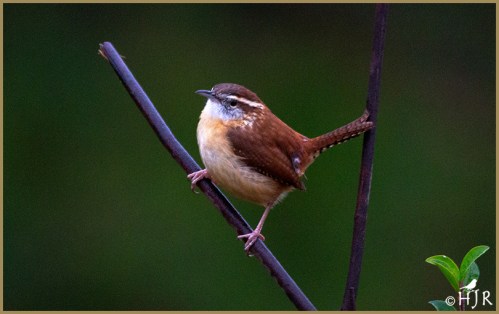
Carolina Wren
The Carolina wren (Thryothorus ludovicianus) is a common species of wren that is a resident in the eastern half of the United States of America, the extreme south of Ontario, Canada, and the extreme northeast of Mexico. Severe winters restrict the northern limits of their range while favorable weather conditions lead to a northward extension of their breeding range. Their preferred habitat is in dense cover in forest, farm edges and suburban areas. This wren is the state bird of South Carolina.
Song Sparrow
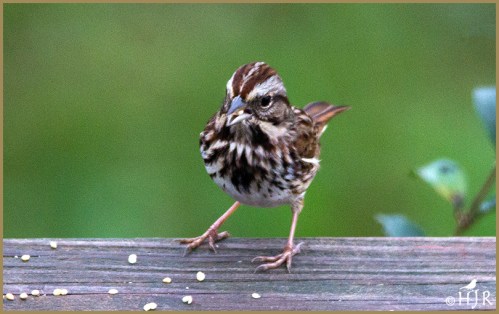
Song Sparrow
These birds forage on the ground, in shrubs or in very shallow water. They mainly eat insects and seeds. Birds in salt marshes may also eat small crustaceans. They nest either in a sheltered location on the ground or in trees or shrubs. Song sparrows with areas of shrub cover in their territory, away from the intertidal coastline, have greater over-winter survival, as well higher reproductive success.
© HJ Ruiz – Avian101
Share this:

Read Past Reviews

Book # 69
Quote from the Author
“A good chuckle is healthy, it helps you break the monotony of a serious life.” ~ H.J. Ruiz
 H.J. Ruiz - Avian101
You must be logged in to post a comment.