Photography of Birds – Set # 125
Set # 125
Downy Woodpecker
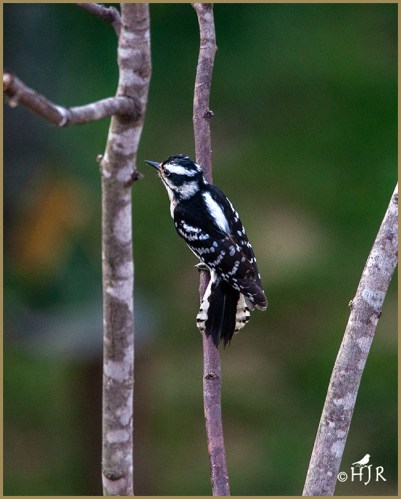
Downy Woodpecker
Downy woodpeckers are native to forested areas, mainly deciduous, of North America. Their range consists of most of the United States and Canada, except for the deserts of the southwest and the tundra of the north. Mostly permanent residents, northern birds may migrate further south; birds in mountainous areas may move to lower elevations.
Downy woodpeckers nest in a tree cavity excavated by the nesting pair in a dead tree or limb. In the winter, they roost in tree cavities. Downy Woodpeckers forage on trees, picking the bark surface in summer and digging deeper in winter. They mainly eat insects, also seeds and berries.
Blue Jay
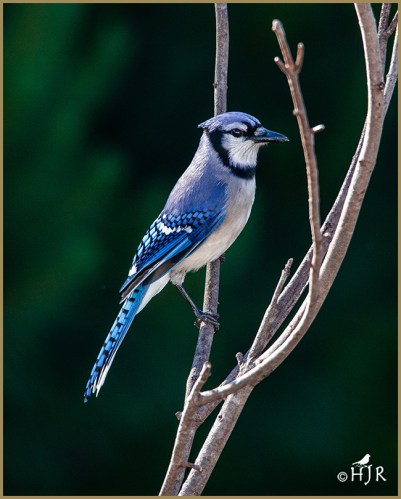
Blue Jay
Its plumage is lavender-blue to mid-blue in the crest, back, wings, and tail, and its face is white. The underside is off-white and the neck is collared with black which extends to the sides of the head. The wing primaries and tail are strongly barred with black, sky-blue and white. The bill, legs, and eyes are all black. Males and females are almost identical, but the male is slightly larger. As with most other blue-hued birds, the blue jay’s coloration is not derived from pigments but is the result of light interference due to the internal structure of the feathers; if a blue feather is crushed, the blue disappears because the structure is destroyed. This is referred to as structural coloration.
© HJ Ruiz – Avian101
Share this:

Framed Memories – # 12
Photo Gallery
-

- Northern Cardinal (M)
-
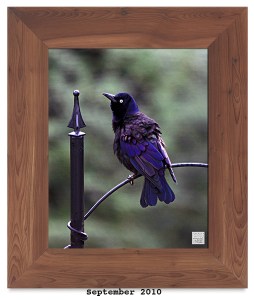
- Common Grackle (M)
© HJ Ruiz – Avian101
Share this:

Photography of Birds – Set # 124
Set # 124
Snowy Egret
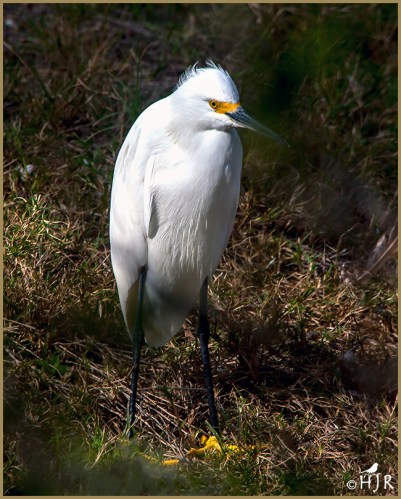
Snowy Egret
Adult snowy egrets are entirely white apart from the yellow lores between the long black bill and the eye, black legs, and bright yellow feet. The nape and neck bear long, shaggy plumes known as aigrettes. Immature snowy egrets have duller, greenish legs.
Yellow-crowned Night Heron
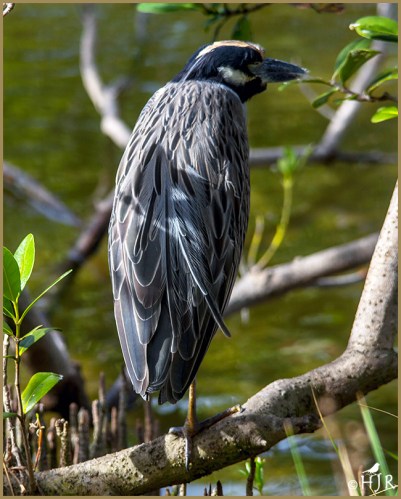
Yellow-crowned Night Heron
The body and back are a smooth grey-blue, with a black scaled pattern on the wings. The long legs are yellow and turn coral, pink or red during courtship. The most characteristic part of the yellow-crowned night heron is the head: black and glossy, with white cheeks and a pale yellow crown going from the bill, between the eyes and to the back of the head, giving the bird its common name. Such colours make the face appear striped in a horizontal black-white-black-white pattern. Long, thin, white feathers grow to the back of the crown during mating season. The bill, also black, is thick and deeply set under the eyes which are dark orange or red.
© HJ Ruiz – Avian101
Share this:

Photography of Birds – Set # 123
Set # 123
Red-winged Blackbird (M)
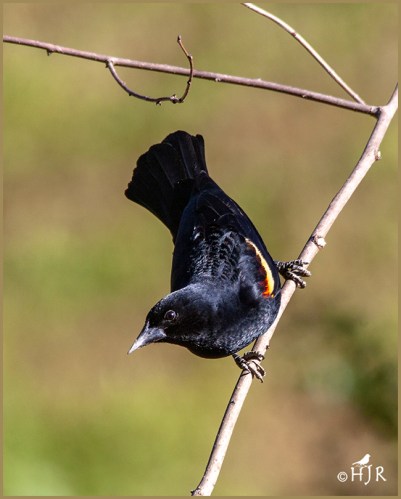
Red-winged Blackbird (M)
Young birds resemble the female, but are paler below and have buff feather fringes. Both sexes have a sharply pointed bill. The tail is of medium length and is rounded. The eyes, bill, and feet are all black. Unlike most North American passerines, which develop their adult plumage in their first year of life, so that the one-year-old and the oldest individual are indistinguishable in the breeding season, the sergeant thrush does not. it acquires until after the breeding season of the year following its birth, when it is between thirteen and fifteen months of age. Young males go through a transition stage in which the wing spots have an orange coloration before acquiring the most intense tone typical of adults.
European Starling

European Starling
The European Starling has about 12 subspecies breeding in open habitats across its native range in temperate Europe and across the Palearctic to western Mongolia, and it has been introduced to Australia, New Zealand, Canada, the United States, Mexico, Argentina, South Africa and Fiji. This bird is resident in western and southern Europe and southwestern Asia, while northeastern populations migrate south and west in the winter within the breeding range and also further south to Iberia and North Africa.
© HJ Ruiz – Avian101
Share this:

Read Past Reviews

Book # 69
Quote from the Author
“A good chuckle is healthy, it helps you break the monotony of a serious life.” ~ H.J. Ruiz
 H.J. Ruiz - Avian101
You must be logged in to post a comment.