Photography of Birds – Set # 159
Set # 159
Red-winged Blackbird (F)
Red-winged Blackbird (F)
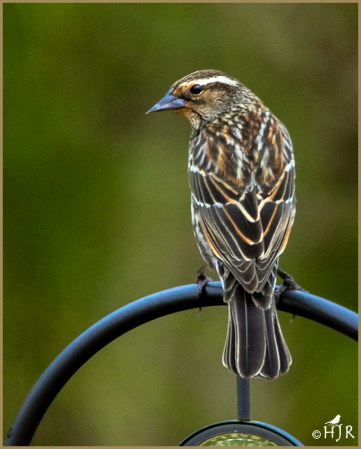
Young birds resemble the female, but are paler below and have buff feather fringes. Both sexes have a sharply pointed bill. The tail is of medium length and is rounded. The eyes, bill, and feet are all black. Unlike most North American passerines, which develop their adult plumage in their first year of life, so that the one-year-old and the oldest individual are indistinguishable in the breeding season, the sergeant thrush does not. it acquires until after the breeding season of the year following its birth, when it is between thirteen and fifteen months of age. Young males go through a transition stage in which the wing spots have an orange coloration before acquiring the most intense tone typical of adults.
Brown Thrasher
Brown Thrasher
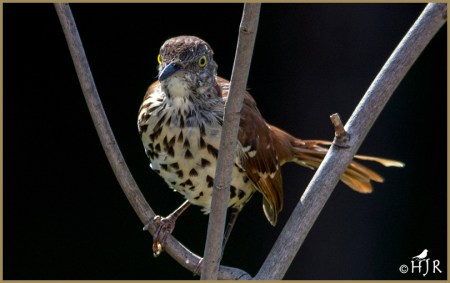
The brown thrasher is bright reddish-brown above with thin, dark streaks on its buffy underparts. It has a whitish-colored chest with distinguished teardrop-shaped markings on its chest. Its long, rufous tail is rounded with paler corners, and eyes are a brilliant yellow. Its bill is brownish, long, and curves downward. Both male and females are similar in appearance. The juvenile appearance of the brown thrasher from the adult is not remarkably different, except for plumage texture, indiscreet upper part markings, and the irises having an olive color.
© HJ Ruiz – Avian101
Share this:

Photography of Birds – Set # 158
Set # 158
Canada Geese
Canada Geese
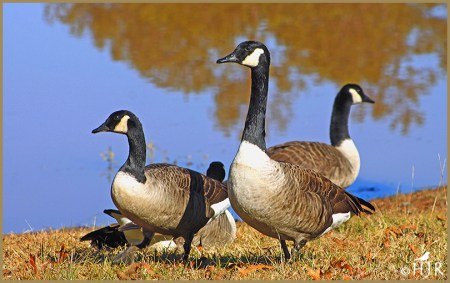
In recent years, Canada goose populations in some areas have grown substantially, so much so that many consider them pests for their droppings, bacteria in their droppings, noise, and confrontational behavior. This problem is partially due to the removal of natural predators and an abundance of safe, man-made bodies of water near food sources, such as those found on golf courses, in public parks and beaches, and in planned communities. Due in part to the interbreeding of various migratory subspecies with the introduced nonmigratory giant subspecies, Canada geese are frequently a year-around feature of such urban environments.
Muscovy Duck
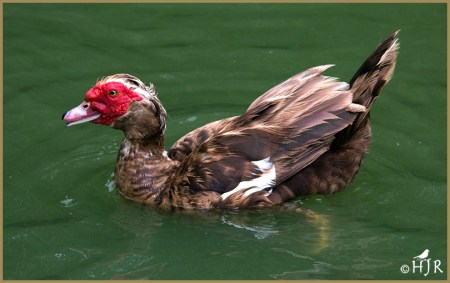
Muscovy Duck
All Muscovy ducks have long claws on their feet and a wide, flat tail. In the domestic drake (male), length is about 86 cm (34 in) and weight is 4.6–6.8 kg (10–15 lb), while the domestic hen (female) is much smaller, at 64 cm (25 in) in length and 2.7–3.6 kg (6.0–7.9 lb) in weight. Large domesticated males often weigh up to 8 kg (18 lb), and large domesticated females up to 5 kg (11 lb).
© HJ Ruiz – Avian101
Share this:

Photography of Birds – Set # 157
Set # 157
Tufted Titmouse

Tufted Titmouse
Tufted titmice nest in a hole in a tree, either a natural cavity, a human-made nest box, or sometimes an old woodpecker nest. They line the nest with soft materials, sometimes plucking hair from a live animal such as a dog. If they find snake skin sheddings, they may incorporate pieces into their nest. Eggs measure under 1 inch (2.5 centimetres) long and are white or cream-colored with brownish or purplish spots.
Carolina Chickadee

Carolina Chickadee
During the fall migration and winter, chickadees often flock together. Many other species of birds, including titmice, nuthatches, and warblers can often be found foraging in these flocks. Mixed flocks stay together because the chickadees call out whenever they find a good source of food. This calling out forms cohesion for the group, allowing the other birds to find food more efficiently.
© HJ Ruiz – Avian101
Share this:

Red Gallery – Northern Cardinal

Photo Gallery


© HJ Ruiz – Avian101
Share this:

Read Past Reviews

Book # 69
Quote from the Author
“A good chuckle is healthy, it helps you break the monotony of a serious life.” ~ H.J. Ruiz
 H.J. Ruiz - Avian101
You must be logged in to post a comment.