
Great Egret
The Great Egret (Ardea alba), also known as the common egret, large egret, or (in the Old World) great white egret or great white heron is a large, widely distributed egret. The four subspecies are found in Asia, Africa, the Americas, and southern Europe. Recently it is also spreading to more northern areas of Europe. Distributed across most of the tropical and warmer temperate regions of the world, it builds tree nests in colonies close to water.The great egret is a large heron with all-white plumage. Standing up to 1 m (3.3 ft) tall, this species can measure 80 to 104 cm (31 to 41 in) in length with a wingspan of 131 to 170 cm (52 to 67 in) Body mass can range from 700 to 1,500 g (1.5 to 3.3 lb), with an average around 1,000 g (2.2 lb). It is thus only slightly smaller than the great blue or grey heron (A. cinerea). Apart from size, the great egret can be distinguished from other white egrets by its yellow bill and black legs and feet, though the bill may become darker and the lower legs lighter in the breeding season. In breeding plumage, delicate ornamental feathers are borne on the back. Males and females are identical in appearance; juveniles look like nonbreeding adults. Differentiated from the intermediate egret (Ardea intermedia) by the gape, which extends well beyond the back of the eye in case of the great egret, but ends just behind the eye in case of the intermediate egret.
Photo Gallery
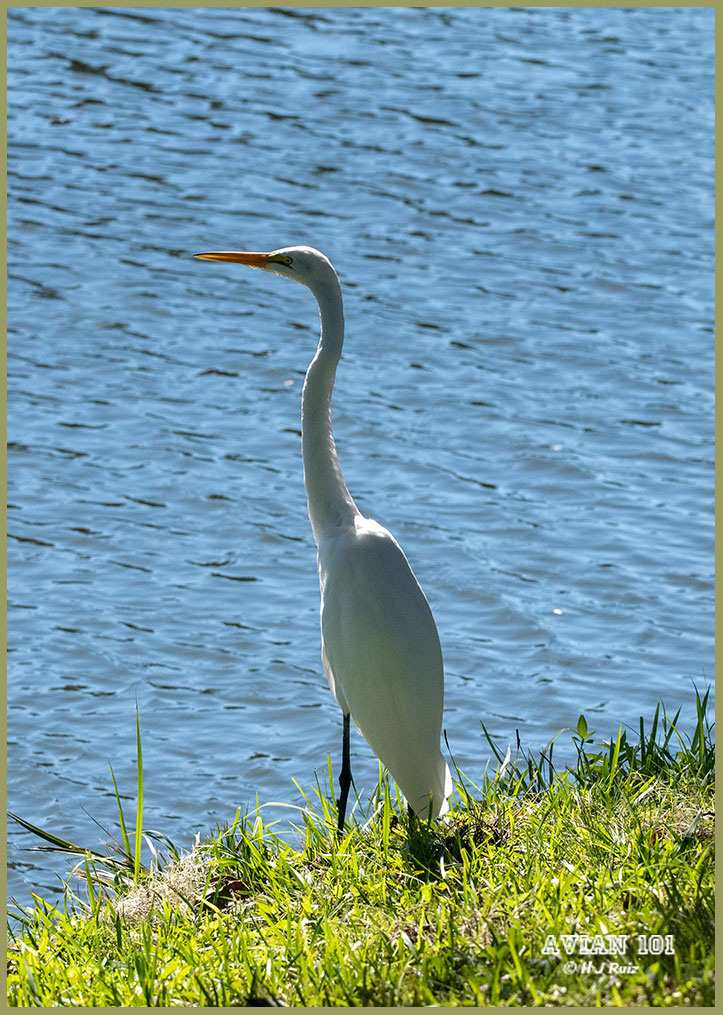
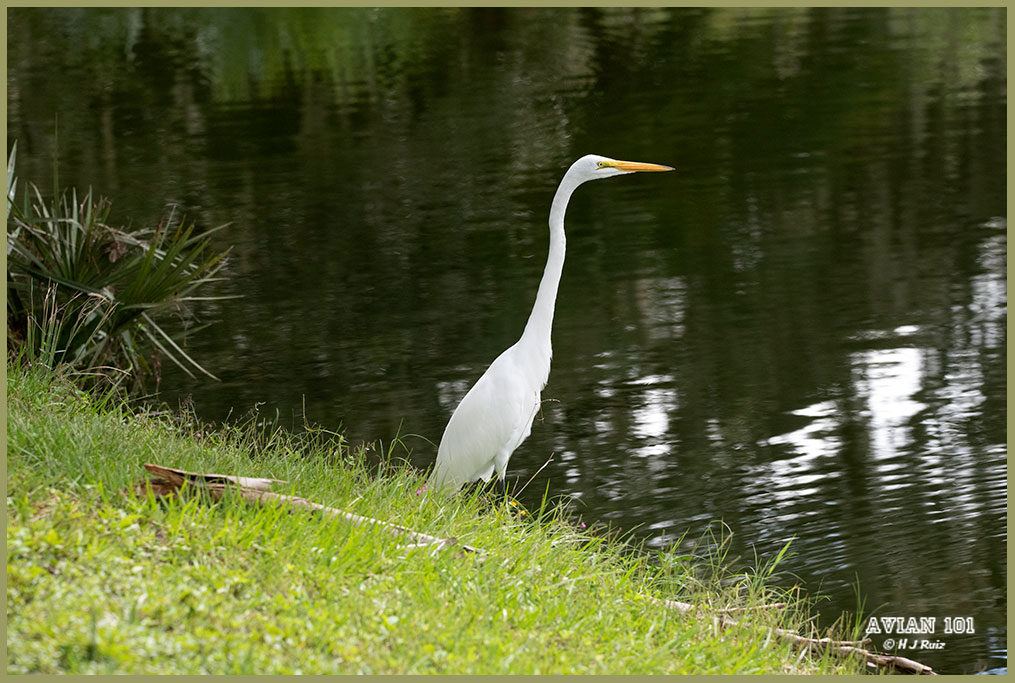
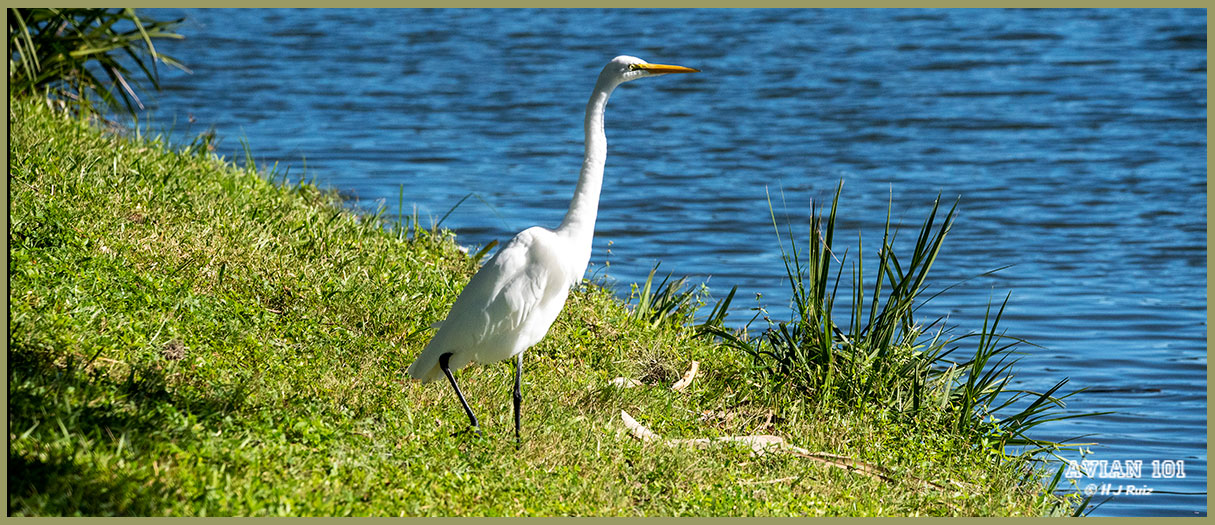
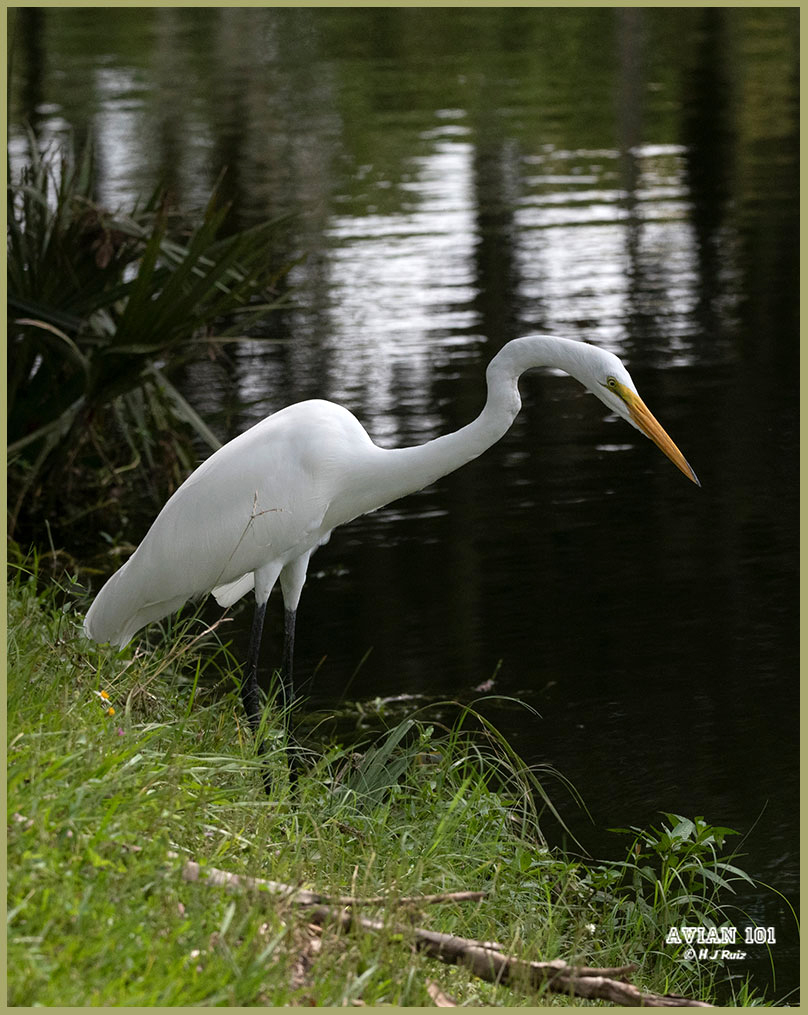

HJ Ruiz September 26th, 2023
Share this:

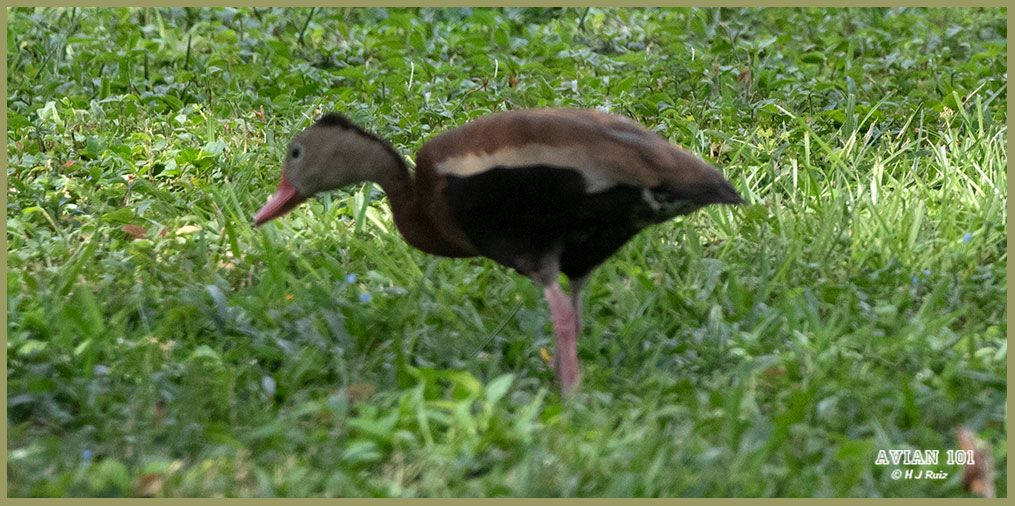
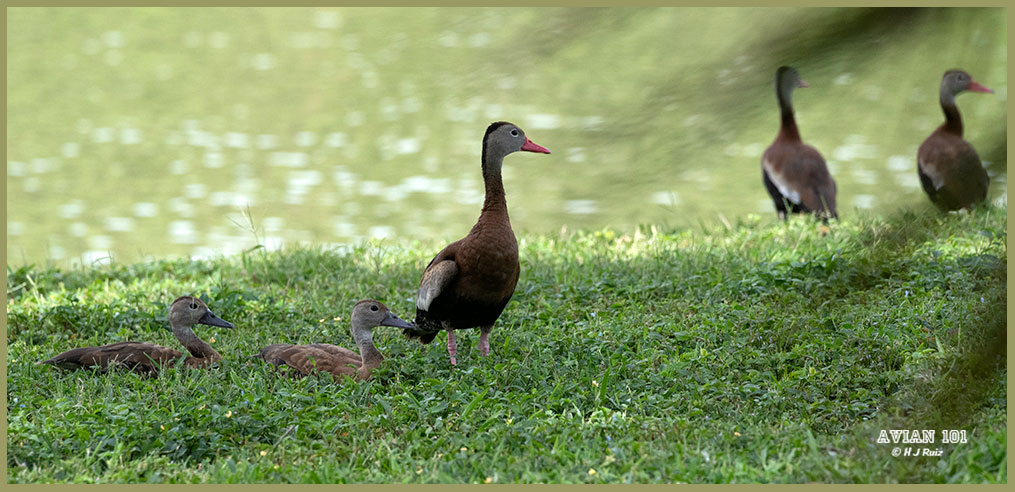
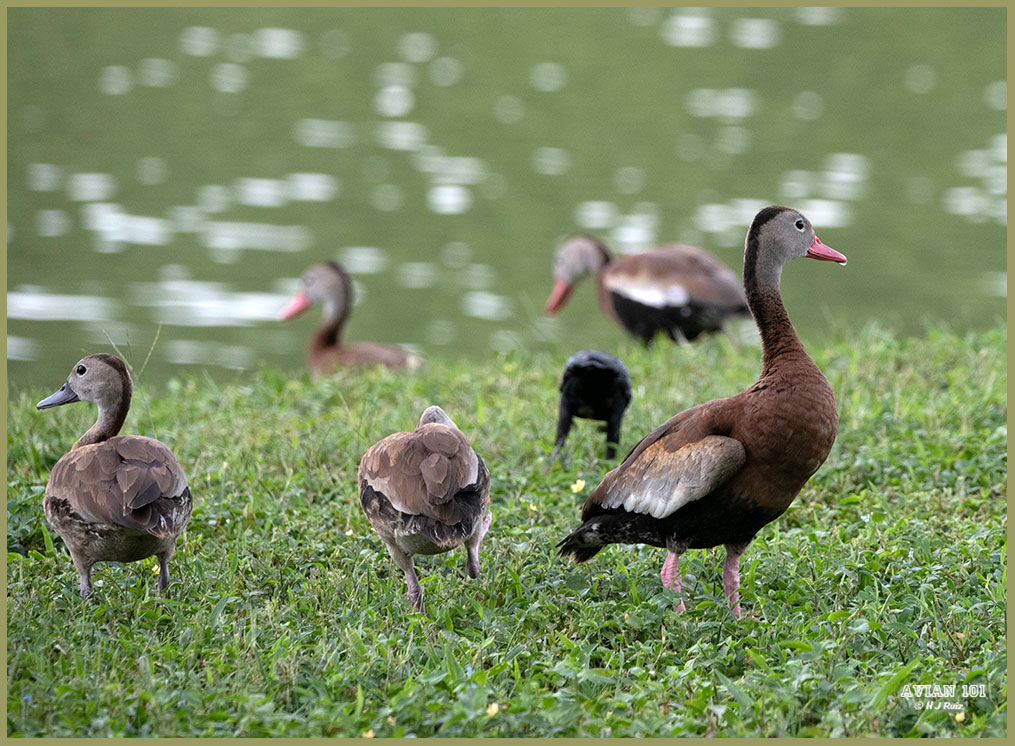
Black-bellied whistling duck
The black-bellied whistling duck (Dendrocygna autumnalis), formerly called the black-bellied tree duck, is a whistling duck that before 2000 bred mainly in the southernmost United States, Mexico, and tropical Central to south-central South America. It can be found year-round in much of the United States. It has been recorded in every eastern state and adjacent Canadian province. Since it is one of only two whistling duck species native to North America, it is occasionally just known as the “whistling duck” or “Mexican squealer” in the southern USA. The black-bellied whistling duck is a mid-sized waterfowl species. Length ranges from 47 to 56 cm (19 to 22 in), body mass from 652 to 1,020 g (1.437 to 2.249 lb), and wingspan ranges from 76 to 94 cm (30 to 37 in). It has a long pink bill, long head and longish legs, pale gray head and mostly gray-brown plumage. The belly and tail are black, and the body plumage, back of the neck and cap are a rich chestnut brown. The face and upper neck are gray, and they sport a thin but distinct white eye-ring.
Photo Gallery

HJ Ruiz – September 21st, 2023
Share this:

WOOD STORK
The WOOD STORK (Mycteria americana) is a large American wading bird in the family Ciconiidae (storks), the only member of the family to breed in North America. It was formerly called the “wood ibis”, though it is not an ibis. It is found in subtropical and tropical habitats in the Americas, including the Caribbean. In South America, it is resident, but in North America, it may disperse as far as Florida. Originally described by Carl Linnaeus in 1758, this stork likely evolved in tropical regions. The head and neck are bare of feathers, and dark grey in color. The plumage is mostly white, with the exception of the tail and some of the wing feathers, which are black with a greenish-purplish sheen. The juvenile differs from the adult, with the former having a feathered head and a yellow bill, compared to the black adult bill. There is little sexual dimorphism.
Photo Gallery


HJ Ruiz – September 19th, 2023
Share this:

I need to be back…
Dear friends,
It has been quite long months that I haven’t written to you.
I should tell you first of all, Lucy, my wife of many years passed away more than a month ago, after a long period of time fighting a battle with cancer.
Now, it is my son Tyler and I, to face life which it’s going to be difficult without Lucy present. I am still pondering
My return to WordPress,is perhaps bit of distracting from the fact that Lucy is not here any mor I even went looking for birds to photograph because I haven’t used my camera for the length of seven months! I know that I can be out there again…
I just hope that all the good friends that I had for many years did not forget me!
My personal EMail address is: ruizhj800@gmail.com
Thank you my friends,
H.J
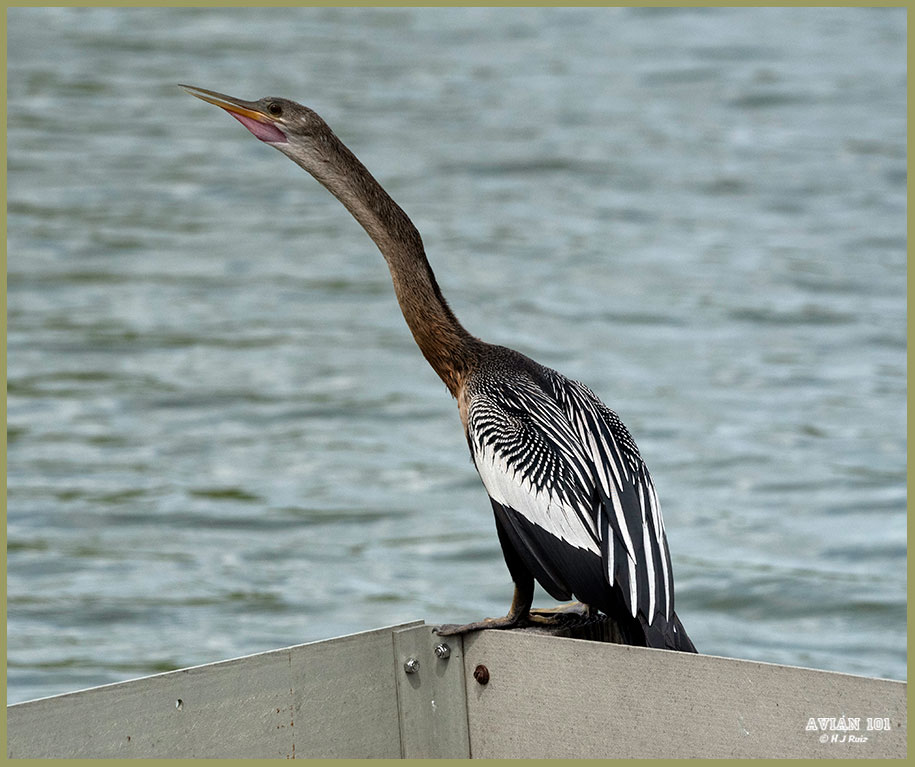
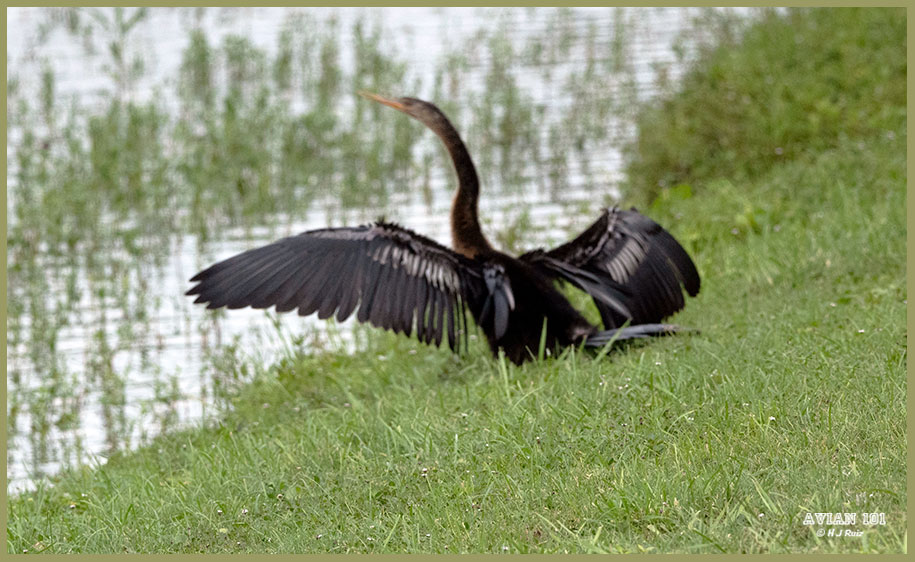
ANHINGA
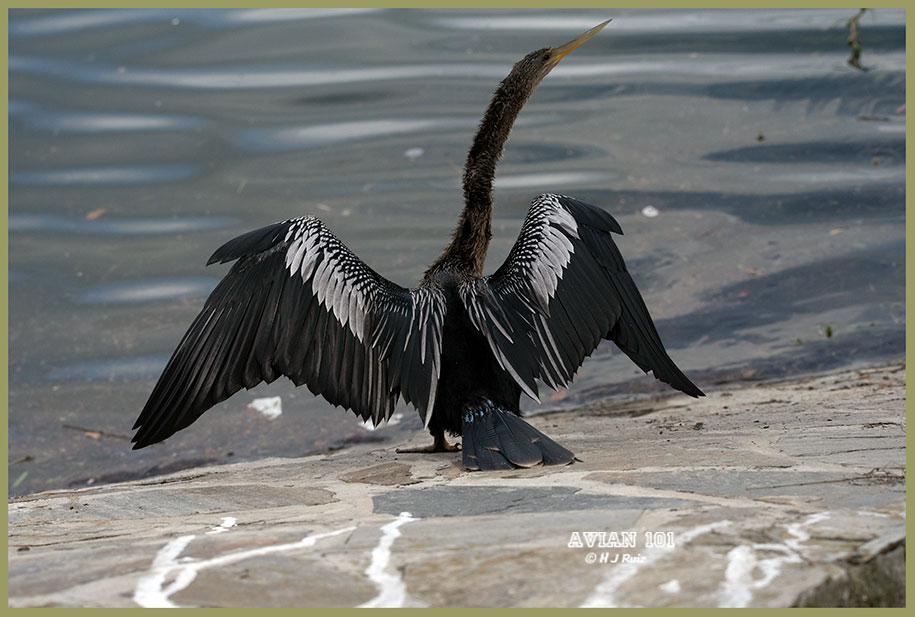
The anhinga (Anhinga anhinga), sometimes called snakebird, darter, American darter, or water turkey, is a water bird of the warmer parts of the Americas. The word anhingacomes from a’ñinga in the Brazilian Tupi language and means “devil bird” or “snake bird”. The origin of the name is apparent when swimming: only the neck appears above water so the bird looks like a snake ready to strike. They do not have external nares (nostrils) and breathe solely through their epiglottis.
The anhinga is placed in the darter family, Anhingidae, and is closely related to Indian (Anhinga melanogaster), African (Anhinga rufa), and Australian (Anhinga novaehollandiae) darters. Like other darters, the anhinga hunts by spearing fish and other small prey using its sharp, slender beak.
HJ Ruiz – September 17th, 2023
Share this:

Read Past Reviews

Book # 69
Quote from the Author
“A good chuckle is healthy, it helps you break the monotony of a serious life.” ~ H.J. Ruiz
 H.J. Ruiz - Avian101
You must be logged in to post a comment.