
Red Art Gallery – Northern Cardinal # 20
Red Art Gallery
Photo Gallery
-
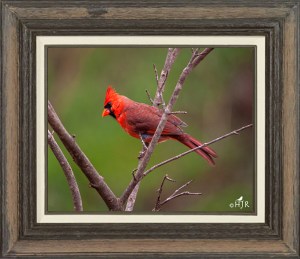
- Male
-
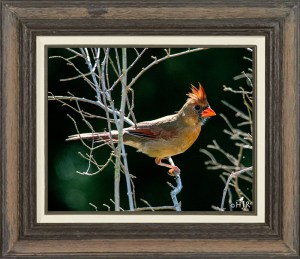
- Female
© HJ Ruiz – Avian101
Share this:

Bird’s ID – Great-tailed Grackle # 230
Great-tailed Grackle
The Great-tailed Grackle or Mexican Grackle (Quiscalus mexicanus) is a medium-sized, highly social passerine bird native to North and South America. A member of the family Icteridae, it is one of 10 extant species of grackle and is closely related to the boat-tailed grackle and the extinct slender-billed grackle. Great-tailed grackles are medium-sized birds (larger than starlings and smaller than crows; 38 cm (15 in)-46 cm (18 in)) with males weighing 203 g (7.2 oz)-265 g (9.3 oz) and females between 115 g (4.1 oz)-142 g (5.0 oz), and both sexes have long tails. Wingspan ranges from 18.9-22.8 in (48-58 cm). Males are iridescent black with a purple-blue sheen on the feathers of the head and upper body, while females are brown with darker wings and tail. Adults of both sexes have bright yellow eyes, while juveniles of both sexes have brown eyes and brown plumage like females (except for streaks on the breast). Great-tailed grackles, particularly the adult males, have a keel-shaped tail that they can fold vertically by aligning the two halves.
The great-tailed grackle and boat-tailed grackle were considered the same species until genetic analyses distinguished them as two separate species.
Great-tailed grackles are noted for their diverse foraging habits. They extract larvae and insects from grassy areas; eat lizards, nestlings, and eggs; forage in freshly plowed land; remove parasites from cattle, and eat fruits (e.g., bananas, berries) and grains (e.g., maize, corn on the cob by opening the husks). They turn over objects to search for food underneath, including crustaceans, insects, and worms, they hunt tadpoles and fish by wading into shallow water, and although they do not swim, they catch fish by flying close to the water’s surface, and are even reported to dive a few inches into the water to retrieve a fish. They are also known to pick dead insects stuck to the license plates of parked cars, and kill barn swallows while flying.
The Great-tailed Grackle is # 230 – “Lifer”
Photo Gallery
-
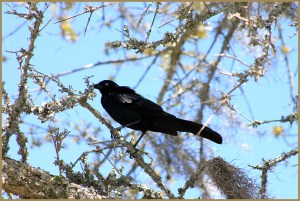
- Male
-
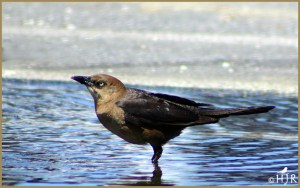
- Female
-

- Male
-
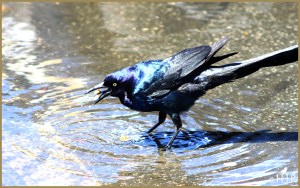
- Male
-
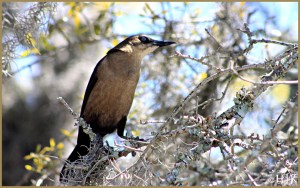
- Female
-
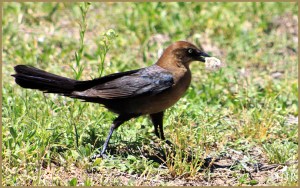
- Female
© HJ Ruiz – Avian101
Share this:

Photography of Birds – Set # 249
Set # 249
West Peruvian Dove
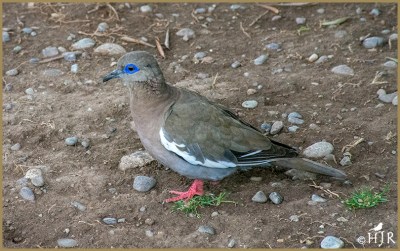
West Peruvian Dove
Native range of the West Peruvian Dove extends along the Pacific coastal plains from southern Ecuador to northern Chile. Contrary to unscientific internet sources, the species is not found on San Andrés. This species has a large range, with an estimated global extent of occurrence of 187,000 km2. Its global population has not been estimated, but may be large, as the species is described as “common” in at least parts of its range. Global population trends have not been quantified, but the species is not believed to approach the thresholds for the population decline criterion of the IUCN Red List (i.e. declining more than 30% in 10 years or three generations). For these reasons, the species is evaluated as least concern.
Mourning Dove
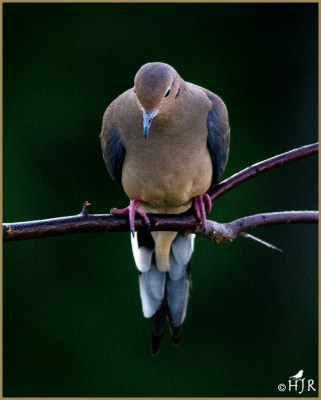
Mourning Dove
The Mourning Dove is a medium-sized, slender dove approximately 31 cm (12 in) in length. Mourning doves weigh 112–170 g (4.0–6.0 oz), usually closer to 128 g (4.5 oz). The mourning dove has a wingspan of 37-45 cm. The elliptical wings are broad, and the head is rounded. Its tail is long and tapered (“macroura” comes from the Greek words for “large” and “tail”). Mourning doves have perching feet, with three toes forward and one reversed. The legs are short and reddish colored. The beak is short and dark, usually a brown-black hue.
The plumage is generally light gray-brown and lighter and pinkish below. The wings have black spotting, and the outer tail feathers are white, contrasting with the black inners. Below the eye is a distinctive crescent-shaped area of dark feathers. The eyes are dark, with light skin surrounding them. The adult male has bright purple-pink patches on the neck sides, with light pink coloring reaching the breast. The crown of the adult male is a distinctly bluish-grey color. Females are similar in appearance, but with more brown coloring overall and a little smaller than the male. The iridescent feather patches on the neck above the shoulders are nearly absent, but can be quite vivid on males. Juvenile birds have a scaly appearance, and are generally darker.
© HJ Ruiz – Avian101
Share this:

Photography of Birds – Set # 248
Set # 248
Tufted Titmouse
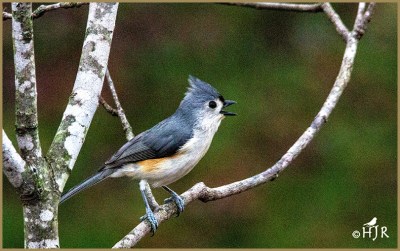
Tufted Titmouse
The Tufted Titmouse gathers food from the ground and from tree branches. It eats berries, nuts, insects, small fruit, snails, and seeds. Caterpillars constitute a major part of its diet during the summer. Titmice will stash food for later use. The titmouse can demonstrate curiosity regarding humans, and sometimes will perch on a window ledge and seem to be peering into the house. It may cling to the windows and walls of buildings seeking prey in wasp and hornet nests. It is a regular visitor around bird feeders. Its normal pattern is to scout a feeder from cover, fly in to take a seed, then fly back to cover to eat it.
Yellow – rumped Warbler
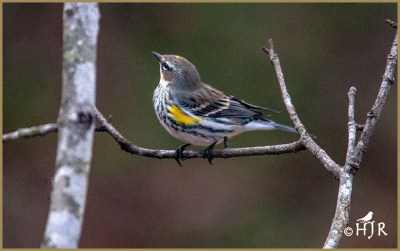
Yellow-rumped Warbler
During the winter, when the Yellow-rumped Warbler is not in breeding season, it often inhabit resourceful open areas with shrubs or scattered the trees, that can provide it with some source of food supply, such as bayberries and insects, etc. Open areas preferred by the yellow-rumped warbler may include agricultural and residential areas, secondary forests, and shrublands, etc., these habitats generally do not have very dense vegetation; the species can also inhabit forests that are relatively open, such as mangroves, pine forests, and even coffee plantations, etc. The yellow-rumped warbler tends to have more diversified habitats during the migration process, though it is sometimes found in desert areas of the U.S. southwest, it is more common for the species to inhabit alpine habitats during migration as it tends to arid lowland areas.
© HJ Ruiz – Avian101
Share this:

Read Past Reviews

Book # 69
Quote from the Author
“A good chuckle is healthy, it helps you break the monotony of a serious life.” ~ H.J. Ruiz
 H.J. Ruiz - Avian101
You must be logged in to post a comment.