Bird’s ID – Yellow-crowned Night Heron
Yellow-crowned Night Heron
The Yellow-crowned Night Heron (Nyctanassa violacea), is one of two species of night herons found in the Americas, the other one being the black-crowned night heron. It is known as the Bihoreau Violacé in French and the Pedrete Corona Clara in Spanish.
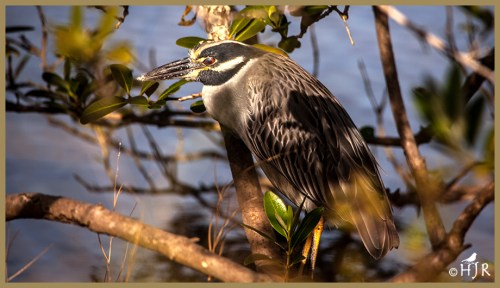
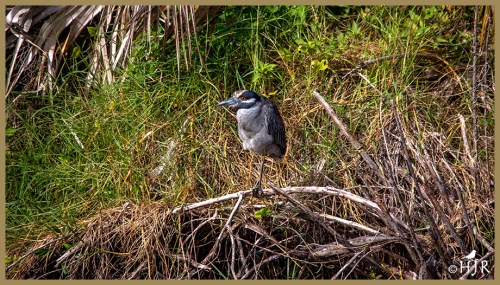
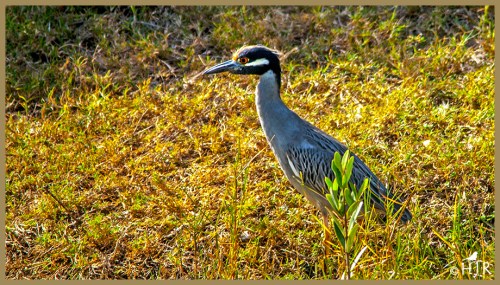
The yellow-crowned night heron is a rather stocky wading bird, ranging from 55 to 70 cm (1 ft 10 in–2 ft 4 in) and from 650 to 850 g (1.43–1.87 lb), the females being a little smaller than the males. The neck, slim when extended, gives the bird a comically large head compared to its body, with a large and heavy bill.
The body and back are a smooth gray-blue, with a black scaled pattern on the wings. The long legs are yellow and turn coral, pink or red during courtship. The most characteristic part of the yellow-crowned night heron is the head: black and glossy, with white cheeks and a pale yellow crown going from the bill, between the eyes and to the back of the head, giving the bird its common name. Such colors make the face appear striped in a horizontal black-white-black-white pattern. Long, thin, white feathers grow to the back of the crown during mating season. The bill, also black, is thick and deeply set under the eyes which are dark orange or red.
Being a heron, the yellow-crowned night heron is related to egrets and bitterns (the family Ardeidae), and, to a further extent, to pelicans and ibises (the order Pelecaniformes). The night herons are usually considered to have separated from the day herons (such as the great blue heron or the green heron).
The yellow-crowned night heron looks for shallow water to live in: marshes, wooded swamps, and lakeshores for inland populations, and thickets, mangroves and cliff-bound coasts for coastal populations. It can also be found in areas that don’t always have enough water, but that get flooded on a regular basis. Its habitat is closely linked to that of the crustaceans that make for most of its diet, and it tolerates fresh water, brackish water and saltwater.
Another important habitat factor is nesting sites. The yellow-crowned night heron needs bushes or trees to build nests, although it will use rock ledges where vegetation is unavailable (for example, on cliffs).
Unlike the black-crowned night heron, the yellow-crowned does not mind living near humans and can be found in wooded neighborhoods, nesting on rooftops and driveways. Such cohabitation may not go smoothly and can create conflicts with humans.
Photo Gallery
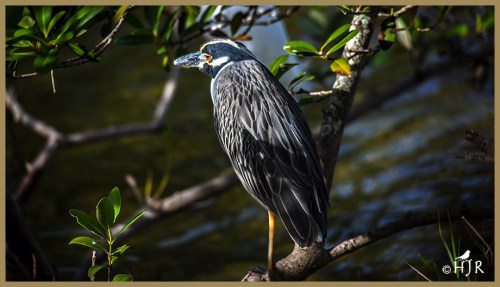
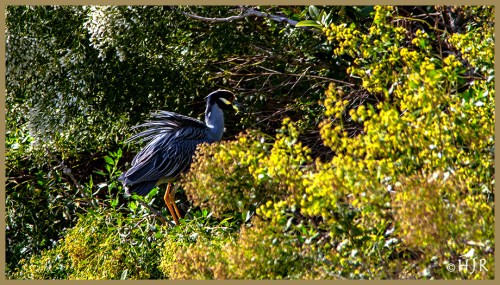
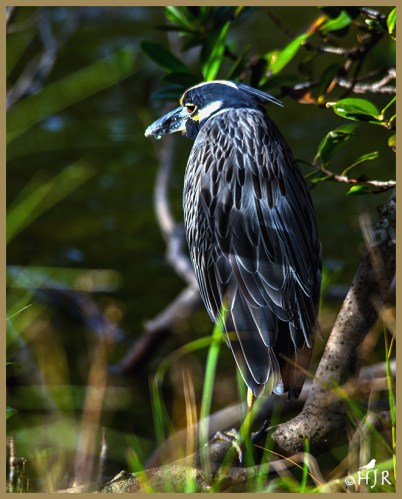


 H.J. Ruiz - Avian101
Such striking facial markings!
Thank you! 🙂
What a sight to see! Great captures!
Beautiful photographs.
Thank you very much Susan. 🙂
Very distinctive markings on the face. What an attractive heron, HJ!
He is a good looking bird! Thank you Chris. 🙂
Very nice gallery, HJ! I would love to come upon one of these one of these days!
You might have more chances to see one in Florida. Thank you Donna. 🙂
Great shots of a stunning bird HJ and thanks for the interesting info.
Thanks so much Ashley. 🙂
Beautiful photos of a beautiful bird, H.J. I have yet to see one (only know the black-crowned cousin).
One of these days… One of these days, Tanja. Thank you very much. 🙂