
Bird’s ID – House Wren
House Wren
The House Wren (Troglodytes aedon) is a very small songbird of the wren family, Troglodytidae. It occurs from Canada to southernmost South America, and is thus the most widely distributed bird in the Americas. It occurs in most suburban areas in its range and it is the single most common wren. Its taxonomy is highly complex and some subspecies groups are often considered separate species.
Adults are 11 to 13 cm (4.3 to 5.1 in) long, with a 15 cm (5.9 in) wingspan and weigh about 10 to 12 g (0.35 to 0.42 oz). Among standard measurements, the wing chord is 4.7 to 5.3 cm (1.9 to 2.1 in), the tail is 3.9 to 4.4 cm (1.5 to 1.7 in), the culmen is 1.1 to 1.3 cm (0.43 to 0.51 in) and the tarsus is 1.6 to 1.8 cm (0.63 to 0.71 in). The subspecies vary greatly. The legs are pinkish or grey. The short tail is typically held cocked.
This bird’s rich bubbly song is commonly heard during the nesting season but rarely afterwards. There is marked geographical variation in the song, though somewhat more gradual than in the bird’s outward appearance that can strikingly differ, e.g., on neighboring islands in the Caribbean. Birds from far north and south of the species’ range nonetheless have songs that differ markedly.
The nesting habits do not seem to differ significantly between the northern and southern house wrens at least. They usually construct a large cup nest in various sorts of cavities, taking about a week to build. The nest is made from small dry sticks and is usually lined with a variety of different materials. These include: feather, hair, wool, spider cocoons, strips of bark, rootlets, moss, and trash. The male wren finds dry sticks, which he adds to the nest. Once he is done, the female inspects at the nest; but if she does not approve of the construction, she will throw any unwanted sticks to the ground. After this process, the female lines the nest. Nest cavities are usually a few meters above ground at most, but occasionally on cliffs as high up as 15 m (49 ft) and more at least in southern populations; they may be natural or man-made, often using bird houses.

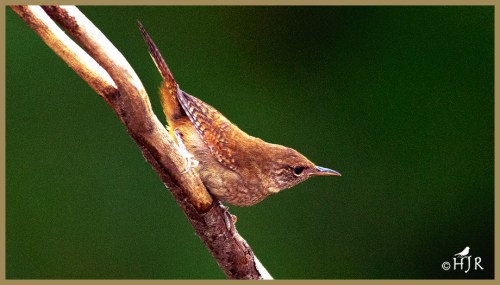
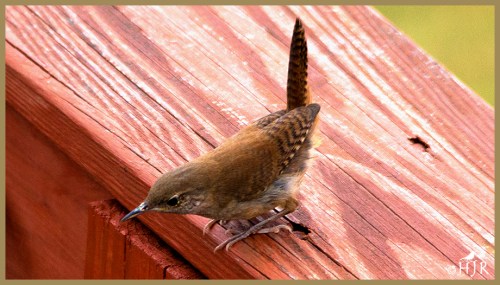
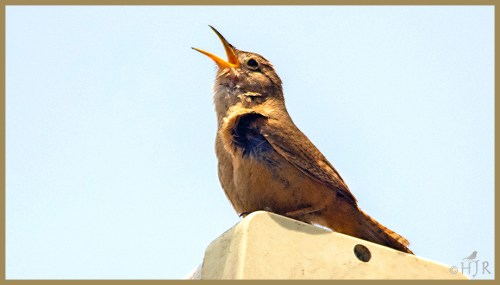
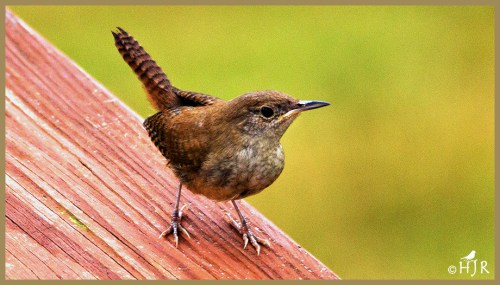



 H.J. Ruiz - Avian101
Pretty wren, HJ, I’ve never seen one before. 🙂
Thank you Donna. 🙂
Lovely wren pictures!
Thanks Indira. 🙂
Great pictures.
Thank you Susan. 🙂
What a lovely little bird HJ 😊
Thank you very much, Ashley. 🙂
Uno spettacolare piumaggio per questo esserino grazioso
buon fine settimana e un sorriso,silvia
Grazie Sylvia, sono felice che ti piaccia questo uccellino. Buon fine settimana. 🙂
One of those birds that are hard to get in the tin due to how hyper they are – nice job!
Thank you Brian. 🙂
Fine pics! RH
Thanks RH! 🙂