
Bird’s ID – Common Grackle
Common Grackle
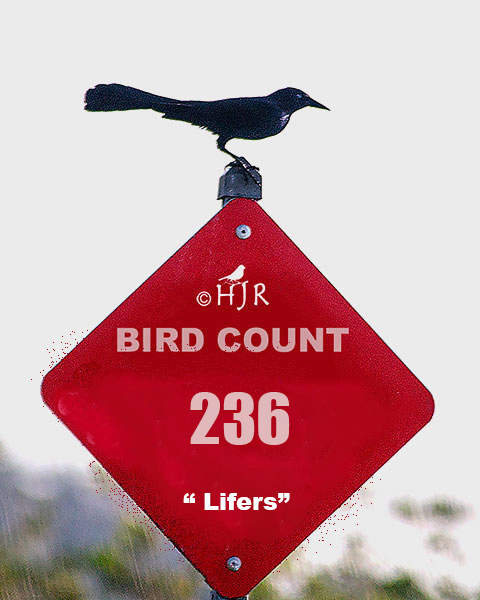
The Common Grackle (Quiscalus quiscula) is a large icterid which is found in large numbers through much of North America.
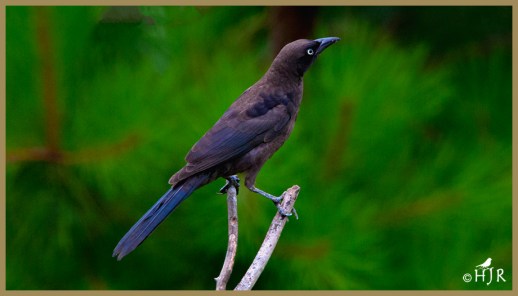
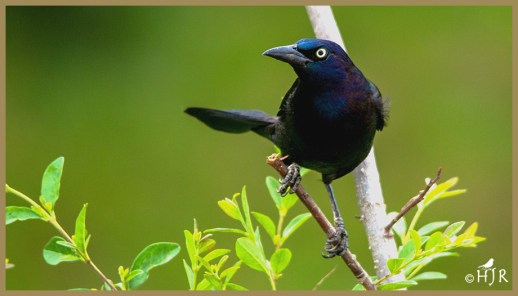
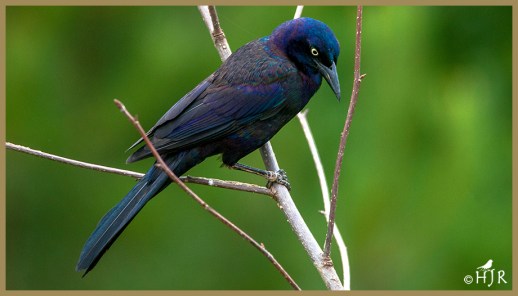
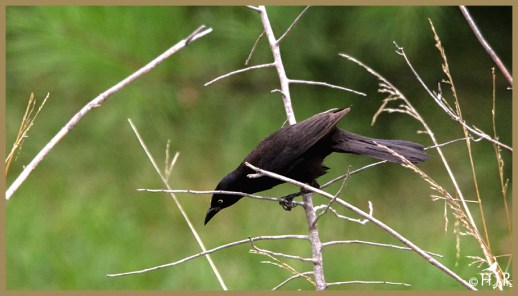
Adult common grackles measure from 28 to 34 cm (11 to 13 in) in length, span 36–46 cm (14–18 in) across the wings and weigh 74–142 g (2.6–5.0 oz). Common grackles are less sexually dimorphic than larger grackle species but the differences between the sexes can still be noticeable. The male, which averages 122 g (4.3 oz), is larger than the female, at an average of 94 g (3.3 oz). Adults have a long, dark bill, pale yellowish eyes and a long tail; its feathers appear black with purple, green or blue iridescence on the head, and primarily bronze sheen in the body plumage. The adult female, beyond being smaller, is usually less iridescent; her tail in particular is shorter, and unlike the males, does not keel (display a longitudinal ridge) in flight and is brown with no purple or blue gloss. The juvenile is brown with dark brown eyes.
The common grackle forages on the ground, in shallow water or in shrubs; it will steal food from other birds. It is omnivorous, eating insects, minnows, frogs, eggs, berries, seeds, grain and even small birds and mice. Grackles at outdoor eating areas often wait eagerly until someone drops some food. They will rush forward and try to grab it, often snatching food out of the beak of another bird. Grackles prefer to eat from the ground at bird feeders, making scattered seed an excellent choice of food for them. In shopping centers, grackles can be regularly seen foraging for bugs, especially after a lawn trimming.
Along with some other species of grackles, the common grackle is known to practice “anting”, rubbing insects on its feathers possibly to apply liquids such as formic acid secreted by the insects.
Though the exact mechanism is poorly understood, several studies have examined the ability of the common grackle to interpret the Earth’s magnetic field—or in this case, the variability of it. The common grackle, (like most of its Quiscalus siblings) has been found to exhibit a scientifically significant attuning with a dynamic magnetic field.



 H.J. Ruiz - Avian101
Well captured HJ.
Thanks Tom! 🙂
Thanks for information and an excellent gallery.
Thank you so much Susan! 🙂
That’s a very distinctive bird. It reminds me of a starling with that gaze!
Thank you Val for sharing! 🙂
Speciali primi piani di un bel volatile grigio ferro
Auguri di buon anno,silvia
Grazie! Felice anno nuovo! 🙂
Looking at your beautiful shots, I’m reflecting on how light changes the colors of the birds we observe – the “black” common grackle is not really black 🙂
That’s right, also our eyes filter certain hue. The camera captures most color hues. Thank you very much Tiny. 🙂
I have seen your gravatar for some time on Donna’s site and when I read you will be recording bluebirds nesting, well, I just had to come to your site. Love the quality of your photographs.
Thank you very much Jane, you’re welcome to my blog anytime. 🙂