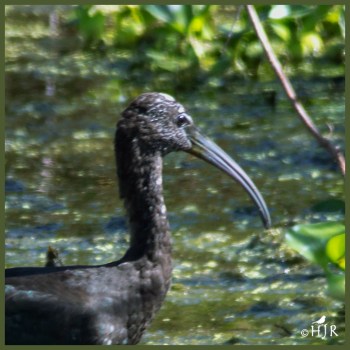
How fun to be close friends with this elegant ibis. Wonderful photo, HJ. I like the ibis for its unique bill, the glossy for its unique coloring, and especially for their ancient ancestry.
It’s an interesting bird, very shy and loves to be in the swamp, where it’s not easy to shoot pictures. I wonder why Mother Nature designed that particular bill’s shape for them…(??)
Thank you my friend! 🙂
One of the greatest puzzlements for me when I began paying attention to birds was the difference between the glossy and white-faced ibis. Sometimes I’m certain now, but not always.
The white-faced ibis is very similar to the glossy ibis in its non-breeding plumages, but it tends to be slightly smaller and the plumage color is somewhat warmer. Breeding adults have a pink bare face bordered with white feathers (rather than a bluish bare face with no bordering feathers), a grey bill, and brighter colored, redder legs. Adults have red eyes year-round, whereas glossy ibises have dark eyes. Juveniles of the two species are nearly identical. Thank you Linda. 🙂



 H.J. Ruiz - Avian101
How fun to be close friends with this elegant ibis. Wonderful photo, HJ. I like the ibis for its unique bill, the glossy for its unique coloring, and especially for their ancient ancestry.
It’s an interesting bird, very shy and loves to be in the swamp, where it’s not easy to shoot pictures. I wonder why Mother Nature designed that particular bill’s shape for them…(??)
Thank you my friend! 🙂
One of the greatest puzzlements for me when I began paying attention to birds was the difference between the glossy and white-faced ibis. Sometimes I’m certain now, but not always.
The white-faced ibis is very similar to the glossy ibis in its non-breeding plumages, but it tends to be slightly smaller and the plumage color is somewhat warmer. Breeding adults have a pink bare face bordered with white feathers (rather than a bluish bare face with no bordering feathers), a grey bill, and brighter colored, redder legs. Adults have red eyes year-round, whereas glossy ibises have dark eyes. Juveniles of the two species are nearly identical. Thank you Linda. 🙂