Stilt Sandpiper # 213
The stilt sandpiper (Calidris himantopus or Micropalama himantopus) is a small shorebird. The scientific name is from Ancient Greek.
he stilt sandpiper breeds in the open arctic tundra of North America. It is a long-distance migrant, wintering mainly in northern South America. It occurs as a rare vagrant in western Europe, Japan and northern Australia
This species nests on the ground, laying three or four eggs. The male has a display flight. Outside the breeding season, this bird is normally found on inland waters, rather than open coasts.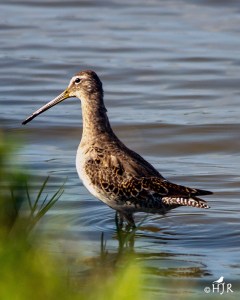
This species resembles the curlew sandpiper in its curved bill, long neck, pale supercilium and white rump. It is readily distinguished from that species by its much longer and paler legs, which give rise to its common and scientific names. It also lacks an obvious wing bar in flight.
Breeding adults are distinctive, heavily barred beneath, and with reddish patches above and below the supercilium. The back is brown with darker feather centres. Winter plumage is basically gray above and white below.
Juvenile stilt sandpipers resemble the adults in their strong head pattern and brownish back, but they are not barred below, and show white fringes on the back feathering.
These birds forage on muddy, picking up food by sight, often jabbing like the dowitchers with which they often associate. They mainly eat insects and other invertebrates.
The Stilt Sandpiper is # 213 on my “Lifer” List
Scientific classification
- Kingdom: Animalia
- Phylum: Chordata
- Class: Aves
- Order: Charadriiformes
- Family: Scolopacidae
- Genus: Calidris (disputed)
- Species: C. himantopus
Binomial name
Calidris himantopus
(Bonaparte, 1826)
Photo Gallery




 H.J. Ruiz - Avian101
Photo Gallery…informative sharing, Ruiz! 👍
Thanks Indira! 🙂
Beautiful! So nice to see lots of them. Kudos to you for your lifer and for providing the shorebird stumped with images to help identify next time we see one.
Thank you very much Lisa, I do the best I can to help others ID the birds. 🙂
My problem with shorebirds is that you have to go to a specific place where they all gather at once in migration to see them and then it’s distinguishing them from one another at usually a great distance. So whatever helps refresh the memories stored somewhere in my brain!
How wonderful to so many in one capture! 🙂
Just mere luck! Thanks Donna! 🙂