
Little Blue Heron
Little blue heron – (Egretta caerulea)
This is a small heron. It breeds in the Gulf states of the US, through Central America and the Caribbean south to Peru and Uruguay. It is a resident breeder in most of its range, but some northern breeders migrate to the southeastern US or beyond in winter. There is post-breeding dispersal to well north of the nesting range, as far as the Canada–US border.
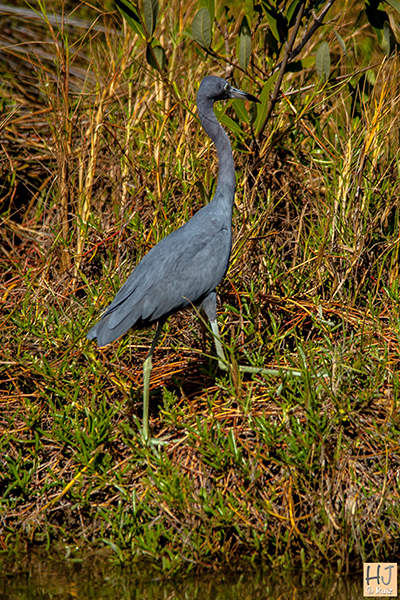
Little Blue Heron
This species is about 24 in. long, with a 40 in. wingspan, and weighs 11.5 oz. It is a medium-large, long-legged heron with a long pointed blue or greyish bill with a black tip. Breeding adult birds have blue-grey plumage except for the head and neck, which are purplish and have long blue filamentous plumes. The legs and feet are dark blue. The sexes are similar. Non-breeding adults have dark blue head and neck plumage and paler legs. Young birds are all white except for dark wing tips and have dull greenish legs. They gradually acquire blue plumage as they mature.
The little blue heron’s breeding habitat is sub-tropical swamps. It nests in colonies, often with other herons, usually on platforms of sticks in trees or shrubs. Three to seven light blue eggs are laid. The little blue heron stalks its prey methodically in shallow water, often running as it does so. It eats fish, frogs, crustaceans, small rodents and insects.
White little blue herons often mingle with snowy egrets. The snowy egret tolerates their presence more than little blue herons in adult plumage. These young birds actually catch more fish when in the presence of the snowy egret and also gain a measure of protection from predators when they mix into flocks of white herons. It is plausible that because of these advantages, they remain white for their first year.
Note: The Little Blue Heron is # 202 on my List of Birds


Text © Wikipedia – Photographs © HJ Ruiz – Avian101



 H.J. Ruiz - Avian101
Fine photos!
Thanks P.! 🙂
I love little blue herons! We get them here in Illinois, more in the southerly section than north. One of my favorite places to see them is Corkscrew Swamp in Florida. Haven’t been there in ages.
That’s great Sheryl! I’m glad that you liked my pictures. Thanks for sharing! 🙂
Such long necks these little dudes have! I’ve seen their cousins in the marshy lands in the south bay (SF). Gotta love em!
Thank you for sharing Jan!:)
Interesting information with lovely pictures.
Thank you Susan! 🙂
So is this the little brother of the Great Blue? I’ve never seen one! Thx for sharing!
This is more like a cousin I’d say! Thanks Lori! 🙂
Fascinating! Really interesting what you say about the young white ones being able to feed with snowy egrets. That blue and purple colour is so strong and bright.
It’s quite common for some species of birds to join and travel along with other species sharing the habitats of their choice. As you mentioned it’s Fascinating! Thanks Clare for your interesting comment! 🙂
Great post H.J.! Earlier this year I saw some juveniles here, white with little blue spots.
Thank you Tiny! They are white when little and spots as juveniles. 🙂
Did I see long green legs on that blue Heron ? 🙂
Yes, you did. This species have a deceiving name because is not a Great Blue Heron that is little, it is a separate species. That will remain blue as an adult. Thanks Emy! 🙂
One of my favorite birds! Love the sparkle on the water~
Thanks a lot! 🙂
Wow, glad you explained the green legs! That’s amazing – how the young ones stay white for their first year and then turn blue. 😮
It’s quite a transformation, isn’t it? Thanks Christine! 🙂
Pingback: Little Blue Heron | H.J. Ruiz – Avian101 – Wolf's Birding and Bonsai Blog