
Red-tailed Hawk
Red-tailed Hawk – Latin name: Buteo jamaicensis
This is a bird of prey, one of three species colloquially known in the United States as the “chickenhawk,” though it rarely preys on standard sized chickens. It breeds throughout most of North America, from western Alaska and northern Canada to as far south as Panama and the West Indies, and is one of the most common buteos in North America. Red-tailed Hawks can acclimate to all the biomes within their range.
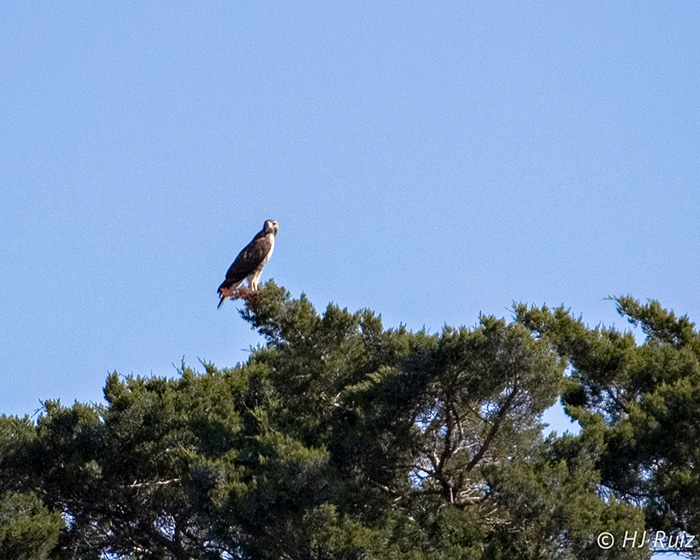
Red-tailed Hawk
There are fourteen recognized subspecies, which vary in appearance and range. It is one of the largest members of the genus Buteo in North America, typically weighing from 690 to 1600 grams (1.5 to 3.5 pounds) and measuring 45–65 cm (18 to 26 in) in length, with a wingspan from 110 to 145 cm (43 to 57 in). The Red-tailed Hawk displays sexual dimorphism in size, with females averaging about 25% heavier than males.
Red-tailed Hawk plumage can be variable, depending on the subspecies and the region. These color variations are morphs, and are not related to molting. The western North American population, B. j. calurus, is the most variable subspecies and has three color morphs: light, dark, and intermediate or rufus. The dark and intermediate morphs constitute 10–20% of the population.
Though the markings and hue vary across the subspecies, the basic appearance of the Red-tailed Hawk is consistent. Overall, this species is blocky and broad in shape, often appearing (and being) heavier than other Buteos of similar length. A whitish underbelly with a dark brown band across the belly, formed by horizontal streaks in feather patterning, is present in most color variations. Especially in younger birds, the underside may be otherwise covered with dark brown spotting. The red tail, which gives this species its name, is uniformly brick-red above and light buff-orange below. The bill is short and dark, in the hooked shape characteristic of raptors, and the head can sometimes appear small in size against the thick body frame.[4] They have a relatively short, broad tails and thick, chunky wings. The cere, the legs, and the feet of the Red-tailed Hawk are all yellow.
Immature birds can be readily identified at close range by their yellowish irises. As the bird attains full maturity over the course of 3–4 years, the iris slowly darkens into a reddish-brown hue. In both the light and dark morphs, the tail of the immature Red-tailed Hawk are patterned with numerous darker bars.
The Red-tailed Hawk is one of the most widely distributed hawks in the Americas. It breeds from central Alaska, the Yukon, and the Northwest Territories east to southern Quebec and the Maritime Provinces of Canada, and south to Florida, the West Indies, and Central America. The winter range stretches from southern Canada south throughout the remainder of the breeding range.
Its preferred habitat is mixed forest and field, with high bluffs or trees that may be used as perch sites. It occupies a wide range of habitats and altitudes, including deserts, grasslands, coastal regions, mountains, foothills of mountains coniferous and deciduous woodlands, tropical rainforests, agricultural fields and urban areas. It is second only to the Peregrine Falcon in the use of diverse habitats in North America. It lives throughout the North American continent, except in areas of unbroken forest or the high Arctic.
NOTE: The Red-tailed Hawk is a new addition to my List of Birds as: # 189


Text © Wikipedia – All photographs © H.J. Ruiz -Avian 101


 H.J. Ruiz - Avian101
Love this post!
Thank you very much Mary! I had shot these photos 2 years ago and I forgot to ID the specie. I’m glad I did! 🙂
Great to see another subspecies of Red-Tailed Hawk! Thanks for the post.
Thank you Lisa! 🙂
A common sighting for me along my ride to and from work. I’ve stopped so many times to get a photo and they fly just I’m raising the lens! My ‘good’ shots are very few. Great captures & congrats on 189, HJ!
Thanks Donna! Sometimes one get lucky! 🙂