Franklin’s Gull
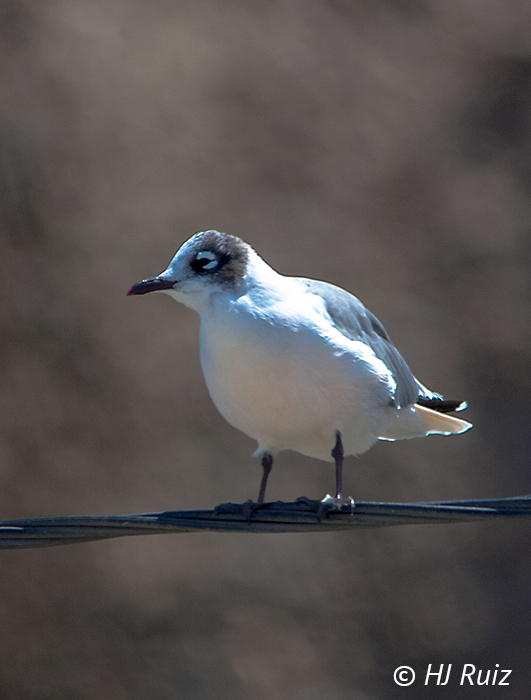
Franklin’s Gull – Latin name: Leucophaeus pipixcan
It breeds in central provinces of Canada and adjacent states of the northern United States. It is a migratory bird, wintering in Argentina, the Caribbean, Chile and Peru.
The summer adult’s body is white and its back and wings are much darker grey than all other gulls of similar size except the larger Laughing Gull. The wings have black tips with an adjacent white band. The bill and legs are red. The black hood of the breeding adult is mostly lost in winter.
Franklin’s Gull
Young birds are similar to the adult but have less developed hoods and lack the white wing band. They take three years to reach maturity.
Although the bird is uncommon on the coasts of North America, it occurs as a rare vagrant to northwest Europe, south and west Africa, Australia and Japan, with a single record from Eilat, Israel, in 2002 (Smith 2002).
Among the gulls, the Franklin’s are one of the world champion long-distance migrants. After nesting, they undergo a complete molting of their feathers, then fly south to the coast of Texas, and continue south along the Caribbean coast of Mexico to the Isthmus of Tehuantepec. From there they make an overland flight across to the Pacific Coast which they follow all the way to southern Peru and northern Chile.
After spending the winter there, they undergo another complete feather molt, and follow the same migration route in reverse. The 2 complete feather molts, which is unique among the gulls, is an adaptation for long-distance migration. The gulls need new, strong feathers in order to meet the demands of their 5,000 mile flights.
During their fall migration, Franklin’s gulls have formed some of the largest flocks of gulls known. Groups of over 1 million have been noted in the Great Plains, and birders in south Texas in late April often experience flocks moving southward in a constant stream.
NOTE: The Franklin’s Gull is a new addition to my Bird List as: # 171


Text excerpts © Wikipedia – © Smithsonian Migratory Bird Center – All photographs © H.J. Ruiz – Avian 101


 H.J. Ruiz - Avian101
I enjoyed the shot on the wire.
Thanks Tom! 🙂
Reblogged this on Wolf's Birding and Bonsai Blog.