American Coot
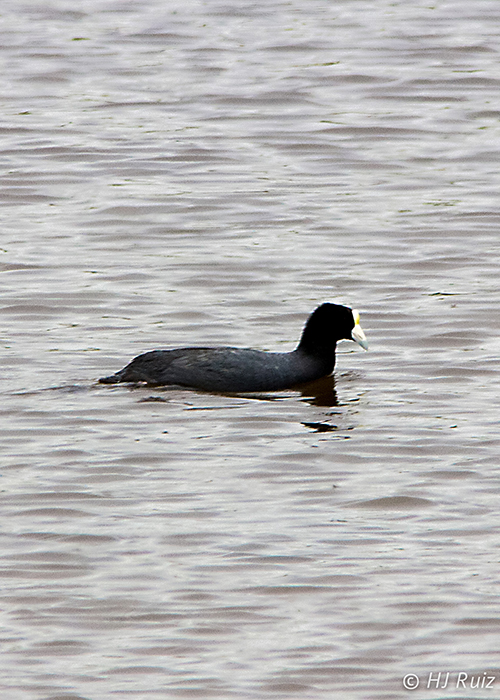
The American Coot – Latin name: Fulica americana is a bird of the family Rallidae. Though commonly mistaken to be ducks, American Coots come from a distinct family. Unlike ducks, Coots have broad lobes of skin that fold back with each step in order to facilitate walking on dry land. They live near water, typically inhabiting wetlands and open water bodies in North America. Groups of these black-feathered, white-billed birds are called covers or rafts. The oldest known Coot lived to be 22 years old.
American Coot
The American coot is a migratory bird that occupies most of North America. They live in the Southwestern United States, Mexico, and the pacific coast year round, and only occupy the northeastern regions during the summer breeding season. In the winter they can be found as far south as Panama *.
* Note from H.J. Ruiz: These American Coots were photographed in mid western Peru.
They generally build floating nests and lay 8-12 eggs per clutch.] American coots eat primarily algae and other aquatic plants but they do eat animals (both vertebrates and invertebrates) when available.
The American coot is listed as “Least Concern” under the IUCN conservation ratings. Hunters generally avoid killing American coots because their meat is not as sought after as that of ducks.
The American Coot measures 34–43 cm (13–17 in) in length and 58–71 cm (23–28 in) across the wings. Adults have a short thick white bill and white frontal shield, which usually has a reddish-brown spot near the top of the bill between the eyes. Males and females look alike, but females are smaller. Body mass in females ranges from 427 to 628 g (0.94 to 1.38 lb) and in males from 576 to 848 g (1.27 to 1.87 lb). Juvenile birds have olive-brown crowns and a gray body. They become adult-colored around 4 months of age.
NOTE: The American Coot is a new addition to my Bird List as: # 169


Text excerpts © Wikipedia – All photographs © H.J. Ruiz – Avian 101




They look huge!
They’re about the size of a regular chicken. Thanks Julie! 🙂
Congrats on your American Coots and thanks for the info. I keep wishing one would walk out of the water when I have my camera so I could capture a definitive picture of those prehistoric greenish feet. We get tons of Coots around Chicago during migration and I think they’re a favorite prey for Bald Eagles.
Thanks Lisa for sharing! 🙂
I forgot to mention, your Coots look much better in Peru than they ever do here!
We call them here in Holland as “water chicken”. Glad to know the American name. 😉
Thanks for your comment Malou! 🙂