Added a New Bird to my List
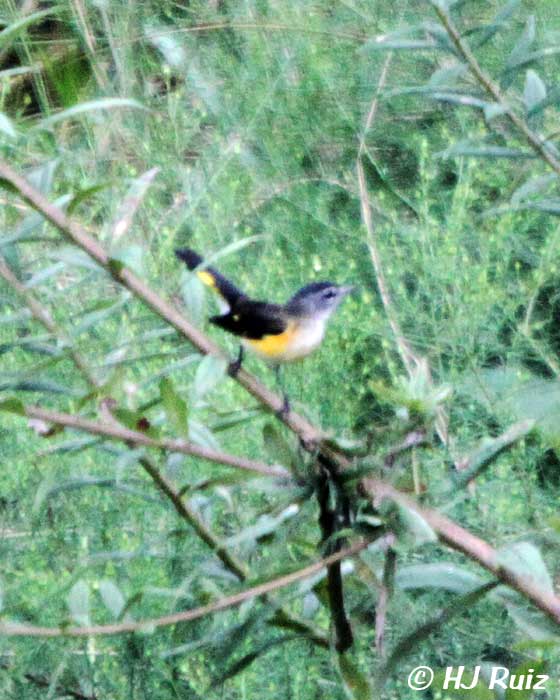
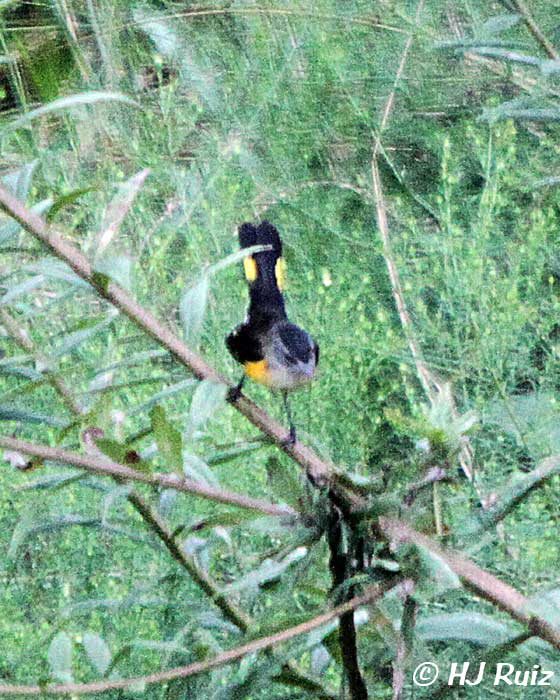
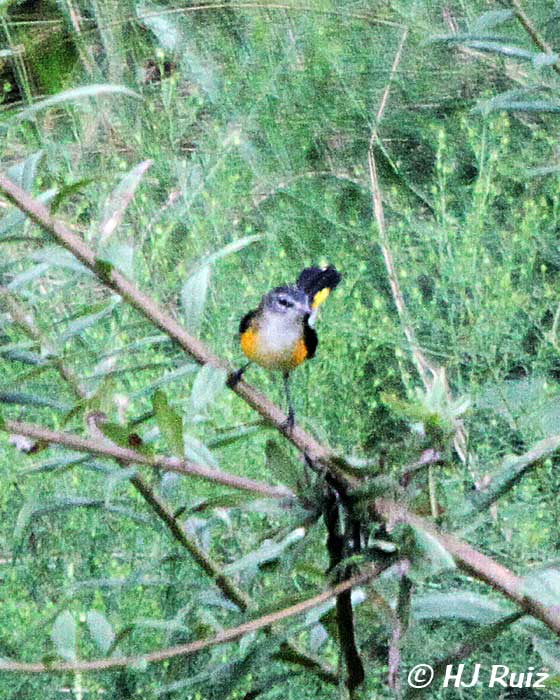
I’m happy to announce an addition of another bird species to my lifer list, it’s the American Redstart. I saw the male and female in the far bushes in my backyard, however I had the chance to photograph only the female. The quality of the photos are not very good but you’ll be able to identify the species.
The American Redstart (Setophaga ruticilla) is a New World warbler. It is unrelated to the Old World redstarts. It derives its name from the male’s red tail, startbeing an old word for tail.
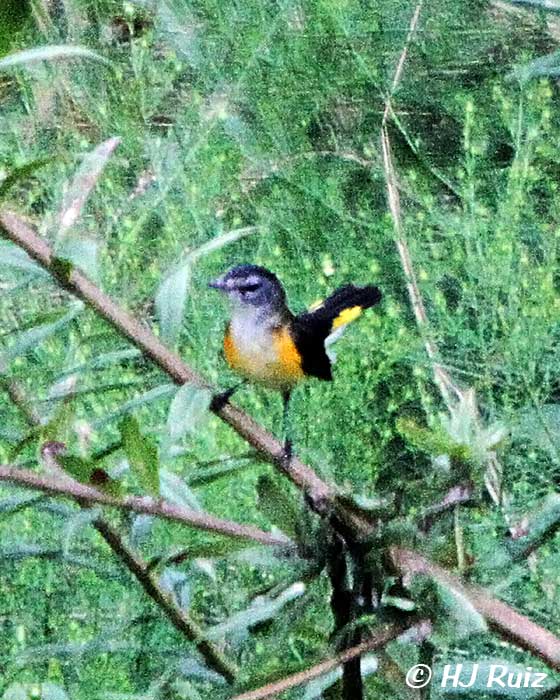
American Redstart (F)
The American Redstart is smallish warbler. The breeding males are unmistakable, jet black above apart from large orange-red patches on their wings and tails. Their breast sides are also orange, with the rest of their underparts colored white. In their other plumages, American Redstarts display green in their upperparts, along with black central tails and grey heads. The orange patches of the breeding males are replaced by yellow in the plumages of the females and young birds. Orange and yellow coloration is due to the presence of carotenoids; males possess the red carotenoid Canthaxanthin and the yellow carotenoids Canary Xanthophyll A and B, all of which mix together to produce an orange color, while the females possess only the yellow carotenoids. Recent research indicates that an age and sex effect on observed color attributes of hue, brightness, and saturation exists in American Redstarts, with the exception for saturation, which only showed an age effect.[2] Their song is a series of musical see notes. Their call is a soft chip.
They breed in North America, across southern Canada and the eastern USA. These birds are migratory, wintering in Central America, the West Indies, and northern South America (in Venezuela they are called “candelitas”). They are very rare vagrants to western Europe. During the breeding season, this warbler inhabits open-canopy, mostly deciduous forests, second growth, and forest edge across much of the United States and southern Canada.
Text and photographs © H.J. Ruiz – Avian 101


 H.J. Ruiz - Avian101
Congrats on a new lifer, H.J. 🙂
Thanks Bob! 🙂
Congratulations indeed on your new lifer! I wish I could take credit for sending him or her your way. Have to be careful with those first-year males, they look a lot like the females! The orange-yellow on the sides of the breast looks to me more like a first-year male.
That’s the first thing I thought! Lisa sent me these birds! The migration has definitely begun! Thanks fro your comment! 🙂
Congrats, HJ! It’s always nice to see new faces (and beaks :P)!
Certainly! You know that very well! 🙂
Nice shot, i like bird-photos 🙂
Thank you! 🙂
So “start” is an old word for tail! Love learning stuff like that.
It’s never late for learning! 🙂
Awesome and congrats HJ!
Thanks a lot Donna! 🙂