
Ruby-throated Hummingbird
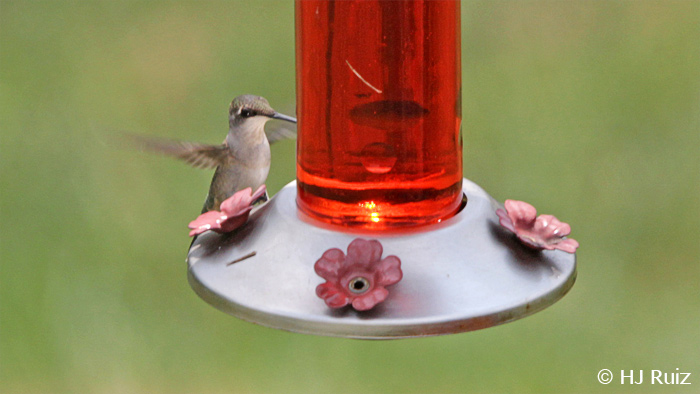
It makes me very happy to post a new “lifer” bird for me which adds another species of birds to my backyard visitors hence my global count.
The Ruby-Throated Hummingbird, Latin name: Archilochus colubris, is a small hummingbird. It is the only species of hummingbird that regularly nests east of the Mississippi River in North America.
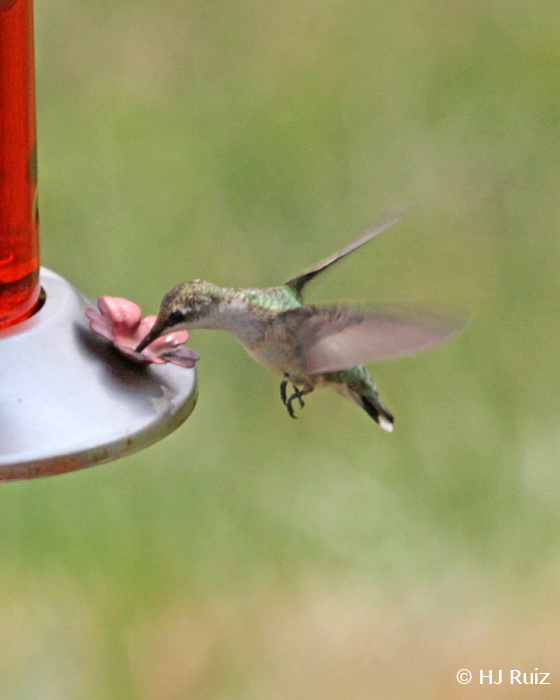
Ruby -throated Hummingbird (F)
The species is sexually dimorphic. The adult male, shown in the photo, has a ruby red throat patch which may appear black in some lighting, and a dark forked tail. The female has a dark rounded tail with white tips and generally no throat patch, though she may sometimes have a light or whitish throat patch. The male is smaller than the female, and has a slightly shorter beak. A molt of feathers occurs once a year, and begins during the autumn migration.
The breeding habitat is throughout most of eastern North America and the Canadian prairies, in deciduous and pine forests and forest edges, orchards, and gardens. The female builds a nest in a protected location in a shrub or a tree.
The Ruby-Throated Hummingbird is migratory, spending most of the winter in southern Mexico, Central America as far south as South America, and the West Indies. It breeds throughout the eastern United States, east of the 100th meridian, and in southern Canada in eastern and mixed deciduous forest.[5] seen mostly in winter, in Mexico.
Click on images to see enlargements
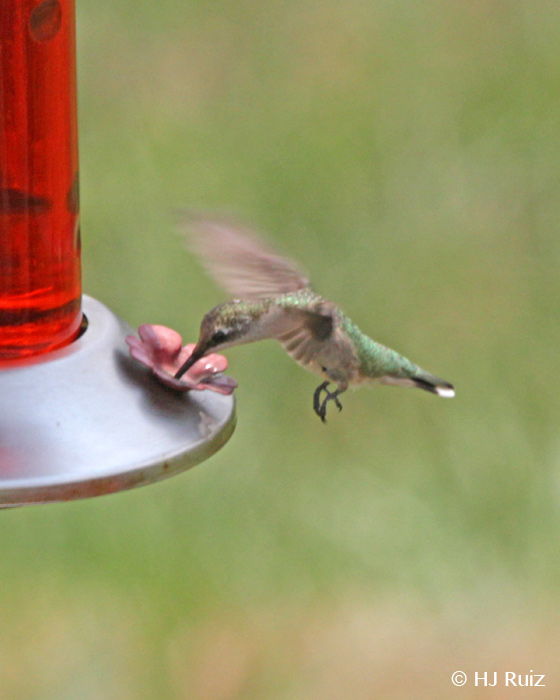
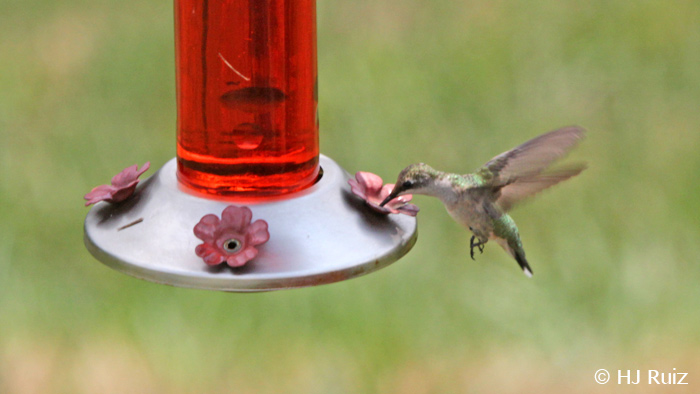
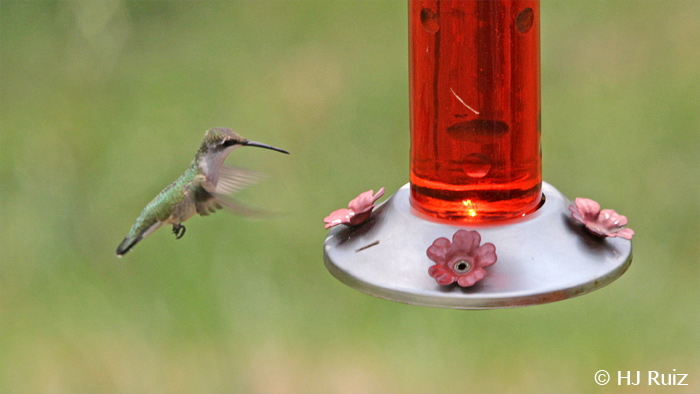
Photographs are © H.J. Ruiz – Avian 101
Text excerpts from Creative Commons Attribution-ShareAlike License


 H.J. Ruiz - Avian101
I love hummingbirds, and someday I hope to catch a shot of one at my feeder – however the squirrels have figured out how to grab the bottom of the feeder and drink the juice! So I’m going to have to move it :)) Love all your bird photos, they are fantastic!
Thank you very much Lynda! 🙂
Reblogged this on healthwellbeingblog and commented:
So small yet so fascinating.
Thank you very much! 🙂
Great photos!. I saw one of these ruby-throated hummingbirds in Calgary, Alberta when I was visiting family there last year. A very small and cute birdie
Could you ID if it was male or female? The female doesn’t have the red specks on her neck only white. thank you for your comment! 🙂
It’s just as well that we don’t have hummingbirds in the UK or I would have to buy yet another feeder and find somewhere to hang it. Lovely shots HJ.
Thanks Dave! I’m sorry about the hummingbirds. 🙂
Lovely bird and good shots.
Thank you Tom! 🙂
I get these tiny flying jewels at my feeders from mid-May to the end of September — or even into early October some years, if I’m lucky. I’ve been fortunate to spy them in their wintering grounds in Costa Rica, too.
That sounds very nice Annie! Thank you for sharing! 🙂
Congratulations on another lifer — terrific photos!
Thanks Scott! 🙂
I’ve only spotted a few hummingbirds in my backyard but they’ve never stayed long. The photos are gorgeous. 😉
Thank you for your comment Daphne! 🙂
Awesome photos HJ! I love hummingbirds and the challenge to capture them, it is not easy! You did an awesome job. This evening I saw a male flying around my balcony, looking yet again for my feeder that I had to recently remove due to ants climbing down the chain & into the feeder. I haven’t figured out yet what to do, my only option is to hang it from my balcony ceiling (condo third floor) if I want to have one. Is there something I can put on the chain or a rope that would deter the ants that HOA can’t seem to rid? I didn’t want to spray any ant killer spray because I worried it would wash down into the feeder during rain. Any suggestions other than I have to give it up? Thanks HJ!
Thank you Donna! I don’t know what to tell you about the ants, do you know what kind of ants they are? I just hope that you don’t have carpenter ants, they’re as destructive as termites. I imagine they are domestic ants, they love sweet stuff. The only way I can see is if you put a buffer somewhere at the beginning of the chain with some kind of a repellent for ants, this way they will not cross to the chain going down. Just an idea! 🙂
Forgot to say too, congrats on adding a lifer, HJ!! 🙂