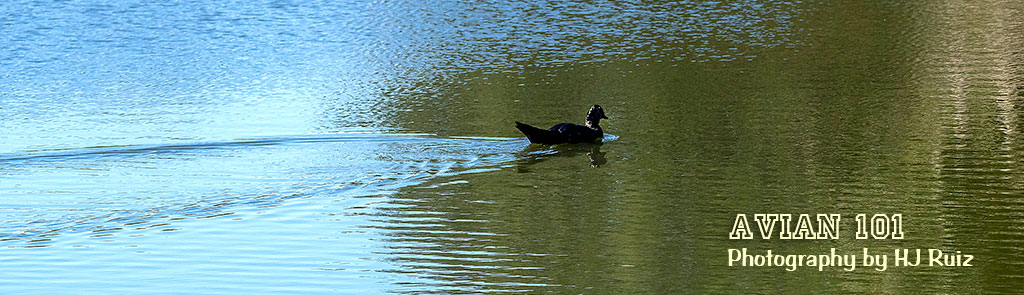
Is Birding Popular?
I asked myself about what is motivating me to get involved in birding, observing birds behavior, their habitats, their migrations and many other factors about the avifauna. One way to know if there’s more interest in the well-being of birds by people in the world was by doing some searching on the Internet. I bumped into one study that pretty much gave me the answer to my question. Although the study is very extensive and based on intricate statistics I cut to the chase and got to the conclusion as briefly as I could.
The popularity of Birding is still growing
As social scientists we are observing and recording human behavior. As concerned birders, however, we see a special and additional responsibility for ourselves and our fellow enthusiasts. As we see more of our rural land converted to urban and other developed uses, it is crucial to think about the bird habitat being lost. We all need to work on mediating the effects of this trend. Encouraging people to bird is certainly one way to help. With participation—and thus appreciation—for the ecological role and the sheer beauty and mystique of birds, come increased awareness of what is happening to their habitats. Here are a couple of examples of segments of our society to whom we could reach out, those who might not otherwise think of birding as an activity of choice:
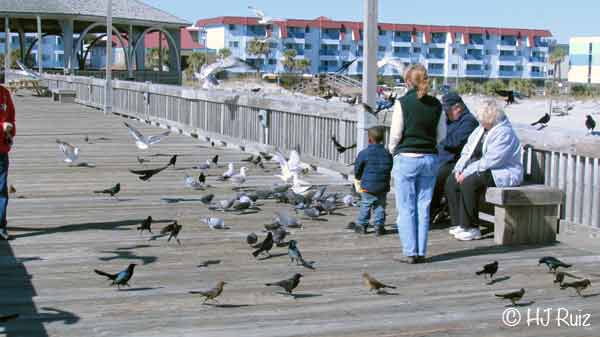
People feeding birds
- Young people: Experienced birders should look for opportunities to share the world of birding with a young friend. An investment of time in introducing young people to birds and the natural world around them is an investment in the future of our precious natural resources. (ABA has several programs for young birders. Participate and contribute!)
- Family birding: We know that a lower percent- age of active birders are between 25 and 39 years old. This is the child-rearing age-group. Facilitating opportunities for “family birding” could do wonders for opening up this arena.
• Minority groups: Smaller percentages of our fellow birders are of Black, Hispanic, or other non- white ethnic backgrounds. Any opportunity to increase bird-exposure here—from mentoring to festival activities to increasing school-oriented programs—should be maximized.
• People with disabilities: When hosting birding field trips, running festivals, or managing natural areas, be sure that these are inclusive, at locations with facilities and topographies that encourage participation by older birders or those with disabilities.
In addition to reaching out to others, we birders can and should take action to improve bird habitats, to conserve unique natural areas, and to provide funding to help maintain these areas.
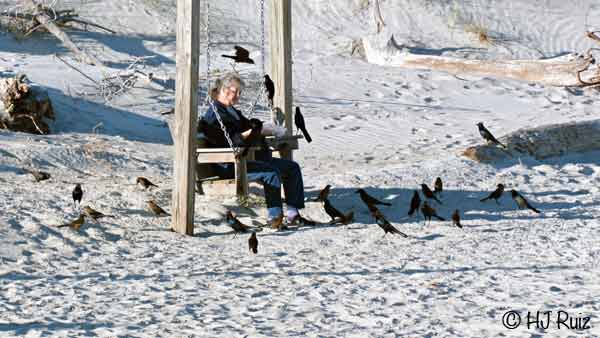
Reading and feeding birds
- Birders do not have to purchase a license to bird, thus there is no automatic pool of funds for bird management and habitat conservation. But, there are other ways that contributions can be made toward the protection and maintenance of important natural areas in your region: direct contributions to private organizations purchasing or managing natural areas, contributing to your state’s non-game wildlife fund, joining a “friends” organization associated with one of your favorite birding areas, and encouraging conservation easement programs.
- Become aware of pending legislation at the local, state, and federal levels that affect funding for bird habitat conservation and management. Make your voice heard—for the birds, for your enjoyment, and for future generations.
- Improve bird habitat in your own backyard and contribute at a very local level to the creation and conservation of bird habitats: use native vegetation, keep your cat indoors, maintain bird boxes.
- On the other end of the spectrum, contribute to the conservation of bird habitats in countries far from home. You can do this by supporting the efforts to protect natural areas and improve the local economy through responsible ecotourism. (Recent articles in Winging It have had some good examples in the Yucatan, in Costa Rica, and in Belize. Also, support the Birders’ Exchange program to get the birding tools to where they are needed in the Neotropics.)
In addition to recruiting new birders and taking actions on behalf of bird habitats, we as birders can also contribute by showing respect for the birds that we seek and the private property of those who provide habitat for birds. Remember, you are a role model. Follow the ABA Code of Birding Ethics.
Birders can be a very powerful force in helping to assure the future of all bird species. Increasing numbers of birders and of interest in birding should reflect more people willing and eager to be active in the stewardship of this most precious of natural resources. - Authors – © H. Ken Cordell —Nancy G. Herbert
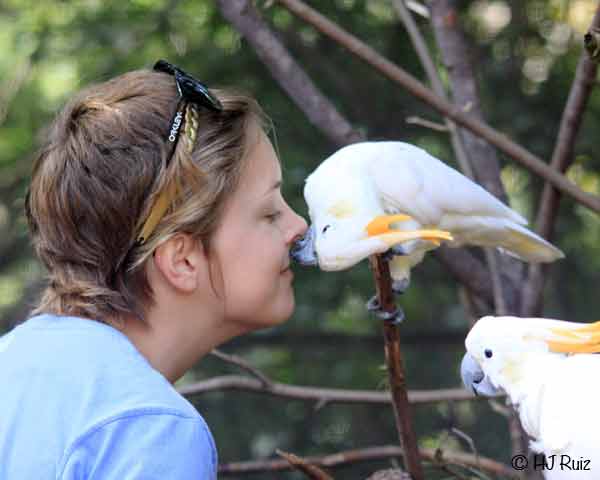
Isn't this love?


 H.J. Ruiz - Avian101
Great post, H.J. I agree, birding is getting to be one of most popular past-times, at least, here in Texas. In south Texas there are some of the best birding spots in the country. I can’t wait to get down there, and get some of those photographs.
It’s funny that when I’m doing food shopping I usually pickup a 20lbs bag of seeds and other customers approach me to ask me about what kinds of birds I feed? Then like it was a secret they tell me that they feed such and such birds too! I conclude that many people love birds but are a bit shy to talk about it. That’s one good reason for me to keep posting my photos and this articles. You are doing exactly the same. 🙂