
Red-billed Hornbill
Red-billed Hornbill – Spec. Name: Tockus erythrorhynchus
This is a relatively small species of hornbill found in savanna and woodland of sub-Saharan Africa. It is sometimes split into five species, the Northern Red-billed Hornbill (T. erythrorhynchus), Western Red-billed Hornbill (T. kempi), Tanzania Red-billed Hornbill (T. ruahae), Southern Red-billed Hornbill (T. rufirostris) and Damara Red-billed Hornbill (T. damarensis), but at present most authorities considered them all to be subspecies of a single species.
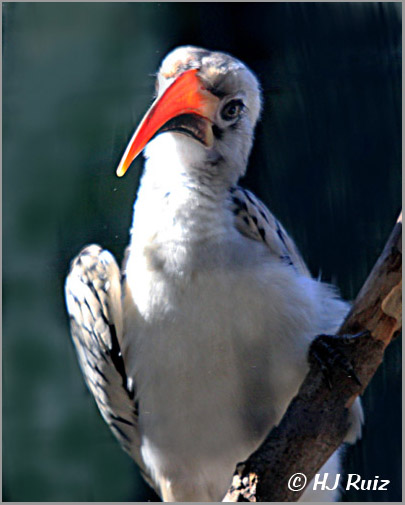
Red-billed Hornbill
This conspicuous bird has mainly whitish underparts and head, and grey upperparts. It has a long tail and a long and curved red bill which lacks a casque. Sexes are similar, but the female has a smaller bill. It is a large bird, at 42 cm long, but is one of the smaller hornbills. It advertises its presence with its noisy accelerating tok-tok-tok-toktoktok call.
During incubation, the female lays three to six white eggs in a tree hole, which is blocked off with a plaster of mud, droppings and fruit pulp. 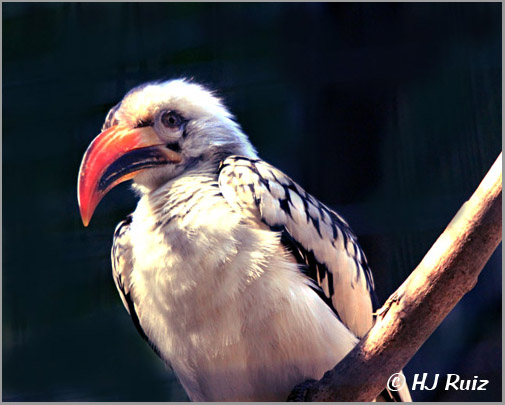 There is only one narrow aperture, just big enough for the male to transfer food to the mother and the chicks. When the chicks and the female are too big to fit in the nest, the mother breaks out and rebuilds the wall, then both parents feed the chicks.
This species is omnivorous, taking insects, fruit and seeds. It feeds mainly on the ground and will form flocks outside the breeding season.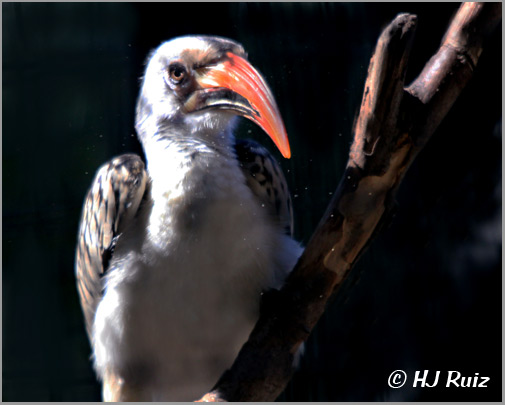
All photographs are © H.J. Ruiz – Avian 101
Text is available under the Creative Commons Attribution-ShareAlike License; additional terms may apply. See Terms of use for details.


 H.J. Ruiz - Avian101
Peculir looking bird, isn’t it.
All the Hornbill family species are very peculiar looking! Thanks for the comment Bob!