
Bald Eagle
Bald Eagle – Spec. Name: Haliaeetus Leucocephalus
This is a bird of prey found in North America. It is the national bird and symbol of the United States of America. This sea eagle has two known sub-species and forms a species pair with the White-tailed Eagle.

Bald Eagle
Its range includes most of Canada and Alaska, all of the contiguous United States, and northern Mexico. It is found near large bodies of open water with an abundant food supply and old-growth trees for nesting.
The plumage of an adult Bald Eagle is evenly brown with a white head and tail. The tail is moderately long and slightly wedge-shaped. Males and females are identical in plumage coloration, but sexual dimorphism is evident in the species in that females are 25 percent larger than males. The beak, feet, and irises are bright yellow. The legs are feather-free, and the toes are short and powerful with large talons. The highly developed talon of the hind toe is used to pierce the vital areas of prey while it is held immobile by the front toes. The beak is large and hooked, with a yellow cere.
The plumage of the immature is brown, speckled with white until the fifth (rarely fourth, very rarely third) year, when it reaches sexual maturity. Immature Bald Eagles are distinguishable from the Golden Eagle in that the former has a more protruding head with a larger beak, straighter edged wings which are held flat (not slightly raised) and with a stiffer wing beat, and feathers which do not completely cover the legs.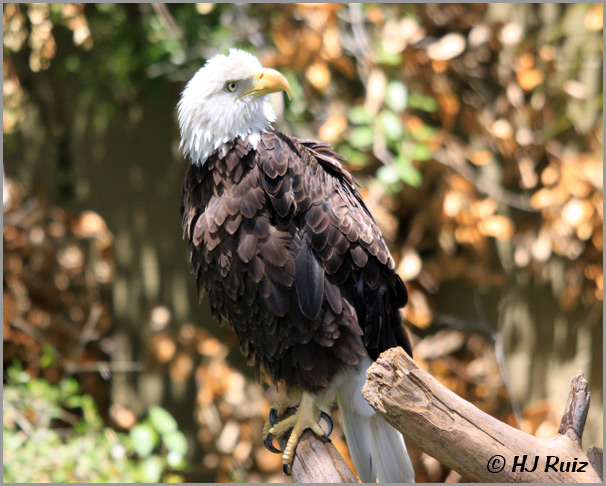
The Bald Eagle is a large bird, with a body length of 28–40 in, a wingspan of between 66 in and 96 in, and a mass of 5.5–15 lbs; females are about 25 percent larger than males, adult females averaging 13 lbs. and males averaging 9.0 lbs. The size of the bird varies by location; the smallest specimens are those from Florida, where an adult male may barely exceed 5.1 lbs and a wingspan of 5.9 ft. The largest are Alaskan birds, where large females may exceed 17 lbs. and have a wingspan of over 7.9 ft.
Its diet consists mainly of fish, but it is an opportunistic feeder. It hunts fish by swooping down and snatching the fish out of the water with its talons. It is sexually mature at four years or five years of age. In the wild, Bald Eagles can live up to thirty years, and often survive longer in captivity. The Bald Eagle builds the largest nest of any North American bird, up to 13 ft deep, 8.2 ft wide, and 1.1 tons in weight.
The call consists of weak chirping whistles, harsher and more shrill from young birds than adults.
The average lifespan of Bald Eagles in the wild is around 20 years, with the oldest living to be about 30. In captivity, they often live somewhat longer. In one instance, a captive individual in New York lived for nearly 50 years. As with size, the average lifespan of an eagle population appears to be influenced by its location.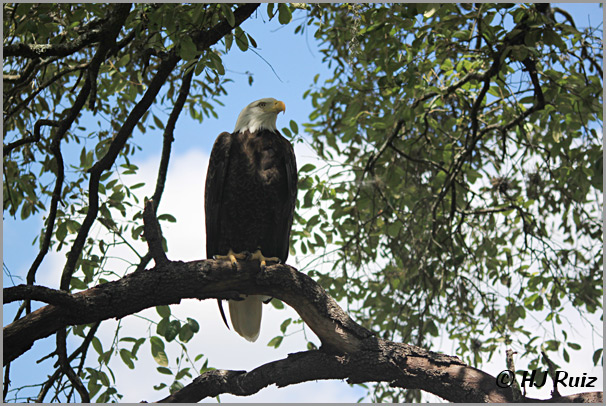
Photographs are © H. J. Ruiz – “My Backyard Visitors”
Text is available under the Creative Commons Attribution-ShareAlike License; additional terms may apply. See Terms of Use for details.
Wikipedia® is a registered trademark of the Wikimedia Foundation, Inc., a non-profit organization.


 H.J. Ruiz - Avian101
This is partly in response to your request for photos of birds I stumbled upon somewhere on your blog. I can contribute some photographs and video footage from the work I do with eagles in Florida Bay (eagle’s nesting in mangroves not much taller than you or I is not what most people have in mind).
Did your interest in photography develop from a love of birds or did want of a subject lead you outdoors?
Hi Jason,
Thank you accepting my invitation, I have already sent you an email on reference to that. Also trying to answer your question. I expect a reply from you.