
Laughing Gull
A few days ago my wife and I went to Jekyll Island (GA) and of course we had a great time in such beautiful place. In a point of the West side of the island we saw a group of Laughing Gulls flying around the parking lot and pecking at shells on the shore. I couldn’t help but to photograph a group of girls throwing food in the air for the laughing gulls to catch and eat. The scene was very cool and I’ll show it to you today. Have a great Sunday! 🙂
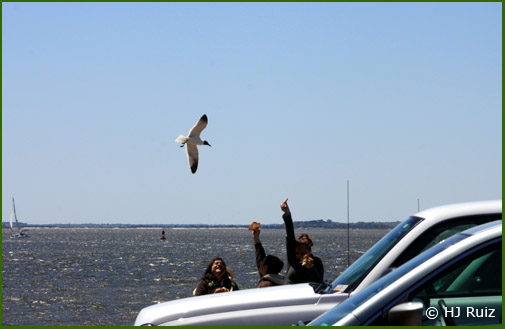
Laughing Gull being fed.
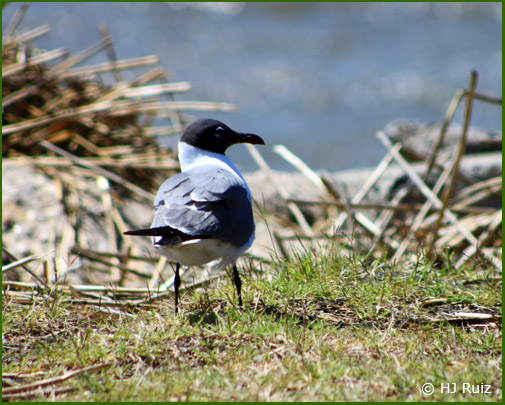
Laughing Gull
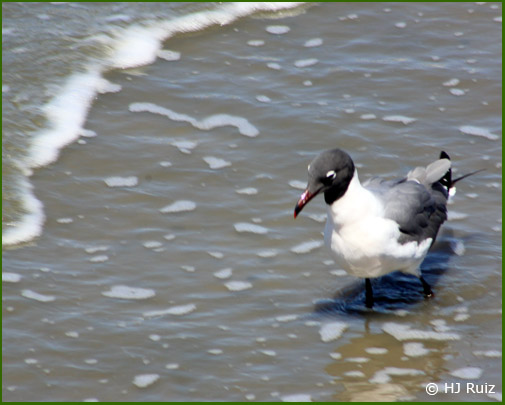
Laughing Gull wading
Share this:

House Sparrow
- House Sparrows – Spc.Name: Passer Domesticus
- House Sparrows aren’t related to other North American sparrows, and they’re differently shaped. House Sparrows are chunkier, fuller in the chest, with a larger, rounded head, shorter tail, and stouter bill than most American sparrows.
- Color Pattern
Male House Sparrows are brightly colored birds with gray heads, white cheeks, a black bib, and rufous neck – although in cities you may see some that are dull and grubby. Females are a plain buffy-brown overall with dingy gray-brown underparts. Their backs are noticeably striped with buff, black, and brown. - Habitat
House Sparrows have lived around humans for centuries. Look for them on city streets, taking handouts in parks and zoos, or cheeping from a perch on your roof or trees in your yard. House Sparrows are absent from undisturbed forests and grasslands, but they’re common in countryside around farmsteads. - The House Sparrows shown below I shot while sitting at a bench in front of the Savannah Canal. I didn’t have my telephoto lens ready and I simply shot with a regular lens.
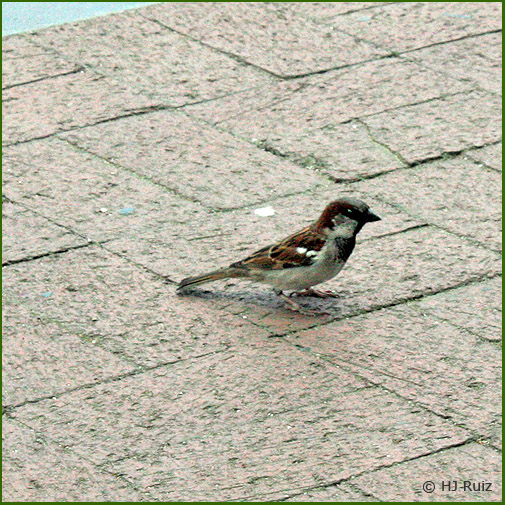
House Sparrow (Passer Domesticus)
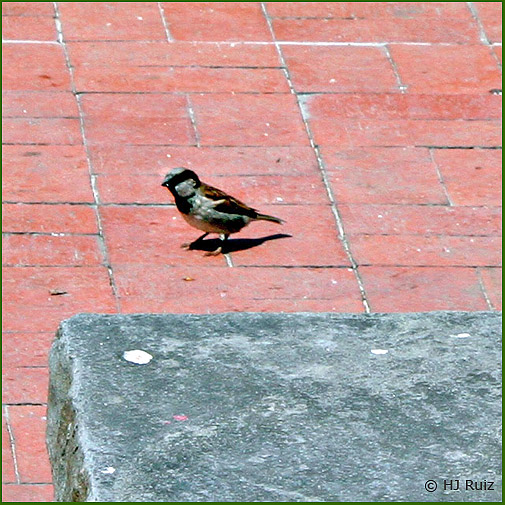
House Sparrow (Passer Domesticus)
Share this:

Dinosaurs a.k.a. Birds
Dinosaurs a.k.a. Birds?
Sometimes I love to run my mind into a wild imagination mode and create my own theories of things, let me explain, so bear with me. Here it goes:
Ample studies and thorough research by scientists conclude that birds are a direct descendants from dinosaurs.
They are the result of evolution gone through millions of years. From a race of gigantic reptilian kind that ruled the Earth for millions of years to actual times. However! I never mention extinction because I believe that if the dinosaurs went extinct, birds would have not existed now.
My wild theory is that they all did not simply died because one cataclysmic event (Meteor hitting the Earth) Creating a glacial environment, in great parts of the globe. I believe that the event I’m talking about happened, but only partially affected life on Earth. Evolution continued for more millions of years and Nature made mutations to adapt reptiles to diverse geographic and climatic changes, resulting in smaller species, more mammals and better suited animals with warm blood, able to survive colder temperatures, and increasing amount of aquatic species, insects, birds, fish etc. More of what we have now and know in the world.
What do you think about my theory? I told you it was pure wild imagination. 🙂
Would it be correct to say: ”I have dinosaurs visiting my backyard”
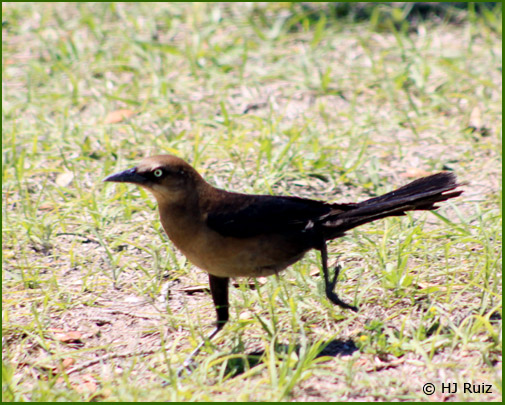
Bird (Boat-tailed Grackle -female)
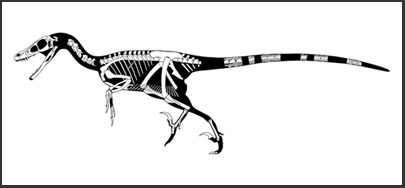
Velociraptor

Velociraptor
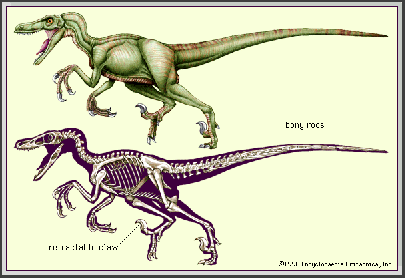
Velociraptor
Share this:

Important Info from Princeton University Press
Here’s a very interesting release from our friends at Princeton University Press:
Princeton University Press announces the acquisition of The Crossley ID Guide: Eastern Birds
Princeton, NJ — Today, executive editor and science and reference group publisher Robert Kirk announced the acquisition of The Crossley ID Guide: Eastern Birds by prominent photographer and birder Richard Crossley.
Featuring unique, layered images of birds in real life contexts, The Crossley ID Guide: Eastern Birds creates the truest representation of the field experience; birds appear in their natural settings, behaviors are documented, and more specimens of differing age ranges and sexes are included on each page to ease in identification. This is quite simply the next generation of field guides and will transform the way we look at birds. (For a preview of the book’s images, please visit http://crossleybirds.com.)
“The word ‘revolution’ is overused and consistently devalued; but when the history of nature guide publishing is written, the publication of The Crossley ID Guide: Eastern Birds will surely be recognized as a turning point, a true revolution in the depiction of birds that ushered in the modern era in field guides,” said Kirk.
The Crossley ID Guide: Eastern Birds is the brain-child of Richard Crossley, a passionate innovator and popularizer of birding. Birding since the age of 7, Crossley is the co-author of The Shorebird Guide and obtained his Green Card for being internationally recognized as an Individual of Exceptional Ability – in Ornithology. Crossley is also a skilled photographer and captured nearly all 8,000 images used in The Crossley ID Guide: Eastern Birds.
When asked about his decision to publish with Princeton University Press, Crossley cited the Press’s success in publishing top-notch landmark field guides to North America and the world.
“Princeton University Press has a shared vision of the future of birding, the outdoors and how books can play a substantial role in promoting these ” noted Crossley. “I am thrilled to publish with them.”
Press Director Peter Dougherty also praised the acquisition of this book, “We are excited – and delighted – to be the publisher of this ground-breaking work.”
The anticipated publication date for The Crossley ID Guide: Eastern Birds is February 2011. The initial print run will be 20,000 copies.
About Princeton University Press
Princeton University Press is an independent publisher with close connections, both formal and informal, to Princeton University. As such it has overlapping responsibilities to the University, the academic community, and the reading public. Our fundamental mission is to disseminate scholarship (through print and digital media) both within academia and to society at large.
About Richard Crossley
Richard Crossley is an expert birder and photographer. A birder since age 7, Crossley holds the distinction of being granted a Green Card for being internationally recognized as an Individual of Exceptional Ability – in Ornithology. Passionate about changing the way we look at birds and surroundings, Crossley’s goal is to popularize birding through video, the internet, and books. He is co-author of The Shorebird Guide (Houghton Mifflin Harcourt, 2006). He lives in Cape May, New Jersey with his wife Debra, and daughters Sophie and Sam. More information: http://www.crossleybirds.com/
Media contact: Jessica Pellien | 609-258-7879 | jessica_pellien@press.princeton.edu
Share this:


Read Past Reviews

Book # 69

Quote from the Author
“A good chuckle is healthy, it helps you break the monotony of a serious life.” ~ H.J. Ruiz


You must be logged in to post a comment.