Eastern Towhees
Today’s weather temperature is lower than yesterday and the sky is gray and filled with humidity. However I see a lot of bird activity in my backyard. I can see a few different species flying around, some at the feeders and some on the ground.
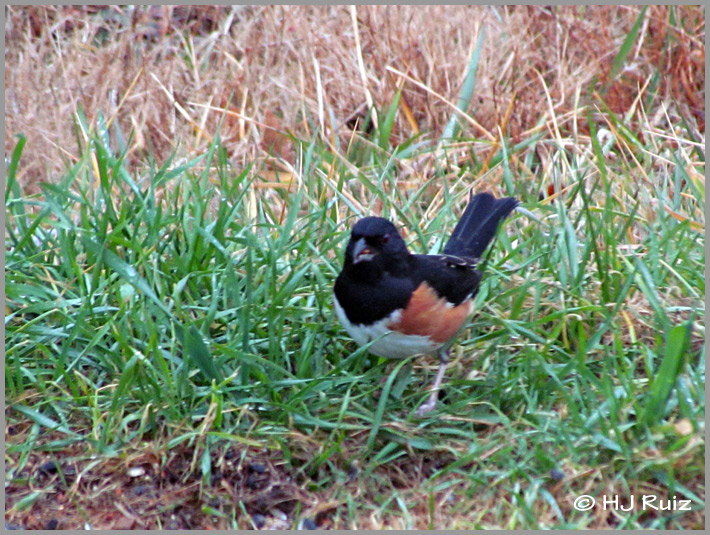
I concentrated more in the Eastern Towhees.
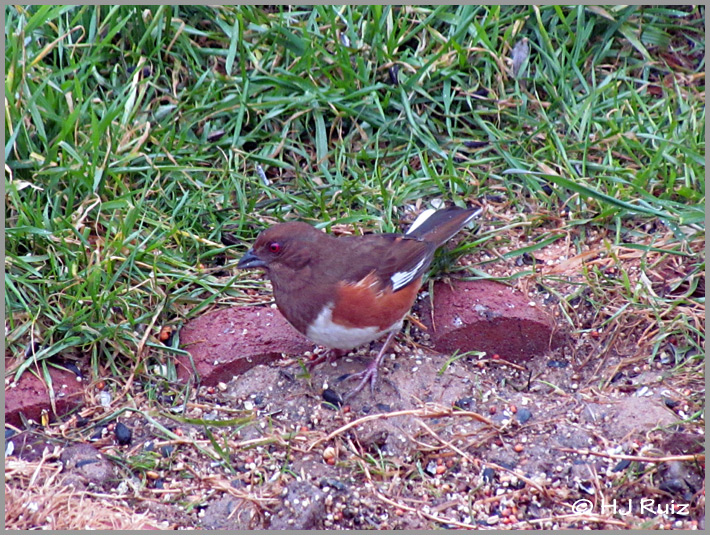
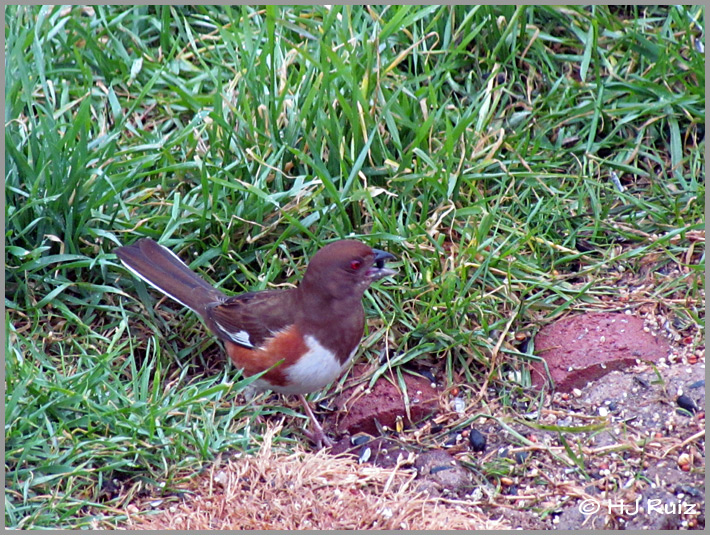
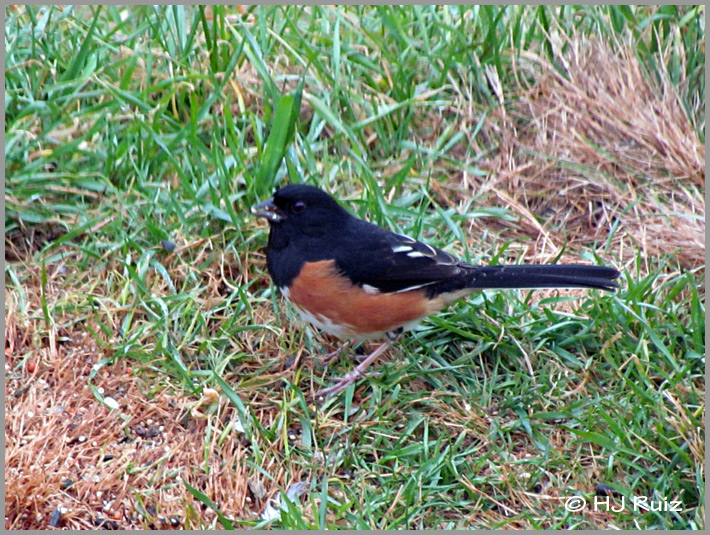
There are at least three or four couples that I could see at one time. They are looking pretty good, they seem strong and healthy. The Towhees usually mind their own business, I’ve never seen them fighting or confronting any birds. Most of times they feed in pairs and as soon as they get their food they retire to their nests. They are excellent flyers, however they spend most of their time on the ground hopping around, Flicking their long tails, flashing the under-tail feathers.
Male E.Towhees are black on the top of their body including head, females are brown in the same pattern.
-
- Eastern Towhee (M)
-
- Eastern Towhee (F)
Share this:

Birding News from Princeton University Press
I’ve just some good news from my friend Jessica Pellien at Princeton University Press which I’m sure will be of interest to you:
Dear H.J.,
Greetings from snowy New Jersey. I am writing with a few tidbits of information about The Crossley ID Guide.
If you are headed to the Space Coast Bird Festival, stop by Princeton University Press’s booth. We are raffling off an advance copy of The Crossley ID Guide: Eastern Birds with a pair of Nikon ProStaff ATB 8×25 Waterproof Binoculars! Visit booth 54 for details. And if you’re not lucky enough to be headed to Florida this week, I hope you will consider sharing news of this great giveaway with your friends, colleagues, and readers.
Some advance copies were shipped out last week. The Birdbooker Report shares a few early thoughts on the book:http://birdbookerreport.blogspot.com/2011/01/crossley-id-guide-eastern-birds.html
Joe Eaton at the Berkeley Daily Planet accuses us of using “four-letter birds”: http://www.berkeleydailyplanet.com/issue/2011-01-26/article/37186?headline=Four-letter-Birds
Lastly, we posted another video for Crossley Unplugged, this time on how to become a better birder:http://press.princeton.edu/blog/2011/01/27/richard-crossley-unplugged-becoming-a-better-birder/
We expect a shipment of The Crossley ID Guide next week so additional review copies will be available soon. Please let me know if you would like a copy.
Best,
Jessica
Jessica Pellien
Assistant Publicity Director
ePublicity Media Manager
Share this:

Mysterious event
This is what happened in Arkansas a few weeks back. Read this article written by CNN, about the case. Of course I’m talking about something that involved avians Let me know what do you think about the whole thing.
http://www.cnn.com/2011/US/01/27/arkansas.bird.mystery/index.html?eref=mrss_igoogle_cnn
Share this:

American Robin
- American Robins are fairly large songbirds with a large, round body, long legs, and fairly long tail. Robins are the largest North American thrushes, and their profile offers a good chance to learn the basic shape of most thrushes. Robins make a good reference point for comparing the size and shape of other birds, too.
- Color Pattern
American Robins are gray-brown birds with warm orange underparts and dark heads. In flight, a white patch on the lower belly and under the tail can be conspicuous. Compared with males, females have paler heads that contrast less with the gray back. - Behavior
American Robins are industrious and authoritarian birds that bound across lawns or stand erect, beak tilted upward, to survey their environs. When alighting they habitually flick their tails downward several times. In fall and winter they form large flocks and gather in trees to roost or eat berries. - Habitat
American Robins are common across the continent in gardens, parks, yards, golf courses, fields, pastures, tundra, as well as deciduous woodlands, pine forests, shrublands, and forests regenerating after fires or logging.
Yesterday afternoon I had the pleasure to photograph and make an addition to my list of species, birds that visit my backyard: An American Robin. He was hopping around looking for worms or bugs. I saw him flying around too. It wasn’t the first time I shot pictures of a robin, but it was in New York.
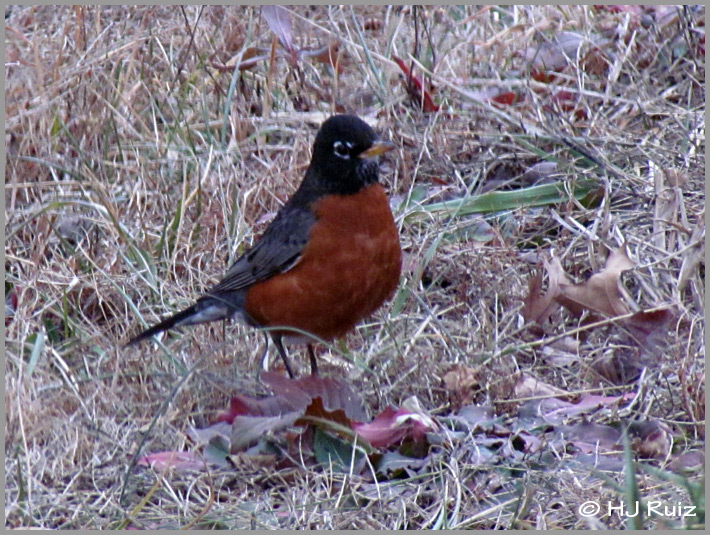
A. Robin
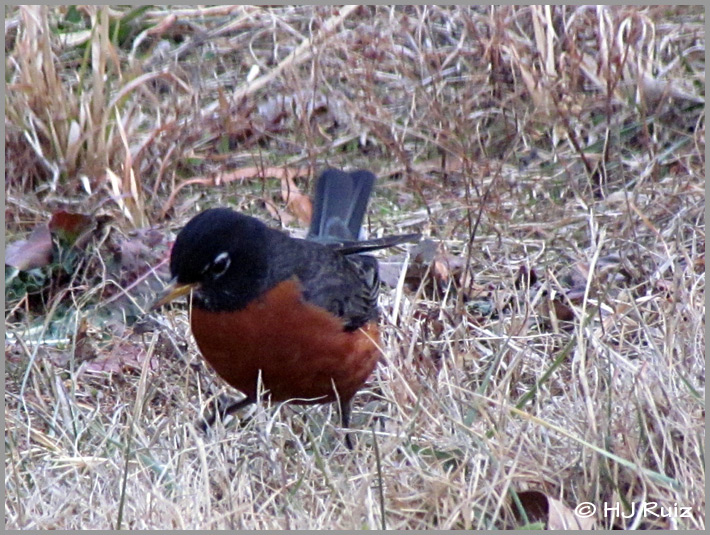
A. Robin
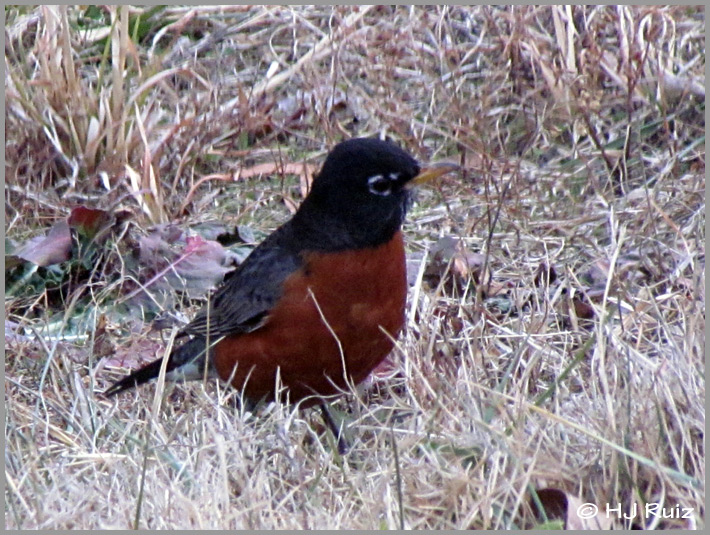
American Robin
Share this:


Read Past Reviews

Book # 69

Quote from the Author
“A good chuckle is healthy, it helps you break the monotony of a serious life.” ~ H.J. Ruiz


You must be logged in to post a comment.