
Bird Humor # 3
“Laughter is a few seconds of peace and no problems in one’s mind”

REASON WHY SOME BIRDS ARE NOT IN AUSTRALIA!
Text and photograph editing © H.J. Ruiz
Share this:

White Chinese Goose
The White Chinese Goose is a breed of domesticated goose descended from the wild Swan Goose. Chinese geese differ from the wild birds in much larger size and in having an often strongly developed basal knob on the upper side of the bill. The knob at the top of the beak is more prominent on males than females. By 6–8 weeks of age, the knob is already pronounced enough that it can be used for sexing. Chinese geese are a close cousin of the African goose, a heavier breed also descended from the Swan Goose.
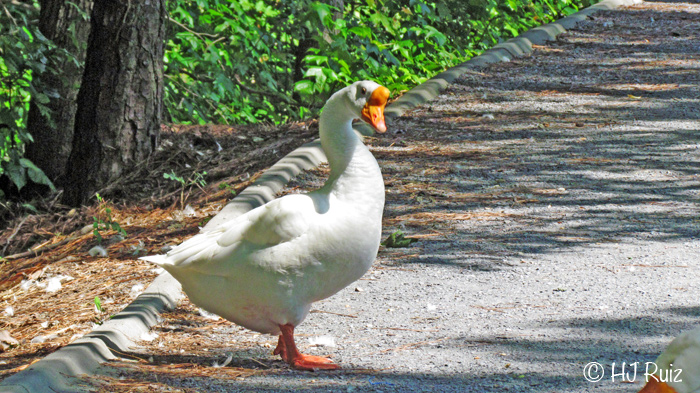
Chinese Goose
Chinese geese appear in two varieties: a brown similar to the wild Swan Goose, and white. While many domestic Chinese geese have a similar body type to other breeds, the breed standards as defined in the American Poultry Association’s Standard of Perfection and other sources call for a slimmer, taller fowl.
Chinese geese are among the better laying breeds of geese. A female Chinese goose can lay 50–60 eggs over the course of the breeding season (February to June), although there are reports of Chinese Geese laying up to 100 eggs during that time.
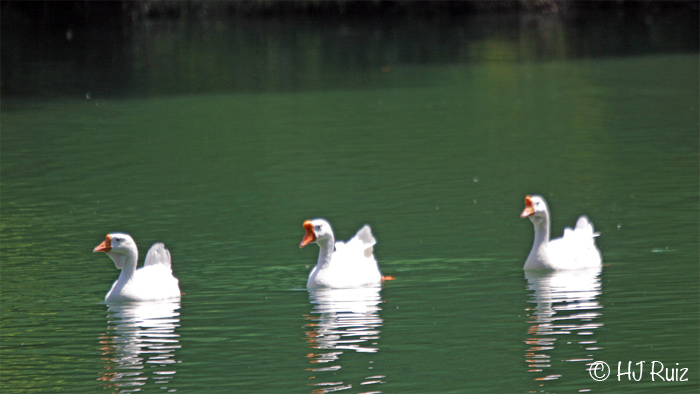
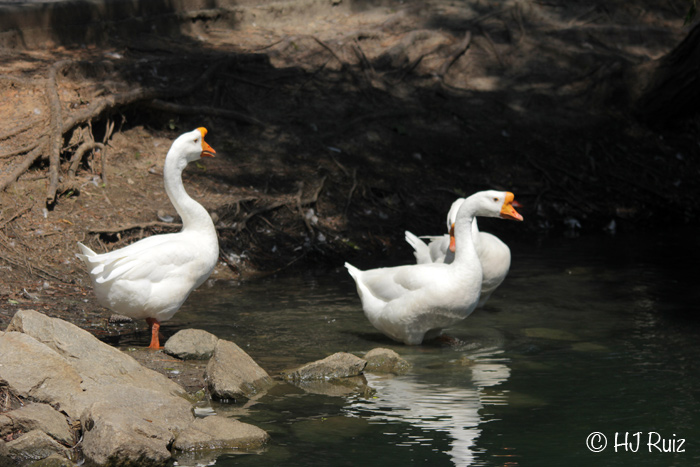
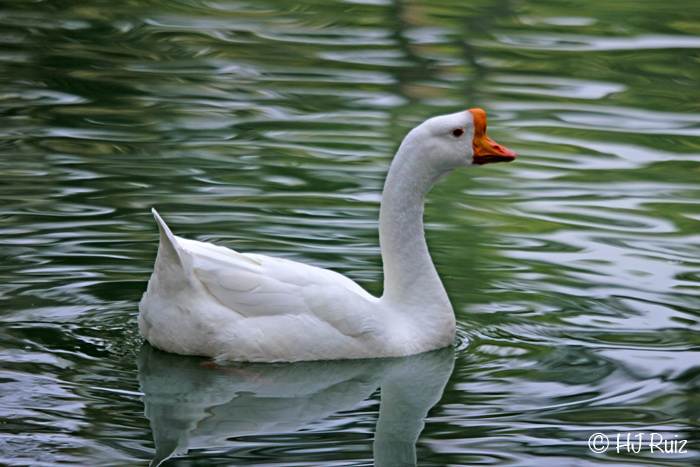
Photographs are © H.J. Ruiz – Avian 101
Text excepts available under the Creative Commons Attribution-ShareAlike License;
Share this:

Muscovy Duck
The Muscovy Duck, (Cairina moschata) is a large duck native to Mexico, Central, and South America. Small wild and feral breeding populations have established themselves in the United States, particularly in the lower Rio Grande Valley of Texas, as well as in many other parts of North America, including southern Canada. Feral Muscovy Ducks have also been reported in parts of Europe.

Muscovy Duck (M)
They are a large duck, with the males weighing up to 15 pounds. Females are considerably smaller, and only grow to 7 pounds, roughly half the males’ size. The bird is predominantly black and white, with the back feathers being iridescent and glossy in males, while the females are more drab. The amount of white on the neck and head is variable, as well as the bill, which can be yellow, pink, black, or any mixture of these. They may have white patches or bars on the wings, which become more noticeable during flight. Both sexes have pink or red wattles around the bill, those of the male being larger and more brightly colored.
Of the original wild species, due to the management by indigenous communities, was derived since pre-Columbian times the domestic subspecies known throughout Latin America as “Pato Criollo” (Creole Duck) which shows significant variations: due to the selection and domestication by man, this subspecies was made it heavier and less able to fly long distances to find their food, as does its wild ancestor. Its feathers are less bright and have a greater variety of colors, being very common specimens with belly, neck and face whitish. The colors are not uniform in all individuals: there are individuals completely white or only black, gray, brown and there are else with different combinations of these colors. This domestic subspecies is also known in Spanish as “Pato Casero” (backyard duck).


Photographs are © H.J. Ruiz – Avian 101
Text excerpts are available under the Creative Commons Attribution-ShareAlike License
Share this:

Aflac?
Last Monday my wife Lucy,grandson Tyler and I met with our friend Lynda and her son Joseph and went to a very nice park in the town where we live. We always look for places where Tyler can play with other kids and do some exercise.

This is my grandson Tyler, 2 years old.
It was the first time for me at this park, I passed by the road thousands of times but I never realized that the park was larger than it look at first sight. The children went there to play at the playground I took a very short walk and found beautiful medium size pond with a water fountain spewing a jet of water high in the air. This park has nice surroundings and has been designed well, there are tennis courts, an open amphitheater and playgrounds for kids. Next time I go I will take a longer walk to see what at the other side of the pond.
I immediately noticed the ducks swimming around and other walking about. So I used my Canon D60 and SX30iS and shot some pictures. I will be posting pictures of the other ducks separately.
Although there were several kinds of ducks I will single out only one species for today. The White Pekin Duck.
Disclaimer: This is not a post based on the celebrity duck you see on TV commercials. I’m not a paparazzo! 🙂


Water fountain in the pond

Beautiful flowers all around.

Visitors are allowed to feed the ducks.
Text and photographs © H.J. Ruiz – Avian 101
Share this:


Read Past Reviews

Book # 69

Quote from the Author
“A good chuckle is healthy, it helps you break the monotony of a serious life.” ~ H.J. Ruiz


You must be logged in to post a comment.