Bird Art # 9
BIRD ART # 9

“Confrontation” Graphite on drawing paper, 5×5″ Sketch
Art work © H.J. Ruiz – Avian 101 – Do not copy or download
Share this:

Ups and Downs – Part Two
After the incident with the Cooper’s Hawk I saw a many more birds coming for feeding, among those were the House Finch group of about 6, most of them juveniles with non breeding colors. They were around feeding at every opportunity to the feeders, there were other birds also and they have to find the right time to feed or they’d get into a fight with other species. Then while and panning back and forth getting shots I see an American Goldfinch, male, standing on the right side railing of the deck. It was a surprise for me because they seldom stop by my backyard for no longer that 2 minutes! This one did not fly away, I shot several pictures and did not fly away, just stood there. I observed through the lens carefully and checked the in camera photos and noticed that this bird was blind of the left eye and his right eye was barely open. Poor little thing is blind! Then I saw something incredible, one of the House Finches stood near him and they both were calling and waited, this H. Finch wouldn’t leave his side. After a few minutes I saw a reaction of both birds and in a flash I saw a female A. Goldfinch near the male. Only then the H.Finch left to join the others. They did not feed but instead they flew to some bushes were the male perched for about 1 hour, then I saw 2 females near him, I saw a Song Sparrow and later a C. Chickadee next to him also. For about 10 minutes there were no birds on the deck and the A. Goldfinch flew to a dish and ate some seeds alone. What a dramatic and compassionate sequence of events. I could sense a deliberate action of protection on the part of the H. Finch as well of cooperation. I could feel the solidarity of the other species to perch near the wounded bird and what it might be also coincidental to clear the deck for him to be able to eat. After he ate some seeds he flew away along with the other Goldfinches.
That night my wife Lucy slipped while entering the shower and fell. Her right leg got caught with the metal angle of the shower door and cut a 5 inch long and very deep gash to her shin. I’ll just tell you that she’s fine and she was very brave all throughout the ordeal.
Please click first image to see gallery
-

- House Finches (J) part of a group

-

- House Finches

-

- American Goldfinch (M) Apparently injured or ill

-

- A House Finch stands guard next to A.Goldfinch and both make calls

-

- They both stand alert when they hear response call

-

- Female Goldfinch comes to meet injured male

-

- American Goldfinch (F)

-

- Song Sparrow stands guard of A. Goldfinch for a while

-

- American Goldfinch eats seeds from dish undisturbed

Text and photographs © H.J. Ruiz – Avian 101
Share this:

Ups and Downs – Part One
Last Sunday was an up and down day for me in various ways.
As always I filled all the feeders to my birds that are usually waiting for me. The day was clear and kind of cool, I went and started setting up my camera and lens etc. when I looked outside and I see a large figure on the deck railing.
It was a Cooper’s Hawk. I started shooting with excitement and trying to do the best of the situation, the hawk kept moving around the deck checking for movement with those piercing eyes.
After a while a car went by on the street and spooked the hawk and flew toward the huge oak tree all the way to the top.

Only feathers remained
That’s when I went around looking for any casualties, unfortunately there was one, a mourning dove the only traces were the feathers which I immediately picked up because I don’t like the sight of it.
I totally understand nature and I respect the wilderness laws of survival, but still feel a bit uncomfortable about it.
This Cooper’s Hawk species is a gorgeous looking bird from any angle, but deadly for the small birds.
I know that I’ll be seeing more of the hawks because there are many Mourning Doves lately, they’re easy target and make a perfect meal for a raptor.
This post will continue tomorrow do not miss it!


Text and photographs © H.J. Ruiz – Avian 101
Share this:

Added a New Bird to my List
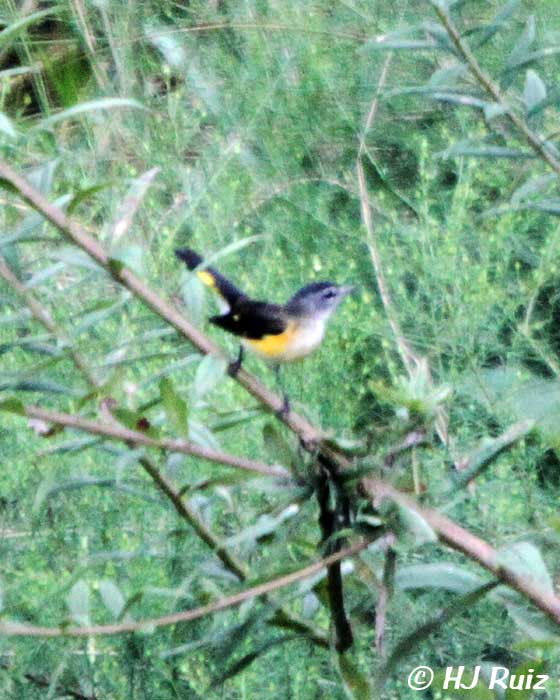
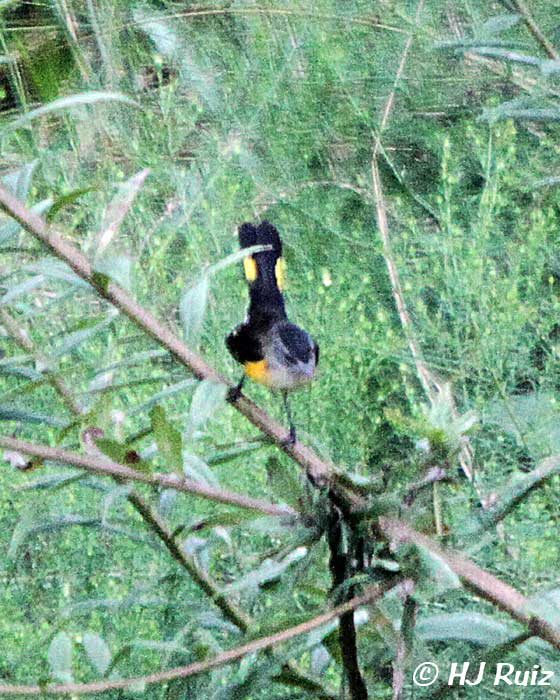
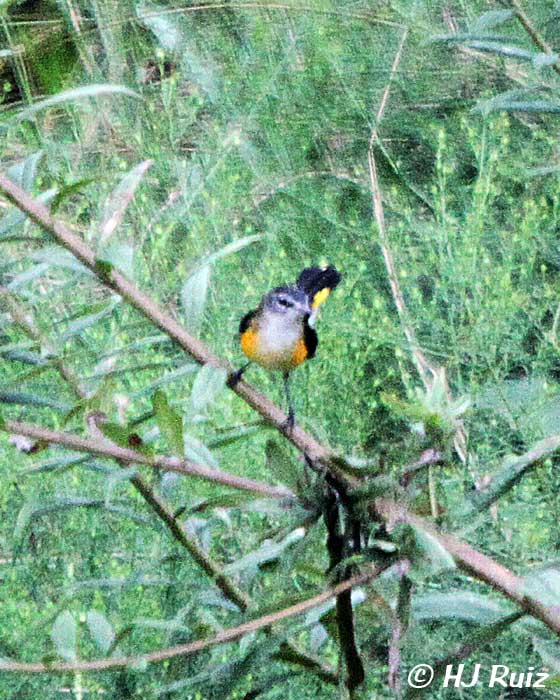
I’m happy to announce an addition of another bird species to my lifer list, it’s the American Redstart. I saw the male and female in the far bushes in my backyard, however I had the chance to photograph only the female. The quality of the photos are not very good but you’ll be able to identify the species.
The American Redstart (Setophaga ruticilla) is a New World warbler. It is unrelated to the Old World redstarts. It derives its name from the male’s red tail, startbeing an old word for tail.
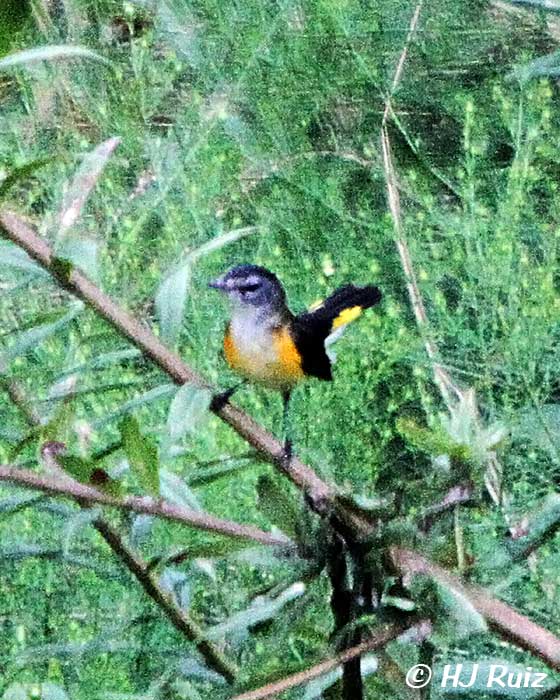
American Redstart (F)
The American Redstart is smallish warbler. The breeding males are unmistakable, jet black above apart from large orange-red patches on their wings and tails. Their breast sides are also orange, with the rest of their underparts colored white. In their other plumages, American Redstarts display green in their upperparts, along with black central tails and grey heads. The orange patches of the breeding males are replaced by yellow in the plumages of the females and young birds. Orange and yellow coloration is due to the presence of carotenoids; males possess the red carotenoid Canthaxanthin and the yellow carotenoids Canary Xanthophyll A and B, all of which mix together to produce an orange color, while the females possess only the yellow carotenoids. Recent research indicates that an age and sex effect on observed color attributes of hue, brightness, and saturation exists in American Redstarts, with the exception for saturation, which only showed an age effect.[2] Their song is a series of musical see notes. Their call is a soft chip.
They breed in North America, across southern Canada and the eastern USA. These birds are migratory, wintering in Central America, the West Indies, and northern South America (in Venezuela they are called “candelitas”). They are very rare vagrants to western Europe. During the breeding season, this warbler inhabits open-canopy, mostly deciduous forests, second growth, and forest edge across much of the United States and southern Canada.
Text and photographs © H.J. Ruiz – Avian 101
Share this:


Read Past Reviews

Book # 69

Quote from the Author
“A good chuckle is healthy, it helps you break the monotony of a serious life.” ~ H.J. Ruiz


You must be logged in to post a comment.