Bird Art # 19
BIRD ART # 19
Click on image to see enlargement

“Red-winged Blackbird (F)(J) Drawing, charcoal and graphite on drawing paper, 8X6”
Artwork © H.J. Ruiz – Do not copy or download
Share this:

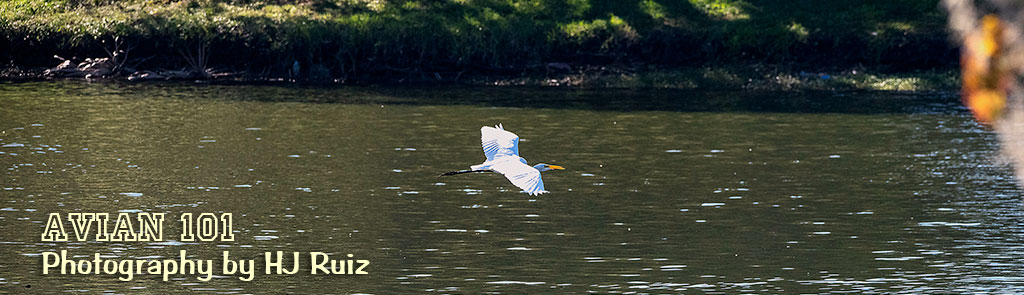
Great Egret
The Great Egret, also known as Great White Egret, Common Egret, Large Egret or Great White Heron is a large, widely-distributed egret. Distributed across most of the tropical and warmer temperate regions of the world, in southern Europe it is rather localized. In North America it is more widely distributed, and it is ubiquitous across the Sun Belt of the United States and in the rainforests of South America.
The Great Egret feeds in shallow water or drier habitats, feeding mainly on fish, frogs, small mammals, and occasionally small reptiles and insects, spearing them with its long, sharp bill most of the time by standing still and allowing the prey to come within its striking distance of its bill which it uses as a spear. It will often wait motionless for prey, or slowly stalk its victim.
Click on images to see enlargements


Text excerpts © Wikipedia, photographs © H.J. Ruiz – Avian 101
Share this:

Anhinga
The Anhinga – Latin name (Anhinga anhinga), sometimes called Snakebird, Darter, American Darter, or Water Turkey, is a water bird of the warmer parts of the Americas. The word anhingacomes from the Brazilian Tupi language and means devil bird or snake bird.

Anhinga (M)
Anhinga species are found all over the world in warm shallow waters. The American Anhinga has been subdivided into two subspecies, A. a. anhinga and A. a. leucogaster, based on their location. A. a. anhinga can be found mainly east of the Andes in South America and also the islands of Trinidad and Tobago. A. a. leucogaster can be found in the southern United States, Mexico, Cuba, and Grenada.
Only birds that not live in the extreme north and south of their range migrate and do so based on temperature and available sunlight. Anhingas will migrate towards the equator during winter but this range is “determined by the amount of sunshine to warm the chilled birds”. Although not in their usual range, anhingas have been found as far north as the states of Pennsylvania and Wisconsin in the United States.
Kettles of anhingas often migrate with other birds and have been described as resembling black paper gliders
Unlike ducks, the Anhinga is not able to waterproof its feathers using oil produced by the uropygial gland. Consequently, feathers can become waterlogged, making the bird barely buoyant. However, this allows it to dive easily and search for underwater prey, such as fish and amphibians. It can stay down for significant periods.
This bird is often mistaken for the Double-crested Cormorant due to its similar size and behavior. However, the two species can be differentiated by their tails and bills. The tail of the anhinga is wider and much longer than that of the cormorant. The bill of the anhinga is pointed, while the bill of the cormorant has a hook-tip.
Click on images to see enlargements


Text excerpts © Wikipedia®, photographs © H.J. Ruiz – Avian 101
Share this:

Neotropic Cormorant
The Neotropic Cormorant is a medium-sized cormorant found throughout the American tropics and subtropics, from the middle Rio Grande and the Gulf and Californian coasts of the USA south through Mexico and Central America to southern South America. It also breeds on the Bahamas, Cuba and Trinidad. It can be found both at coasts (including some mangrove areas) and on inland waters.
Its diet consists mainly of small fish, but will also eat tadpoles, frogs, and aquatic insects. Information about its prey is sparse, but inland birds seem to feed on small, abundant fish in ponds and sheltered inlets.
Click on images to see enlargements


Text and photographs © H.J. Ruiz – Avian 101
Share this:


Read Past Reviews

Book # 69

Quote from the Author
“A good chuckle is healthy, it helps you break the monotony of a serious life.” ~ H.J. Ruiz


You must be logged in to post a comment.