
Miscellaneous
Peruvian Pelican – Pelecanus Thagus


All photographs © H.J. Ruiz – Avian 101
Share this:

Cattle Egret
The Cattle Egret – Latin name: Bubulcus ibis
This bird is a cosmopolitan species of heron (family Ardeidae) found in the tropics, subtropics and warm temperate zones. It is the only member of the monotypic genus Bubulcus, although some authorities regard its two subspecies as full species, the Western Cattle Egret and the Eastern Cattle Egret. Despite the similarities in plumage to the egrets of the genus Egretta, it is more closely related to the herons of Ardea. Originally native to parts of Asia, Africa and Europe, it has undergone a rapid expansion in its distribution and successfully colonised much of the rest of the world.
It is a white bird adorned with buff plumes in the breeding season. It nests in colonies, usually near bodies of water and often with other wading birds. The nest is a platform of sticks in trees or shrubs. Cattle Egrets exploit drier and open habitats more than other heron species. Their feeding habitats include seasonally inundated grasslands, pastures, farmlands, wetlands and rice paddies. They often accompany cattle or other large mammals, catching insect and small vertebrate prey disturbed by these animals. Some populations of the Cattle Egret are migratory and others show post-breeding dispersal.
The adult Cattle Egret has few predators, but birds or mammals may raid its nests, and chicks may be lost to starvation, calcium deficiency or disturbance from other large birds. This species maintains a special relationship with cattle, which extends to other large grazing mammals. The cattle egret removes ticks and flies from cattle and consumes them.
The Cattle Egret is a stocky heron with a 88–96 cm (35–38 in) wingspan; it is 46–56 centimetres (18–22 in) long and weighs 270–512 grams (9.5–18.1 oz). It has a relatively short thick neck, sturdy bill, and a hunched posture. The non-breeding adult has mainly white plumage, a yellow bill and greyish-yellow legs. During the breeding season, adults of the nominate western subspecies develop orange-buff plumes on the back, breast and crown, and the bill, legs and irises become bright red for a brief period prior to pairing. The sexes are similar, but the male is marginally larger and has slightly longer breeding plumes than the female; juvenile birds lack coloured plumes and have a black bill.
NOTE: The Cattle Egret is a new addition to my Bird List as: # 175


Text © Wikipedia – All photographs © H.J. Ruiz – Avian 101
Share this:

Magnificent Frigatebird
Magnificent Frigatebird – Latin name: Fregata magnificens
It is widespread in the tropical Atlantic, breeding colonially in trees in Florida, the Caribbean and Cape Verde Islands. It also breeds along the Pacific coast of the Americas from Mexico to Ecuador including the Galápagos Islands.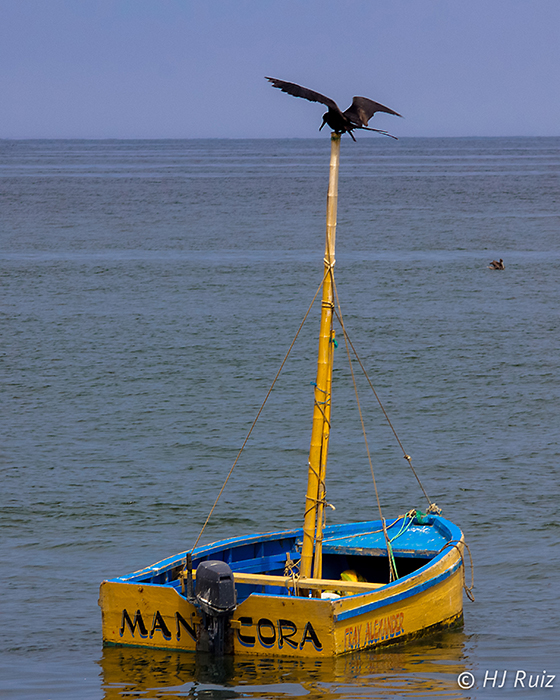
Note: These birds have been photographed by H.J. Ruiz in the northwest of Peru
It has occurred as a vagrant as far from its normal range as the Isle of Man, Denmark, Spain, England, and British Columbia.
The Magnificent Frigatebird is 100 cm (39 inches) long with a 215 cm (85 inch) wingspan. Males are all-black with a scarlet throat pouch that is inflated like a balloon in the breeding season. Although the feathers are black, the scapular feathers produce a purple iridescence when they reflect sunlight (in contrast the male Great Frigatebird has a green sheen). Females are black, but have a white breast and lower neck sides, a brown band on the wings, and a blue eye-ring that is diagnostic of the female of the species. Immature birds have a white head and underparts.
This species is very similar to the other frigatebirds and is similarly sized to all but the Lesser Frigatebird. However, it lacks a white axillary spur, and juveniles show a distinctive diamond-shaped belly patch.
The Magnificent Frigatebird is silent in flight, but makes various rattling sounds at its nest.
This species feeds mainly on fish, and also attacks other seabirds to force them to disgorge their meals. Frigatebirds never land on water, and always take their food items in flight.
It spends days and nights on the wing, with an average ground speed of 10 km/h, covering 223±208 km before landing. They alternately climb in thermals, to altitudes occasionally as high as 2500 m, and descend to near the sea surface. The only other bird known to spend days and nights on the wing is the Common Swift.
A scientific study that examined genetic and morphological variation in Magnificent Frigatebirds found both expected, and also highly unexpected results: firstly—as predicted by the flight capacity of the species—the authors found signatures of high gene flow across most of the distribution range. This included evidence of recent gene flow among Pacific and Atlantic localities, likely across the Isthmus of Panama. This geological formation is a strong barrier to movement in most tropical seabirds. However, the same study also found that the Magnificent Frigatebird on the Galápagos Islands is genetically and morphologically distinct. Based on this study, the Galápagos population has not been exchanging any genes with their mainland counterparts for several hundred thousand years.
Given these findings, the Galapagos population of this tropical seabird may be its own genetically distinct species warranting a new conservation status. This small population of genetically unique Magnificent Frigatebirds is a vulnerable population. Any catastrophic event or threats by humans could wipe out the approximate 2000 Magnificent Frigatebirds that nest on the Galápagos Islands. Magnificent Frigatebirds are currently classified as Least Concern (LC)‘ by the International Union for Conservation of Nature, but the Proceedings of the Royal Society paper recommends that, because of the genetic uniqueness of those on the Galápagos, this status be revisited.
NOTE: The Magnificent Frigatebird is a new addition to my Bird List as: # 174


Text excerpt © Wikipedia – All photographs © H.J. Ruiz – Avian 101
Share this:

Sunday Dinning with HJ

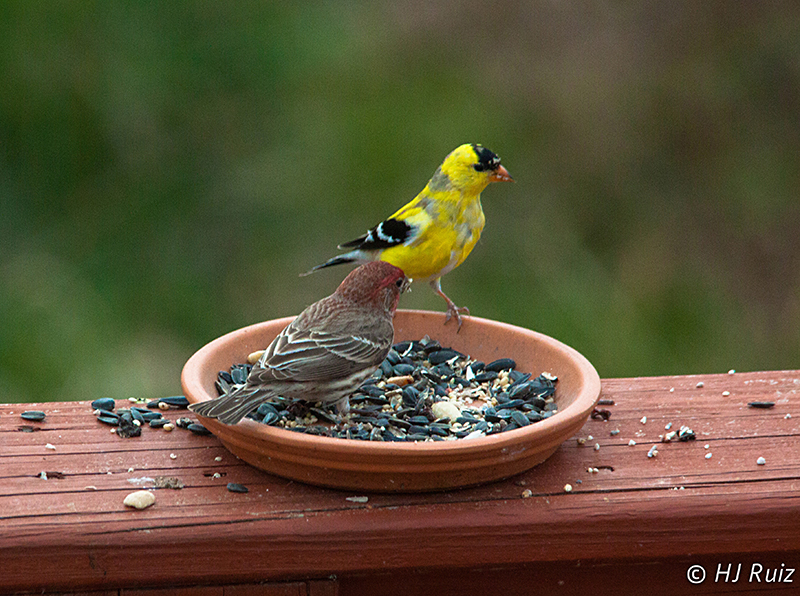 I have the honor to be joined for dinner by a couple of gentlemen, they are Mr. House Finch and Mr. American Goldfinch. Of course we should disregard their table manners, buy the way they were immersed into a discussion by Mr. House Finch regarding the Real Estate situation and the poor handling of the Banks and Financial Lenders point that was not well received by Mr. American Goldfinch being a Lender himself!
All in all, it was quite an interesting dinner!
Text & photograph © H.J. Ruiz
Share this:


Read Past Reviews

Book # 69

Quote from the Author
“A good chuckle is healthy, it helps you break the monotony of a serious life.” ~ H.J. Ruiz


You must be logged in to post a comment.