
Do You Know about Bird Molting?
Molting
A feather is a “dead” structure, somewhat analogous to hair or nails in humans. The hardness of a feather is caused by the formation of the protein keratin. Since feathers cannot heal themselves when damaged, they have to be completely replaced. The replacement of all or part of the feathers is called a molt. Molts produce feathers that match the age and sex of the bird, and sometimes the season.
Molting occurs in response to a mixture of hormonal changes brought about by seasonal changes. The entire process is complex and many questions remain regarding how the process is controlled. A basic understanding of molting patterns can, however, be a useful aid in identifying many species and in determining their age.
There are two kinds of molts with different degrees of feather replacement.
- In a complete molt all feathers are replaced.
- In a partial molt only some feathers are replaced.
Damaged feathers are replaced during a molt. A feather that has been lost completely is replaced immediately.
How often do birds molt? This varies by species.
I brought you a series of pictures I shot of a male Northern Cardinal in my backyard. It’s the perfect example of molting.


Text excerpts © the Cornell Lab of Ornithology – All photographs © H.J. Ruiz – Avian 101
Share this:

House Wren
House Wren – Latin name: Troglodytes aedon
This is a very small songbird of the wren family, Troglodytidae. It occurs from Canada to southernmost South America, and is thus the most widely distributed bird in the Americas. It occurs in most suburban areas in its range and it is the single most common wren. Its taxonomy is highly complex and some subspecies groups are often considered separate species.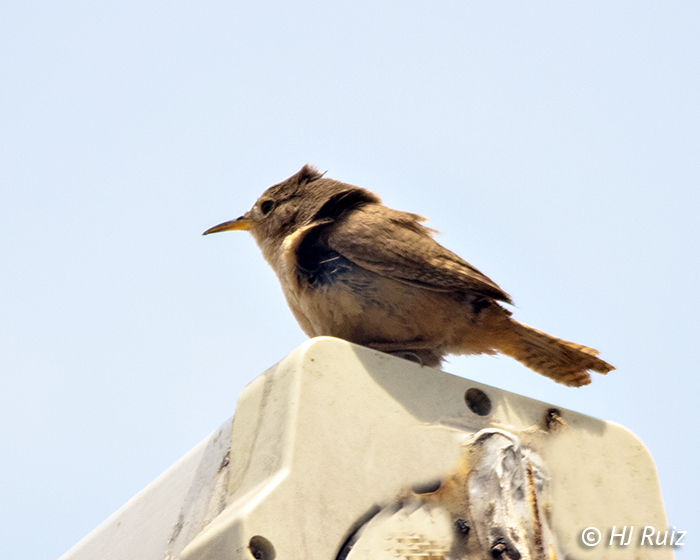
Adults are 11 to 13 cm (4.3 to 5.1 in) long, with a 15 cm (5.9 in) wingspan and weigh about 10 to 12 g (0.35 to 0.42 oz). Among standard measurements, the wing chord is 4.7 to 5.3 cm (1.9 to 2.1 in), the tail is 3.9 to 4.4 cm (1.5 to 1.7 in), the culmen is 1.1 to 1.3 cm (0.43 to 0.51 in) and the tarsus is 1.6 to 1.8 cm (0.63 to 0.71 in). The subspecies vary greatly, with upperparts ranging from dull greyish-brown to rich rufescent-brown, and the underparts ranging from brown, over buff and pale grey, to pure white. All subspecies have blackish barring to the wings and tail, and some also to the flanks. All subspecies show a faint eye-ring and eyebrow and have a long, thin bill with a blackish upper mandible, and a black-tipped yellowish or pale grey lower mandible. The legs are pinkish or grey. The short tail is typically held cocked.
This bird’s rich bubbly song is commonly heard during the nesting season but rarely afterwards. There is marked geographical variation in its song, though somewhat more gradual than in the birds’ outward appearance which can strikingly differ e.g. on neighboring islands in the Caribbean. Birds from far north and south of the species’ range nonetheless have songs that differ markedly.
NOTE: The House Wren is a new addition to my Bird List as: # 179


Text © Wikipedia – All photographs © H.J. Ruiz – Avian 101
Share this:

Sandwich Tern
Sandwich Tern – Latin name: Sterna sandvicensis
This is a seabird of the tern family Sternidae. It is very closely related to the Lesser Crested Tern T. bengalensis, Chinese Crested Tern T. bernsteini, and Elegant Tern T. elegans, and has been known to interbreed with Lesser Crested.

Sandwich Tern
The Sandwich Tern is a medium-large tern with grey upperparts, white underparts, a yellow-tipped black bill and a shaggy black crest which becomes less extensive in winter with a white crown. Young birds bear grey and brown scalloped plumage on their backs and wings. It is a vocal bird. It nests in a ground scrape and lays one to three eggs.
Like all Thalasseus terns, the Sandwich Tern feeds by plunge diving for fish, usually in marine environments, and the offering of fish by the male to the female is part of the courtship display.
This is a medium-large tern, 37–43 cm (15–17 in) long with an 85–97 cm (33–38 in) wingspan, which is unlikely to be confused within most of its range, although the South American race could be confused with the Elegant Tern.
The Sandwich Tern’s thin sharp bill is black with a yellow tip, except in the yellow or orange billed South American race. Its short legs are black. Its upperwings are pale grey and its underparts white, and this tern looks very pale in flight, although the primary flight feathers darken during the summer.
The Lesser Crested Tern and Elegant Tern differ in having all-orange bills; Lesser Crested also differs in having a grey rump and marginally stouter bill, and Elegant in having a slightly longer, slenderer bill. Chinese Crested Tern is the most similar to Sandwich, but has a reversal of the bill colour, yellow with a black tip; it does not overlap in range with Sandwich Tern so confusion is unlikely.
In winter, the adult Sandwich Tern’s forehead becomes white. Juvenile Sandwich Terns have dark tips to their tails, and a scaly appearance on their back and wings, like juvenile Roseate Terns.
The Sandwich Tern is a vocal bird; its call is a characteristic loud grating kear-ik or kerr ink.
NOTE: The Sandwich Tern is a new addition to my Bird list as: # 178


Text © Wikipedia – All photographs © H.J. Ruiz – Avian 101
Share this:

Miscellaneous
Black Skimmer – Rynchops niger


All photographs © H.J. Ruiz – Avian 101
Share this:


Read Past Reviews

Book # 69

Quote from the Author
“A good chuckle is healthy, it helps you break the monotony of a serious life.” ~ H.J. Ruiz


You must be logged in to post a comment.