Miscellaneous
Northern Mockingbird – Mimus poliglottos


Text and photographs © H.J. Ruiz – Avian 101
Share this:

Courtship Ritual?
For anybody that spend some time observing birds and their daily behavior, very often is rewarded in a subtle way. I certainly can give you an example of what I’m referring about.
A few days ago I was watching the birds as I always do, camera ready and all, when I saw a female Red-winged Blackbird eating of one feeder dish, but behaving rather agitated and vociferous. It called my attention of course and I readily trained my camera toward her, shot some pictures of the action when of the corner of my eye I see a large male Red-winged Blackbird, flapping his large wings and flashing the red and yellow wing feathers at full intensity. He landed on the deck’s railing. He immediately proceeded to crouch very low also raffled and spread his body feathers which gave the impression of growing in size. He crawled toward the female slowly, vibrating his body while advancing, did some circular movements. The female bird watched intensely for a while and then flew away!(I guess that she wasn’t so interested after all)
He finished what I assume was his courtship ritual and turned his attention to get something to eat.
I understand that this post may not be as exciting for some readers but it was for me.
The whole deal was fantastic and very interesting! It made my day! I decided to share it with you!


Text and photographs © H.J. Ruiz – Avian 101
Share this:

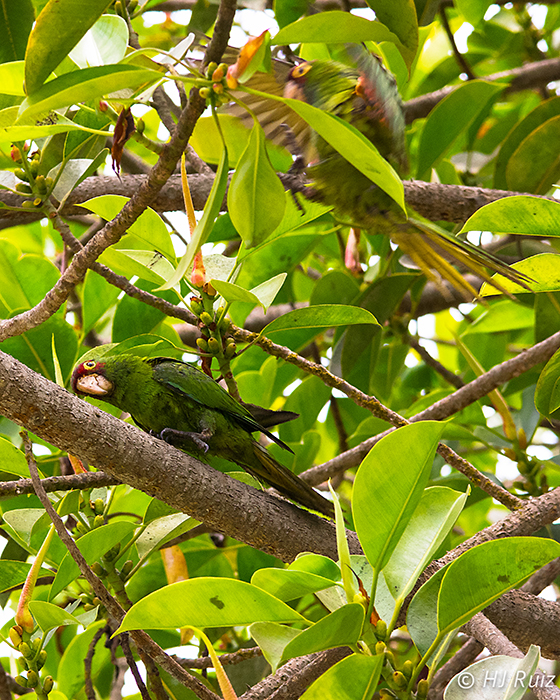
Red-Masked Parakeet
Red-masked Parakeet – Latin name: Aratinga erythrogenys
This is a medium-sized parrot from Ecuador and Peru. It is popular as a pet—known in aviculture as the Cherry-headed Conure or the Red-headed Conure—and considered the best talked of the conures.
Red-masked Parakeets average about 33 cm (13 in) long, of which half is the tail. They are bright green with a mostly red head on which the elongated pale eye-ring is conspicuous; the nape is green. Also, the lesser and median underwing coverts are red, and there is some red on the neck, the thighs, and the leading edge of the wings. Juveniles have green plumage, until their first red feathers appear at around the age of four months.
Red-masked Parakeet
Its call is two-syllabled, harsh and loud.
Clutches average 3 to 4 eggs and incubation is 23 or 24 days. Nests are usually made in tree cavities. Juvenile birds fledge after 50 days with green plumage.
These birds are native to southwestern Ecuador and northwestern Peru, where they inhabit forest edges and partially cleared areas.
It has been the tenth most common Neotropical parrot imported into the USA with over 26,000 parakeets checked in from 1981 to 1985. This bird was formerly more common in its limited range, and only fairly recently has been reclassified from a species of least concern to a species near threatened (1994).
NOTE: The Red-masked Parakeet is a new addition to my Bird List as: #185


Text © Wikipedia – All photographs © H.J. Ruiz – Avian 101
Share this:

Happy Mother’s Day!
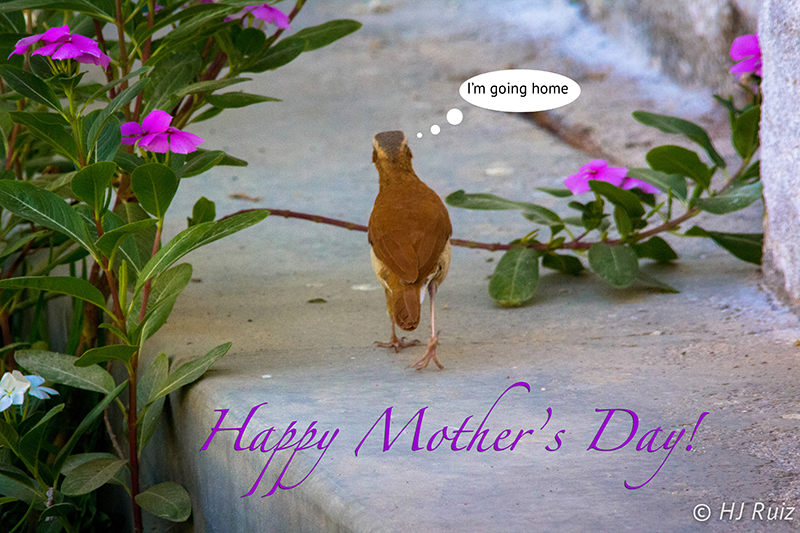
Special greetings from H.J. Ruiz – Avian 101
Share this:


Read Past Reviews

Book # 69

Quote from the Author
“A good chuckle is healthy, it helps you break the monotony of a serious life.” ~ H.J. Ruiz


You must be logged in to post a comment.