Is this a Mockingbird?
Last Sunday was a stormy day as I wrote on a post quite recently. Despite the storm severity as soon as it subsided, I had the opportunity to feed the birds and shoot some pictures which I posted on my blog. These pictures depict some of the bird species that showed up to get their usual seeds from the feeders, curiously there was one bird that immediately called my attention. This bird resemble a juvenile Northern Mockingbird but exceptionally larger and darker in color, in this case black, with a white bar on the wing feathers. Although there are many characteristics typical of a N. Mockingbird, it’s undeniable that exists a difference with the regular Mockingbirds that I see almost daily in my backyard.
These observations bring up a question. If not a N. Mockingbird what kind of Mockingbird is it?
I’ve been doing some searching from books and the internet but I haven’t gotten the answer to this question yet!
Is it a morph? Perhaps you might be able to give me the answer.


Text and photographs © H.J. Ruiz – Avian 101
Share this:

Miscellaneous
Great Blue Heron – Ardea herodias


All photographs © H.J. Ruiz – Avian 101
Share this:

What a Sunday!
Last Sunday was a “get wet” day in the area of Georgia where I live. We had a violent and harsh thunderstorm!
Lightening was striking at rapid rate continuously, the sky was an accumulation of dark clouds looking ominous and menacing. When the storm started passing over our town, the wind increased in force that bended trees and flattened high grass in fields. Rain splashed copiously on houses, rain water over the roads ran like small rivers and at times hail came down , you could hear it with that peculiar staccato sound it makes, over the roof and sides of the house.
Our electric power failed about ten times during the storm but luckily came back after a relative short time. I lost internet connection from 3:00 p.m. to 11:00 p.m.
Immediately after the storm subsided I wasted no time and went outside to my backyard and cleared all birds feeders and filled them with dry fresh seeds. Not long after I could see lots of birds landing near the feeders to eat. They were hungry!
The storm I heard had caused a great deal of damage to roads, trees, patio furniture, plants and countless other minor incidents. Flooding has been the major contributor to damage for homes, roads and landscaping.


All photographs © H.J. Ruiz – Avian 101
Share this:

Least Sandpiper
Least Sandpiper – Latin name: Calidris minutilla
This is the smallest shorebird.
This species has greenish legs and a short thin dark bill. Breeding adults are brown with dark brown streaks on top and white underneath. They have a light line above the eye and a dark crown. In winter, Least Sandpipers are grey above. The juveniles are brightly patterned above with rufous coloration and white mantle stripes.
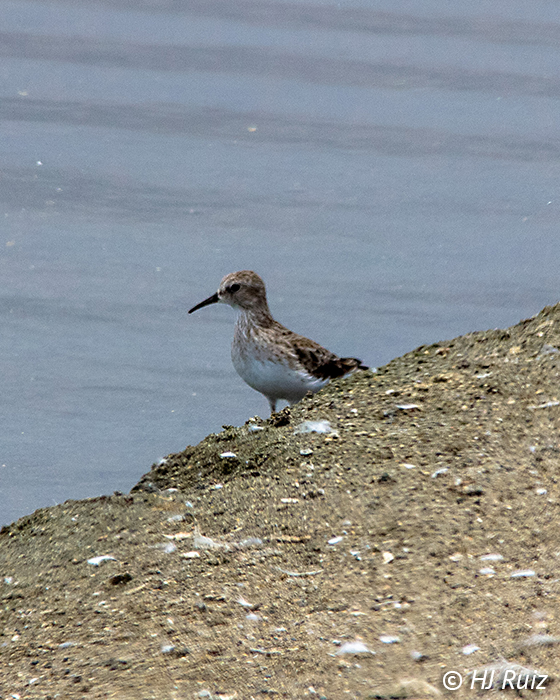
Least Sandpiper
This bird can be difficult to distinguish from other similar tiny shorebirds; these are known collectively as “peeps” or “stints”. In particular, Least Sandpiper is very similar to its Asian counterpart, Long-toed Stint. It differs from that species in its more compact, shorter-necked appearance, shorter toes, somewhat duller colors, and stronger wingbar.
Their breeding habitat is the northern North American continent on tundra or in bogs. They nest on the ground near water. The female lays 4 eggs in a shallow scrape lined with grass and moss. Both parents incubate; the female leaves before the young birds fledge and sometimes before the eggs hatch. The young birds feed themselves and are able to fly within two weeks of birth.
They migrate in flocks to the southern United States and northern South America. They occur as very rare vagrants in western Europe.
These birds forage on mudflats, picking up food by sight, sometimes by probing. They mainly eat small crustaceans, insects and snails.
NOTE: The Least Sandpiper is a new addition to my Bird List as: # 187


Text © Wikipedia – All photographs © H.J. Ruiz – Avian 101
Share this:


Read Past Reviews

Book # 69

Quote from the Author
“A good chuckle is healthy, it helps you break the monotony of a serious life.” ~ H.J. Ruiz


You must be logged in to post a comment.