Carolina Chickadee
Today’s post is about the Carolina Chickadees. These handsome little birds are very busy birds, fast fliers and feisty protectors of their nests. They fly back and forth from their nests to the feeders, collect one sunflower at the time, isn’t that a lot of work if you think of it?
These birds are very independent, do not band in groups or flocks. Once they find their mating partner they dedicate entirely to procreation and family. I’m very fond of these birds.
Here are some photos of the Carolina Chickadees!


Text and photographs © H.J. Ruiz – Avian 101
Share this:

For the Birds
For the Birds # 33


© H.J. Ruiz – Avian 101
Share this:

Law and Order
Sometimes I read or hear stories of how aggressive the Northern Mockingbirds are. Contrary to those comments I believe that I’d like to have these birds in my backyard at all times. Why? Because they are very beneficial to the local (my backyard) bird community.
I’ve had mockingbirds in my backyard since I moved to my new house. I’ve been observing their behavior for some time and I’ve noticed how much they do in order to protect what they consider “their territory”.
The community of local birds, consisting of a variety of songbirds are under the mockingbird’s protection. The transient birds or the outsiders that irrupt the area will definitely be confronted by the mockingbirds on guard.
They can also put order at the feeders area. Like with Mourning Doves that take possession of the feeder and do not allow smaller birds to eat. That goes for the Brown-headed Cowbirds too! And so on, there are other species on that list of misbehaving birds
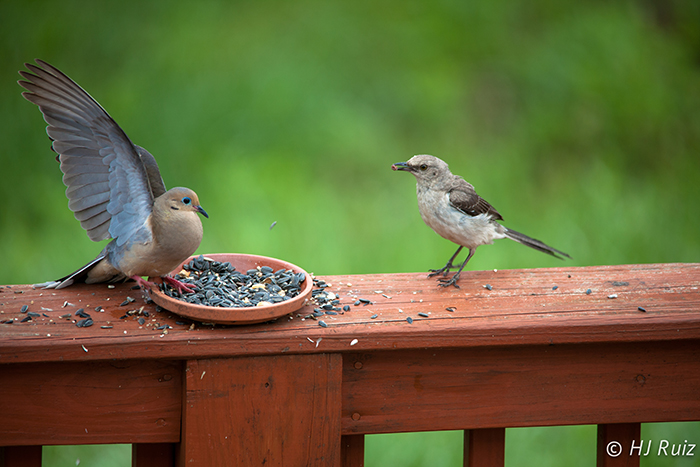
Confronting Mourning Dove for not allowing small birds to eat.
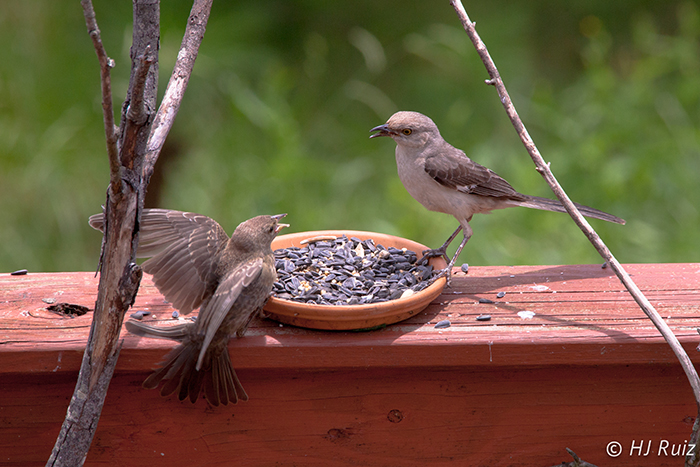
Female Brown-headed Cowbird offered aggressive behavior
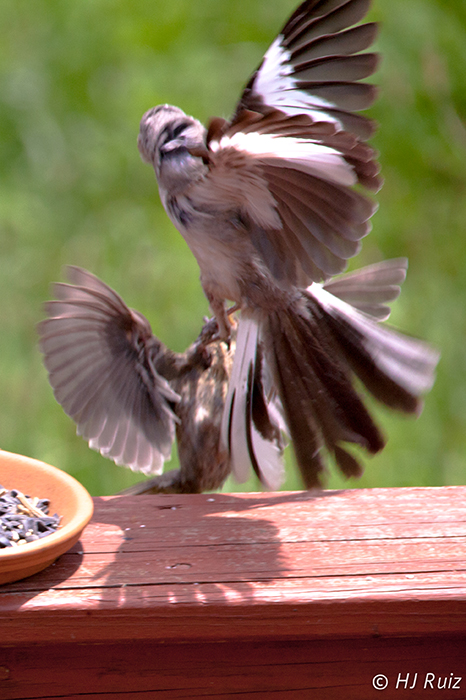
Result of confrontation was immediate fight.


Text and photographs © H.J. Ruiz – Avian 101
Share this:

Song Sparrows
There’s a bird that reminds me of a mouse because his feeding behavior, it’s the Song Sparrow.
The Song Sparrows feed mostly on the ground and act just like mice, move around objects and go from one place to another searching for any fallen seeds that he could eat.
At times they also go to the feeders but not very often. I usually see them getting into bushes or under shrubs where he can be practically invisible. His plumage blends very well on the ground. They do not migrate during winter and nest deep within thickets.
Here I bring you some current photos of the Song Sparrows.


Text and photographs © H.J. Ruiz – Avian 101
Share this:


Read Past Reviews

Book # 69

Quote from the Author
“A good chuckle is healthy, it helps you break the monotony of a serious life.” ~ H.J. Ruiz


You must be logged in to post a comment.