Writing About… Moi
I’ve been writing my ideas, opinions, acquired information and mainly posting my photography work via bird pictures for over three years, and I sometimes amaze myself that could have accomplished that commitment. I can only guess that must be because my deep sense of responsibility about things that are important. I’ve been like that all my life, as soon as a challenge comes in front of me it would be enough to boost my drive to try new venues.
The urge to face new challenges and the never ending thirst for knowledge have helped me model my life. I’d never had a dull moment in my life, I do not wait for fate to lead my life, I found myself the paths that have lead me to what now constitutes as my life, I feel satisfied with my choices.
I love the versatility of the blogs, you can at any time infuse some of your personal stuff to your post and is allowed. The potential is limitless, I like that! 🙂


Text and photographs © Hj Ruiz – Avian101
Share this:

Rainy
At this time it is raining as it’s been for the past three days and nights!. It brings to my mind an old song sung by Brook Benton. I love this song, it has a lot of sentiment. It makes me think that the lyrics are perhaps a metaphor for difficult moments in life when facing a delicate situation and the person feels isolated by the problem. Problems happen to everybody, everywhere! As hard may be to find a way to solve them… there’s always a way!
Rainy Night in Georgia
Over and by my suitcase
Trying to find a warm place
To spend the night
Heavy rains are falling
Seems I hear your voice calling
Alright
A rainy night in Georgia
A rainy night in Georgia
I believe that it’s raining all over the world
I feel that it’s raining all over the world….
Listen! …
Text © HJ Ruiz – Video courtesy of UTube
Share this:

Bird Migrations
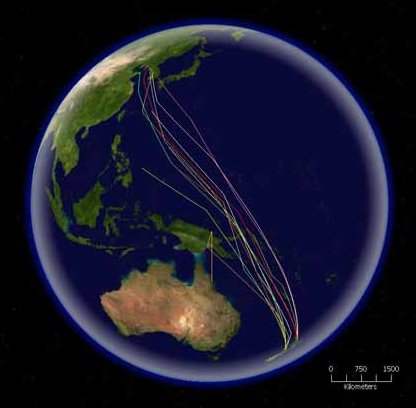
The routes of satellite-tagged Bar-tailed Godwits migrating north from New Zealand. This species has the longest known non-stop migration of any species, up to 10,200 km (6,300 mi).
Many bird species migrate to take advantage of global differences of seasonal temperatures, therefore optimizing availability of food sources and breeding habitat. These migrations vary among the different groups. Many landbirds, shorebirds, and waterbirds undertake annual long distance migrations, usually triggered by the length of daylight as well as weather conditions. These birds are characterized by a breeding season spent in the temperate or arctic/antarctic regions and a non-breeding season in the tropical regions or opposite hemisphere. Before migration, birds substantially increase body fats and reserves and reduce the size of some of their organs. Migration is highly demanding energetically, particularly as birds need to cross deserts and oceans without refueling. Landbirds have a flight range of around 2,500 km (1,600 mi) and shorebirds can fly up to 4,000 km (2,500 mi), although the Bar-tailed Godwit is capable of non-stop flights of up to 10,200 km (6,300 mi). Seabirds also undertake long migrations, the longest annual migration being those of Sooty Shearwaters, which nest in New Zealand and Chile and spend the northern summer feeding in the North Pacific off Japan, Alaska and California, an annual round trip of 64,000 km (39,800 mi). Other seabirds disperse after breeding, travelling widely but having no set migration route. Albatrosses nesting in the Southern Ocean often undertake circumpolar trips between breeding seasons.
Some bird species undertake shorter migrations, traveling only as far as is required to avoid bad weather or obtain food. Irruptive species such as the boreal finches are one such group and can commonly be found at a location in one year and absent the next. This type of migration is normally associated with food availability. Species may also travel shorter distances over part of their range, with individuals from higher latitudes traveling into the existing range of conspecifics; others undertake partial migrations, where only a fraction of the population, usually females and subdominant males, migrates. Partial migration can form a large percentage of the migration behaviour of birds in some regions; in Australia, surveys found that 44% of non-passerine birds and 32% of passerines were partially migratory.] Altitudinal migration is a form of short distance migration in which birds spend the breeding season at higher altitudes elevations and move to lower ones during suboptimal conditions. It is most often triggered by temperature changes and usually occurs when the normal territories also become inhospitable due to lack of food. Some species may also be nomadic, holding no fixed territory and moving according to weather and food availability. Parrots as a family are overwhelmingly neither migratory nor sedentary but considered to either be dispersive, irruptive, nomadic or undertake small and irregular migrations.
The ability of birds to return to precise locations across vast distances has been known for some time; in an experiment conducted in the 1950s a Manx Shearwater released in Boston returned to its colony in Skomer, Wales, within 13 days, a distance of 5,150 km (3,200 mi). Birds navigate during migration using a variety of methods. For diurnal migrants, the sun is used to navigate by day, and a stellar compass is used at night. Birds that use the sun compensate for the changing position of the sun during the day by the use of an internal clock. Orientation with the stellar compass depends on the position of the constellations surrounding Polaris. These are backed up in some species by their ability to sense the Earth’s geomagnetism through specialized photoreceptors.
Text and above photo © Wikipedia


Photographs © HJ Ruiz – Avian101
Share this:

Panoramic View of Birds
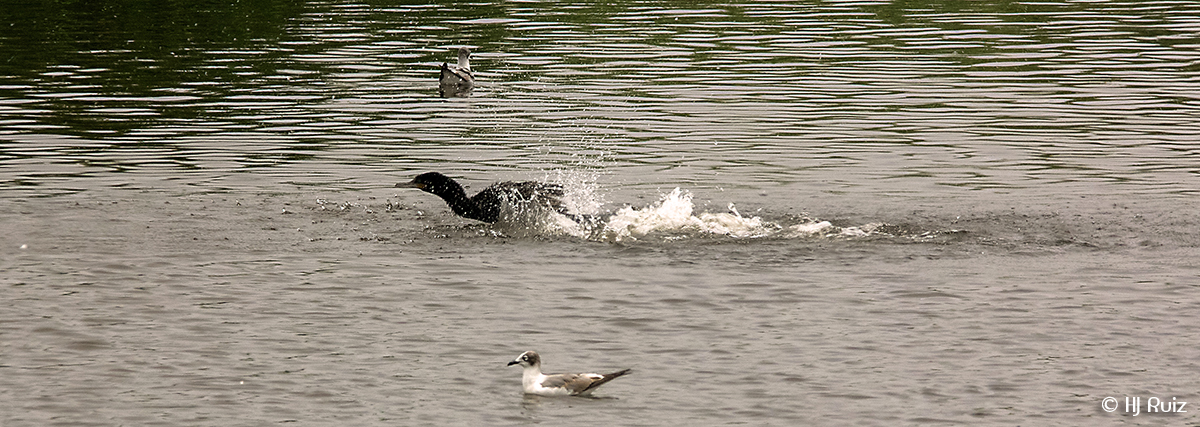
— Neotropic Cormorant — Click on image to see enlargement —
© Hj Ruiz – Avian101
Share this:


Read Past Reviews

Book # 69

Quote from the Author
“A good chuckle is healthy, it helps you break the monotony of a serious life.” ~ H.J. Ruiz


You must be logged in to post a comment.