Memory Lane
MAY 2009
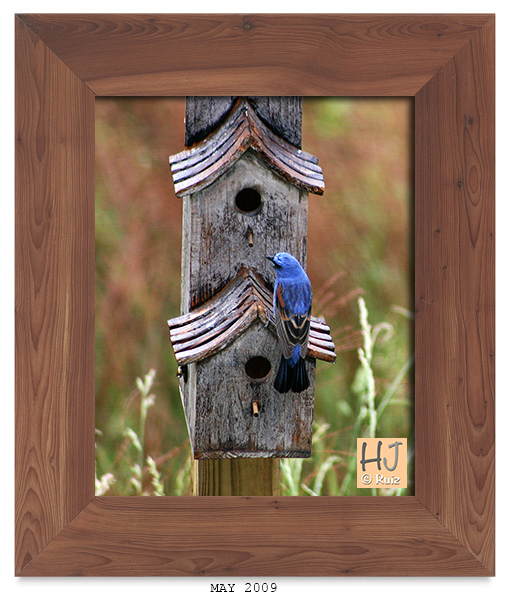
BLUE GROSBEAK (Male) — May 2009
© HJ Ruiz – Avian101
Share this:

Strong Leadership Works
Lately I’ve noticed that in the course of the days, most bird juveniles are beginning to organize in groups, I can only imagine that the position of leader has to be filled in order to encounter the world and adulthood. I was observing and shooting pictures of a group of Brown-headed Cowbird juveniles, males and females, most of the males were showing patches of the adult plumage (Black body, brown head).
This group was feeding but at the same time were kind of unruly… there were some quarrels among them. That’s when I saw the strong young male challenge the rowdy females that were not complying to eating peacefully. Without going to extremes and fight, the male stood up and stared with hard determination to the challenger like saying “ Cut it out now or else, you hear!” After a crucial face to face, the female conceded defeat. The male was accepted as leader and the group bowed. Soon after the new leader decided to fly off all the rest followed him expediently.


Text and photographs © HJ Ruiz – Avian101
Share this:

About Bird Molting
In birds, molting is the periodic replacement of feathers by shedding old feathers while producing new ones. Feathers are dead structures at maturity which are gradually abraded and need to be replaced. Adult birds molt at least once a year, although many molt twice and a few three times each year. It is generally a slow process as birds rarely shed all their feathers at any one time; the bird must retain sufficient feathers to regulate its body temperature and repel moisture. The number and area of feathers that are shed varies. In some molting periods, a bird may renew only the feathers on the head and body, shedding the wing and tail feathers during a later molting period. Some species of bird become flightless during an annual “wing molt” and must seek a protected habitat with a reliable food supply during that time. While the plumage may appear thin or uneven during the molt, the bird’s general shape is maintained despite the loss of apparently many feathers; bald spots are typically signs of unrelated illnesses, such as gross injuries, parasites, feather pecking (especially in commercial poultry), or (in pet birds) feather plucking.
The process of molting in birds is as follows: First, the bird begins to shed some old feathers, then pin feathers grow in to replace the old feathers. As the pin feathers become full feathers, other feathers are shed. This is a cyclical process that occurs in many phases. It is usually symmetrical, with feather loss equal on each side of the body. Because feathers make up 4–12% of a bird’s body weight, it takes a large amount of energy to replace them. For this reason, molts often occur immediately after the breeding season, but while food is still abundant.
Some of the birds in my backyard are undergoing molting as you’ll be able to see at the photo gallery next. Enjoy!


Text excerpts © Wikipedia – Photographs © HJ Ruiz – Avian101
Share this:

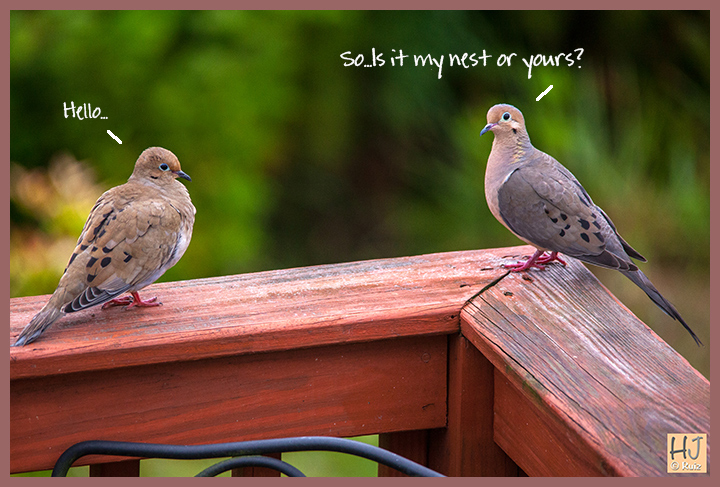
Bird Humor #32
Mourning Doves are very proliferous birds as well as numerous, they have a voracious appetite and apparently a strong libido. When not eating they are mating! Here’s a picture that shows how easy they get to the point.
Quick Dove Moves!
© HJ Ruiz – Avian101
Share this:


Read Past Reviews

Book # 69

Quote from the Author
“A good chuckle is healthy, it helps you break the monotony of a serious life.” ~ H.J. Ruiz


You must be logged in to post a comment.