My Local Friends – lll
Another species of birds that have been residing in my backyard right from the time I moved to that location is the Northern Mockingbird. It took me a while to understand their behavior and the more I observed them I began to appreciate his sense of belonging that also extends to protecting their ‘territory” and everything in it. I think that many readers might be interested to know more about these remarkable birds, here’s some interesting information:
The Northern Mockingbird (Mimus polyglottos) is the only mockingbird commonly found in North America. This bird is mainly a permanent resident, but northern birds may move south during harsh weather. This species has rarely been observed in Europe. This species was first described by Linnaeus in his Systema Naturæ in 1758 as Turdus polyglottos. The northern mockingbird is renowned for its mimicking ability, as reflected by the meaning of its scientific name, ‘many-tongued mimic.’ The northern mockingbird has gray to brown upper feathers and a paler belly. Its wings have white patches which are visible in flight.
The northern mockingbird is an omnivore. It eats both insects and fruits. It is often found in open areas and forest edges but forages in grassy land.
The northern mockingbird is known for its intelligence and has also been noted in North American culture. A 2009 study showed that the bird was able to recognize individual humans, particularly noting those who had previously been intruders or threats. Also birds recognize their breeding spots and return to areas in which they had greatest success in previous years. Urban birds are more likely to demonstrate this behavior.
The northern mockingbird is a medium-sized mimid that has long legs and tail. Both males and females look alike. Its upper parts are colored gray, while its underparts have a white or whitish-gray color.It has parallel wing bars on the half of the wings connected near the white patch giving it a distinctive appearance in flight. The black central rectrices and typical white lateral rectrices are also noticeable in flight. The iris is usually a light green-yellow or a yellow, but there have been instances of an orange color.The bill is black with a brownish black appearance at the base. The juvenile appearance is marked by its streaks on its back, distinguished spots and streaks on its chest, and a gray or grayish-green iris.


Text © Wikipedia & HJ Ruiz – Photographs © HJ Ruiz – Avian101
Share this:

Last Week’s Visitors
Now that we have cold days mixed with some warm days, the number of bird species has lowered in quantity. It’s also a little more difficult to shoot pictures when the days are very dark or deficient lighting to get a decent shot. But here I have some pictures for you. From the better days.


© HJ Ruiz – Avian101
Share this:

Show and Tail
© HJ Ruiz – Avian101
Share this:

Feathers – Part # 1
The fact that we are not only fond of birds, we care for them and are looking for better ways to preserve the avian species for future generations. I believe that we should at least familiarize with knowing more about their anatomy. Today I have posted the first of two parts about Feathers – Part # 1
Feathers are one of the epidermal growths that form the distinctive outer covering, or plumage, on birds and some non-avian theropod dinosaurs. They are considered the most complex integumentary structures found in vertebrates, and indeed a premier example of a complex evolutionary novelty. They are among the characteristics that distinguish the extant Aves from other living groups. Feathers have also been noticed in those Theropoda which have been termed feathered dinosaurs.
Although feathers cover most parts of the body of birds, they arise only from certain well-defined tracts on the skin. They aid in flight, thermal insulation, waterproofing, and coloration that helps in communication and protection.
Structures and characteristics
Feathers are among the most complex integumentary appendages found in vertebrates and are formed in tiny follicles in the epidermis, or outer skin layer, that produce keratin proteins. The β-keratins in feathers, beaks and claws — and the claws, scales and shells of reptiles — are composed of protein strands hydrogen-bonded into β-pleated sheets, which are then further twisted and cross linked by disulfide bridges into structures even tougher than the α-keratins of mammalian hair, horns and hoof. The exact signals that induce the growth of feathers on the skin are not known, but it has been found that the transcription factor cDermo-1 induces the growth of feathers on skin and scales on the leg.
Classification
There are two basic types of feather: vaned feathers which cover the exterior of the body, and down feathers which are underneath the vaned feathers. The pennaceous feathers are vaned feathers. Also called contour feathers, pennaceous feathers arise from tracts and cover the entire body. A third rarer type of feather, the filoplume, is hairlike and (if present in a bird) grows along the fluffy down feathers. In some passerines, filoplumes arise exposed beyond the contour feathers on the neck. The remiges, or flight feathers of the wing, and rectrices, the flight feathers of the tail are the most important feathers for flight. A typical vaned feather features a main shaft, called the rachis. Fused to the rachis are a series of branches, or barbs; the barbs themselves are also branched and form the barbules. These barbules have minute hooks called barbicels for cross-attachment. Down feathers are fluffy because they lack barbicels, so the barbules float free of each other, allowing the down to trap air and provide excellent thermal insulation. At the base of the feather, the rachis expands to form the hollow tubular calamus (or quill) which inserts into a follicle in the skin. The basal part of the calamus is without vanes. This part is embedded within the skin follicle and has an opening at the base (proximal umbilicus) and a small opening on the side (distal umbilicus).
Hatchling birds of some species have a special kind of natal down feathers (neossoptiles) which are pushed out when the normal feathers (teleoptiles) emerge.
Flight feathers are stiffened so as to work against the air in the downstroke but yield in other directions. It has been observed that the orientation pattern of β-keratin fibers in the feathers of flying birds differs from that in flightless birds: the fibers are better aligned in the middle of the feather and less aligned towards the tips.
Here concludes Feather – Part # 1
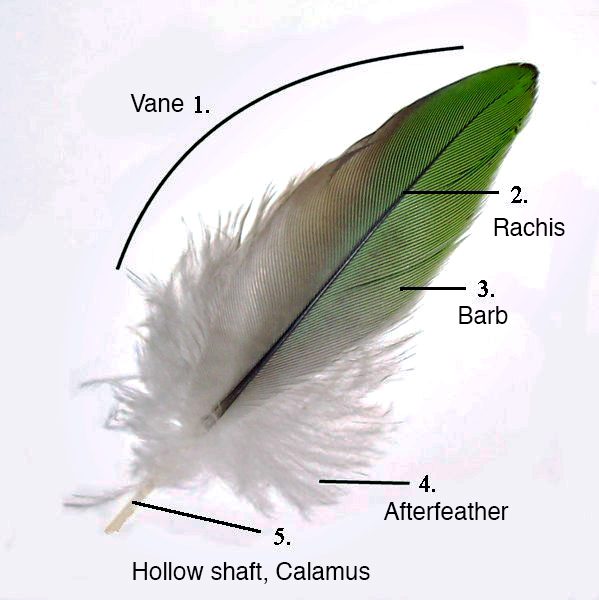
Parts of a feather
Excerpts and image © Wikipedia and HJ Ruiz – Avian101
Share this:


Read Past Reviews

Book # 69

Quote from the Author
“A good chuckle is healthy, it helps you break the monotony of a serious life.” ~ H.J. Ruiz


You must be logged in to post a comment.