The Great Impostor
Several Northern Mockingbirds have nested for for several years in my backyard and shrubs in my front lawn. They are the current authorities of the avian neighborhood. Many times I’ve written about them and their law enforcement qualities. However, I have one more short story to tell you, it just happened two or three days ago.
It all began with a female House Sparrow visiting my feeders, the first time this year. I had fun shooting some pictures of her while she was on the deck and surrounding shrubs, her constant chirping is easy recognizable. After a while I saw her take off and leave the area. My hope was to see her again and shoot some more pictures.
A few hours later I hear the chirping again and I got ready for her return…the chirping got closer and there I see a Northern Mockingbird sitting on a branch chirping like the bird that left previously. He fooled me!
He’s a great impostor, a good one!… I had a good laugh!
Photo Gallery


Text and photographs © HJ Ruiz – Avian101
Share this:

House Sparrow
My backyard was visited again by a female House Sparrow. I believe it’s been about a year since the last time I saw one here. Being birds that you can find in almost every Country i the world. I’ve personally seen these birds almost everywhere! Let find some more information about the House Sparrows (Passer domesticus).
The plumage of the house sparrow is mostly different shades of gray and brown. The sexes exhibit strong dimorphism: the female is mostly buff above and below, while the male has boldly coloured head markings, a reddish back, and grey underparts. The male has a dark grey crown from the top of its bill to its back, and chestnut brown flanking its crown on the sides of its head. It has black around its bill, on its throat, and on the spaces between its bill and eyes (lores). It has a small white stripe between the lores and crown and small white spots immediately behind the eyes (postoculars), with black patches below and above them. The underparts are pale grey or white, as are the cheeks, ear coverts, and stripes at the base of the head. The upper back and mantle are a warm brown, with broad black streaks, while the lower back, rump and upper-tail coverts are grayish-brown.
The male is duller in fresh non-breeding plumage, with whitish tips on many feathers. Wear and preening expose many of the bright brown and black markings, including most of the black throat and chest patch, called the “bib” or “badge”. The badge is variable in width and general size, and some scientists have suggested that patches signal social status or fitness. The female has no black markings or gray crown. Its upper-parts and head are brown with darker streaks around the mantle and a distinct pale supercilium. Its underparts are pale gray-brown. The female’s bill is brownish-gray and becomes darker in breeding plumage approaching the black of the male’s bill.
Juveniles are similar to the adult female but deeper brown below and paler above, with paler and less defined supercilia. Juveniles have broader buff feather edges, and tend to have looser, scruffier plumage, like molting adults. Juvenile males tend to have darker throats and white postoculars like adult males, while juvenile female tend to have white throats. However, juveniles cannot be reliably sexed by plumage: some juvenile males lack any markings of the adult male, and some juvenile females have male features. The bills of young birds are light yellow to straw, paler than the female’s bill. Immature males have paler versions of the adult male’s markings, which can be very indistinct in fresh plumage. By their first breeding season, young birds generally are indistinguishable from other adults, though they may still be paler during their first year.
Photo Gallery


Text and photographs © HJ Ruiz – Avian101
Share this:

Not Shy, Just Blue
As I suspected, I see Blue Jays almost daily because they got acquainted with my backyard and are indeed feeling very comfortable with my feeding set up. Just as the rest of frequent visitors. The following is what birds find in my backyard:
- Nice variety of trees, any of them suitable for building nests.
- Bushes, thickets and shrubs to provide safe areas and cover.
- Stream that carries fresh rain water all year.
- Creek with perfect soil to find worms, invertebrates, insects etc.
- Bird feeders sponsored by yours truly, “free all you can eat”!
What’s not to like? The place is perfect for any species of birds…Don’t you think?
I’m glad that birds like my set up and want to make it their home.
Photo Gallery


Text and photographs © HJ Ruiz – Avian101
Share this:

Look Outside my Window!
Now that you are looking outside my window, see on the left side of near the deck there’s a nectar feeding bottle and… Hey! I can see a Ruby-throated Hummingbird drinking nectar… it’s a female. Notice the white throat with absence of red feathers, also note the length of the tail feathers, these are indications of being a female. If you’d have the opportunity to see a female next to a male you would clearly see that the female is larger than the male. Aren’t they lovely birds?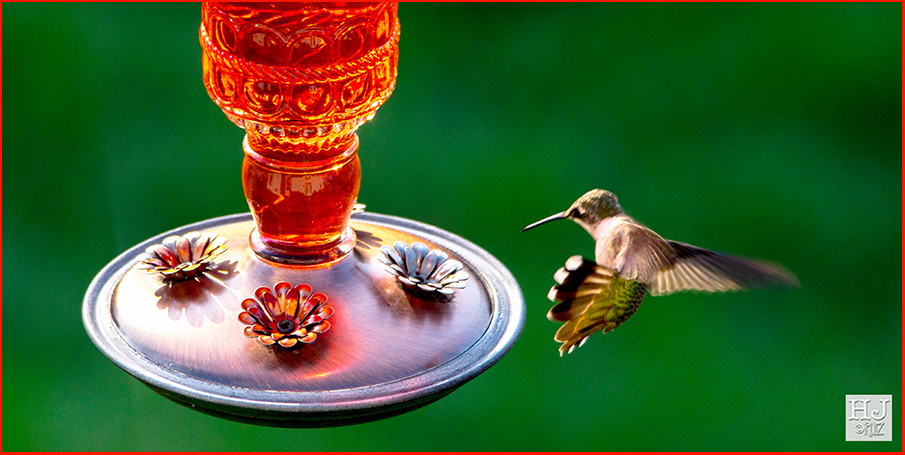
My little friends of the gray suit aka Carolina Chickadee are always there to cheer me up. Even the gloomiest day they act in a cheerfully energetic way which is good to make you feel in good spirits! I’m always pleased by their being so cool, under any circumstances. They are some of the local species that nest and roost in my backyard.
My backyard is going through a proliferation of Brown-headed Cowbirds and Mourning Doves lately, I theorize those birds have an advantage over other species since I observed they can tolerate high weather temperatures and stay out in the open air for longer periods of time, while other birds are limited to a few minutes at a time. Cowbirds and Doves whether male or female are voracious eaters as well as easy to get into fights with their own companions for rights to “own the feeder for themselves”…You get the picture!
Bonus: This time I’ll introduce you to Mr. Chipmunk aka. “Cheeks” He is all over the place acting like a vacuum cleaner! Picks up every seed he sees out on the floor or ground.
Text and photographs © HJ Ruiz – Avian101
Share this:

Read Past Reviews

Book # 69
Quote from the Author
“A good chuckle is healthy, it helps you break the monotony of a serious life.” ~ H.J. Ruiz


You must be logged in to post a comment.