Memory Lane

Yesterday, September 11th was the 6th Anniversary of my blog Avian101 on WordPress.com
My special thanks to all of you my dear friends! — H.J.
Share this:

Gallery of Friends
Our weather has been very unpredictable because even when you have the forecast available not always happen as they said. For example, if they predicted showers at noon, then it would turn out to be a heavy rain storm or the other way around. Or to expect a rainy day then you get only a gray dark day but not rain at all. Many times when I’m working on the lawn or shooting pictures, it suddenly turns dark because a large cloud loaded with water passes on top of us and we get a torrential rain and in a short time we return to the hot and super humid weather.
My birds come and go when they can, many times I’m forced to clear all the soggy seeds from the feeders and refill them with dry fresh ones. I’m getting less opportunities to shoot my camera, between the bad weather and my other obligations.
Photo Gallery


Share this:

Close Friends
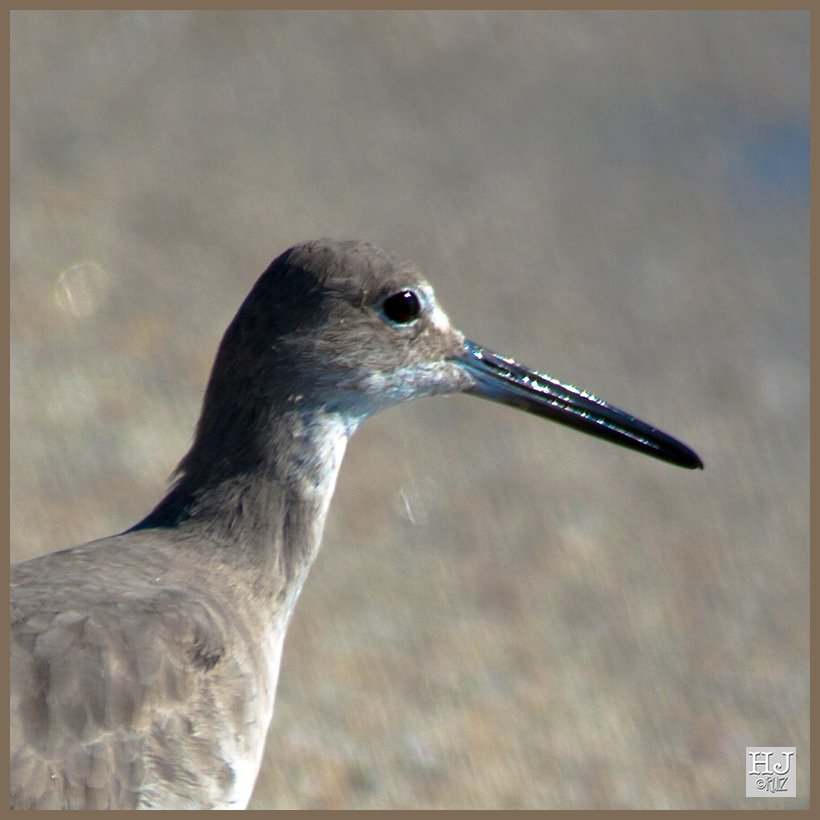
Willet —
© HJ Ruiz – Avian101
Share this:

Blue-gray Gnatcatcher
It was really delightful to see a new bird in my backyard. I was at first confused because it moved fast and it also looked very similar to the Tufted Titmouse. Then it moved to a closer location and that’s when I realized it was a new lifer for my list! I kept this bird in my viewfinder at all times allowing me to get a series of shots in different angles. The bird is a Blue-gray Gnatcatcher. I have researched a bit of information for this bird:
Blue-gray Gnatcatcher – Scientific name: Polioptila caerulea is a very small songbird, 10–13 cm (3.9–5.1 in) in length and weighing only 5–7 g (0.18–0.25 oz). Adult males are blue-gray on the upperparts with white underparts, have a slender dark bill, and a long black tail edged in white. Females are less blue. Both sexes have a white eye ring.
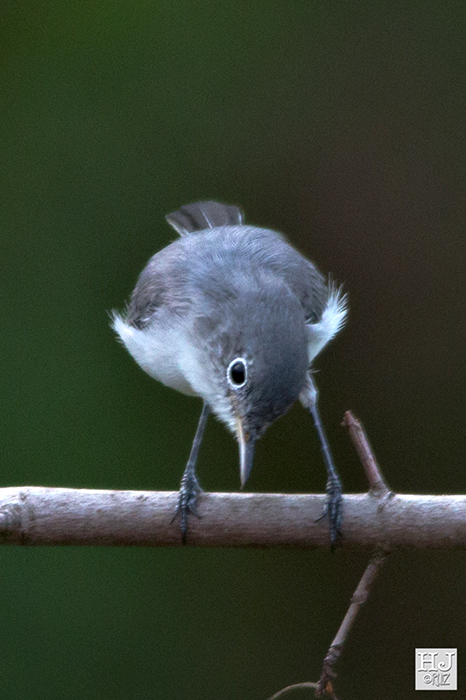
Blue-gray Gnatcatcher
The blue-gray gnatcatcher’s breeding habitat includes open deciduous woods and shrublands in southern Ontario, the eastern and southwestern United States, and Mexico. Though gnatcatcher species are common and increasing in number while expanding to the northeast, it is the only one to breed in Eastern North America. They build a cone-like nest on a horizontal tree branch. The incubation period is 13 days for both sexes. Both parents construct the nest and feed the young; they may raise two broods in a season. These birds migrate to the southern United States, Mexico, northern Central America-(Belize, Guatemala, and Honduras), Cuba, Bahamas, Turks and Caicos Islands, and the Cayman Islands.
They forage actively in trees or shrubs, mainly eating insects, insect eggs and spiders. They may hover over foliage (gleaning), or fly to catch insects in flight (hawking).
The tail is often held upright while defending territory or searching for food.
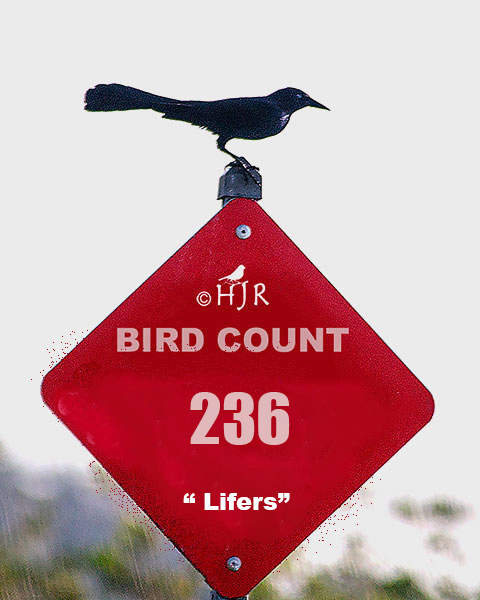
The Blue-gray Gnatcatcher is inscribed on Avian101 List as # 205


Text and photographs © HJ Ruiz – Avian101 – Wikipedia
Share this:

Read Past Reviews

Book # 69
Quote from the Author
“A good chuckle is healthy, it helps you break the monotony of a serious life.” ~ H.J. Ruiz


You must be logged in to post a comment.