What’s Up?
We Are Back!…
We returned home from our Spring vacation…still thinking that we needed even more days to unwind. Our vacations in general, leave us more tired than relaxed! We utilize our vacations to do the most we can, getting up early in the morning and going to bed late at night.
Anyway, we enjoyed every minute of our trip. Tyler had a ball and kept busy at all times. He loved his camera and put it to good use to! His camera is a Sony Cyber -shot DSC-W800 20,1 MP. He shot approximately 45 photos, Some of which I consider very good. See samples:


We visited many places, went to the beach, enjoyed the pools, hikes, restaurants, strolls at night on the beach…I must mention my photo shootings too! The weather was perfect to top it all!.. ( Meanwhile, in our home’s area in Georgia was under severe storms that bordered into extreme!)
Photo Gallery


© HJ Ruiz – Avian101
Share this:

Purple Martin – # 209
Scientific classification
-
Kingdom: Animalia
-
Phylum: Chordata
-
Class: Aves
-
Order: Passeriformes
-
Family: Hirundinidae
-
Genus: Progne
-
Species: P. subis
Binomial name
Progne subis
(Linnaeus, 1758)
Purple Martins are a kind of swallow, of the genus Progne. Like other members of this genus, they are larger than most of the other swallows. The average length from bill to tail is 20 cm (7.9 in). Adults have a slightly forked tail. Adult males are entirely black with glossy steel blue sheen, the only swallow in North America with such coloration. Adult females are dark on top with some steel blue sheen, and lighter underparts. 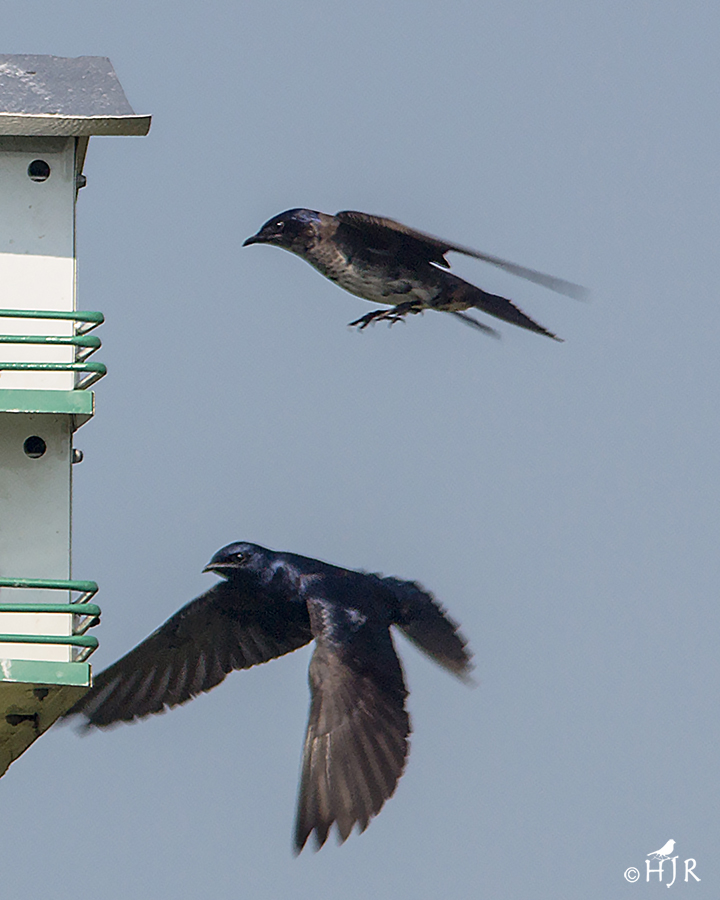 Subadult females look similar to adult females minus the steel blue sheen and browner on the back. Subadult males look very much like females, but solid black feathers emerge on their chest in a blotchy, random pattern as they molt to their adult plumage.
Purple martins are aerial insectivores, meaning that they catch insects from the air. The birds are agile hunters and eat a variety of winged insects. Rarely, they will come to the ground to eat insects. They usually fly relatively high, so, contrary to popular opinion, mosquitoes do not form a large part of their diet. Recent research, however, does indicate that the Purple Martin feeds on invasive fire ants (Solenopsis invicta) and that they may make up a significant portion of their diet.
The Purple Martin is added to my list as # 209
Photo Gallery


© HJ Ruiz – Avian101
Share this:

Panoramic View of Birds
Purple Martin
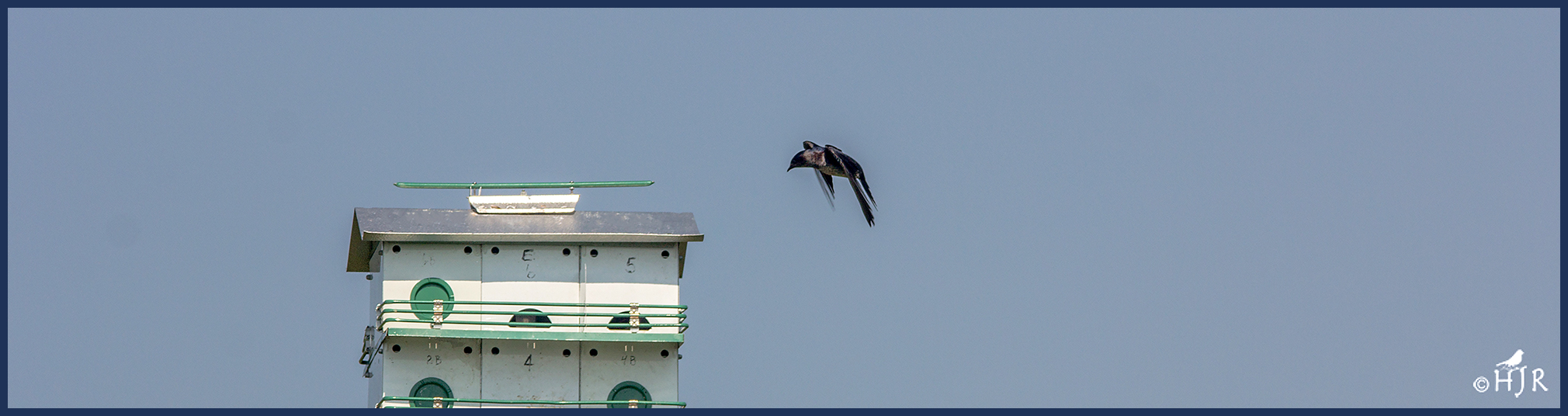
Click image for enlargement
© HJ Ruiz – Avian101
Share this:

Saturday Reds
RED AREA
NORTHERN CARDINAL PHOTOS


© HJ Ruiz – Avian101
Share this:

Read Past Reviews

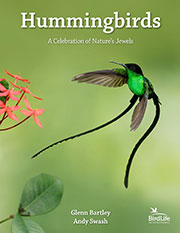
Book # 69
Quote from the Author
“A good chuckle is healthy, it helps you break the monotony of a serious life.” ~ H.J. Ruiz


You must be logged in to post a comment.