
V.I.B. Gallery
V.I.B. (VERY IMPORTANT BIRDS) GALLERY
Reddish Egret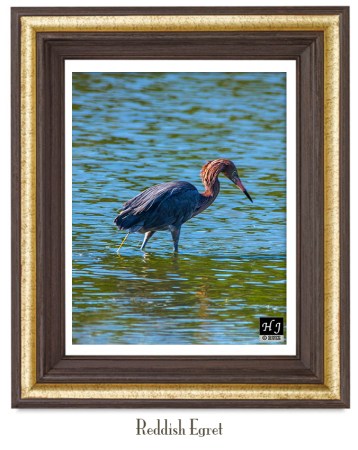
© HJ Ruiz – Avian101
Share this:

What’s Up?
Busy Days!
I had my house painted by a painting company only the outside. I’ve stained my deck myself, I planted a Fig tree (Ficus Carica), I applied mulch to my trees, I trimmed some tree branches and shrubs. I feel my lower back like being broken after all the things I’ve done…and that’s only the beginning of my To Do list!
I have a photo story line,I hope you’d like. Here it is:
“Dad Finch goes out for lunch with his evil twins”


© HJ Ruiz – Avian101
Share this:

Book Review # 37
Raptors of Mexico and Central America
Authors: William S. Clark and John Schmitt
Publisher: Princeton University Press
Review
“I don’t know about you… but field guides with raptors as they main subject…are exciting and quite interesting!. This field guide is one that gives you all you need to know about raptors for those locations ~ plain and simple ~
The authors are experienced and well known experts on raptors. The guide in mention has 304 pages 32 color plates and 213 color photographs covering 69 species of raptors from Mexico and countries from Central America.
Each one of the species are described with concise information such as area where they live or occur, type of habitat, behavior, status and distribution. Description, Etymology, and references. Then the colorful photos make a complete reality for a successful identification. The birder or photographer will not have to wait until the trip is over to know about the raptor in question! It’s much more exciting to be on the field and encounter a raptor and to ‘know” which one it is with certainty right there!…just like a Pro!”
Reviewed by: H.J. Ruiz -avian101.wordpress.com – April 24th, 2017
Share this:

Blue-winged Teal – # 211
The Blue-winged Teal (Anas discors) is a small dabbling duck from North America.
The blue-winged teal is 40 cm (16 in) long, with a wingspan of 58 cm (23 in), and a weight of 370 g (13 oz). The adult male has a greyish blue head with a white facial crescent, a light brown body with a white patch near the rear and a black tail. The adult female is mottled brown, and has a whitish area at base of bill.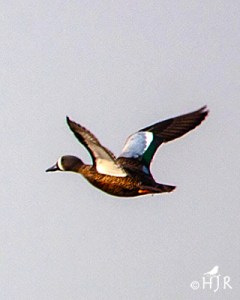 Both sexes have sky-blue wing coverts, a green speculum, and yellow legs. They have two molts per year and a third molt in their first year.The call of the male is a short whistle; the female’s call is a soft quack.
Blue-winged teal inhabit shoreline more often than open water and prefer calm water or sluggish currents to fast water. They inhabit inland marshes, lakes, ponds, pools, and shallow streams with dense emergent vegetation. In coastal areas, breeding occurs in salt-marsh meadows with adjoining ponds or creeks. Blue-winged teal use rocks protruding above water, muskrat houses, trunks or limbs of fallen trees, bare stretches of shoreline, or mud flats for resting sites.
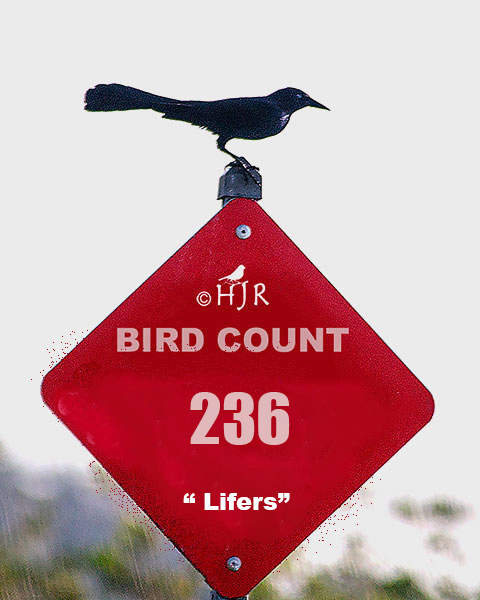
The Blue-winged Teal is # 211 on my “Lifer” List.
| Scientific classification | |
|---|---|
| Kingdom: | Animalia |
| Phylum: | Chordata |
| Class: | Aves |
| Order: | Anseriformes |
| Family: | Anatidae |
| Subfamily: | Anatinae |
| Genus: | Anas (disputed) |
| Species: | A. discors |
| Binomial name | |
| Anas discors (Linnaeus, 1766) |
|
Photo Gallery
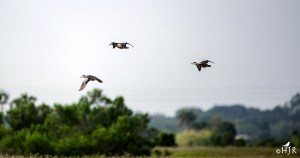
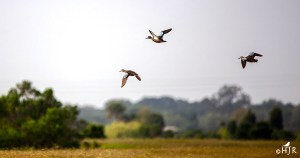
© HJ Ruiz – Avian101
Share this:

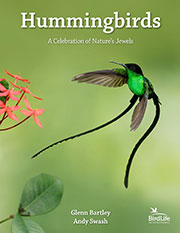
Read Past Reviews

Book # 69
Quote from the Author
“A good chuckle is healthy, it helps you break the monotony of a serious life.” ~ H.J. Ruiz


You must be logged in to post a comment.