What’s Up?…
…Say hello to my little friends!
Without a doubt I can say the most impressive bird of the season are the Ruby-throated Hummingbirds! Why? For many reasons:
They are beautiful, playful, they stuck around in my backyard despite the hurricane Irma. In fact I had 5 of them at one time. They finish 1 bottle of nectar in 3 days. I have seen them almost daily and they don’t spook seeing humans.
Having them longer time this season, allowed me to have a better opportunity to observe them a bit closer in their daily life. Please see next… some things that I learned from them:
- They are very curious about other bird’s actions as well as of insects.
 Observing closely a dragonfly!
 While this Nuthatch is eating, the hummer is watching
 Nuthatch leaves, the Hummer is curious…
 Gets closer…
 I’m myself curious to know what he took from there?
 - They are aware of the photographer but they don’t mind the shooting.


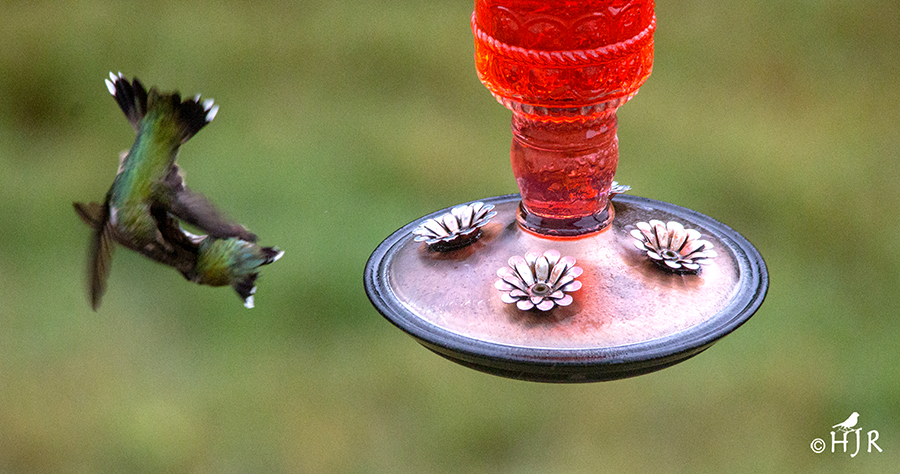
- They are playful with their equals.
They bump each other in flight, just like playing “tag”!
© HJ Ruiz – Avian101
Share this:

My Visitor: American Goldfinch
American Goldfinch
The American Goldfinch (Spinus tristis) is a small North American bird in the finch family. It is migratory, ranging from mid-Alberta to North Carolina during the breeding season, and from just south of the Canada–United States border to Mexico during the winter.
The only finch in its subfamily to undergo a complete molt, the American goldfinch displays sexual dimorphism in its coloration; the male is a vibrant yellow in the summer and an olive color during the winter, while the female is a dull yellow-brown shade which brightens only slightly during the summer. The male displays brightly colored plumage during the breeding season to attract a mate.
The American goldfinch is a granivore and adapted for the consumption of seedheads, with a conical beak to remove the seeds and agile feet to grip the stems of seedheads while feeding. It is a social bird, and will gather in large flocks while feeding and migrating. It may behave territorially during nest construction, but this aggression is short-lived. Its breeding season is tied to the peak of food supply, beginning in late July, which is relatively late in the year for a finch. This species is generally monogamous, and produces one brood each year.
Human activity has generally benefited the American goldfinch. It is often found in residential areas, attracted to bird feeders which increase its survival rate in these areas. Deforestation also creates open meadow areas which are its preferred habitat.
Photo Gallery


Share this:

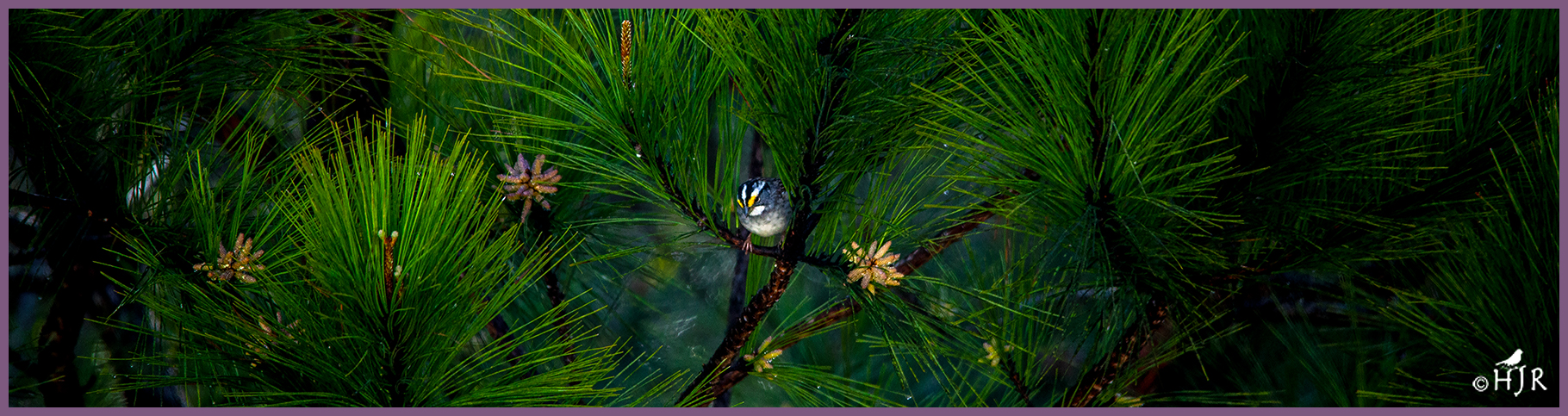
Panoramic View of Birds – White-Throated Sparrow
White– throated Sparrow
Click to enlarge
© HJ Ruiz – Avian101
Share this:

Saturday Reds – Northern Cardinal
You are entering the Red Zone
Northern Cardinal’s photos only
Saturday Red beauties


© HJ Ruiz – Avian101
Share this:

Read Past Reviews

Book # 69
Quote from the Author
“A good chuckle is healthy, it helps you break the monotony of a serious life.” ~ H.J. Ruiz
 H.J. Ruiz - Avian101
You must be logged in to post a comment.