
Photo Capture # 69 – Magnificent Frigatebirds
Magnificent Frigatebirds
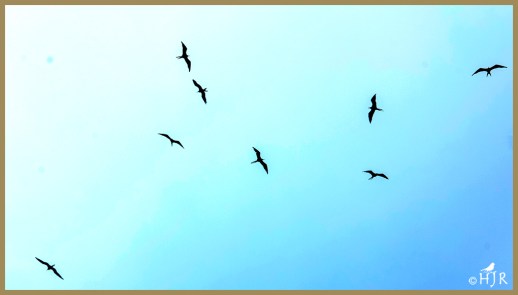
Magnificent Frigatebirds
© HJ Ruiz – Avian101
Share this:

Bird’s ID – American Robin
American Robin
The American Robin (Turdus migratorius) is a migratory songbird of the true thrush genus and Turdidae, the wider thrush family. It is named after the European robin because of its reddish-orange breast, though the two species are not closely related, with the European robin belonging to the Old World flycatcher family. The American robin is widely distributed throughout North America, wintering from southern Canada to central Mexico and along the Pacific Coast. It is the state bird of Connecticut, Michigan, and Wisconsin.
The American robin is active mostly during the day and assembles in large flocks at night. Its diet consists of invertebrates (such as beetle grubs, earthworms, and caterpillars), fruits, and berries. It is one of the earliest bird species to lay eggs, beginning to breed shortly after returning to its summer range from its winter range. Its nest consists of long coarse grass, twigs, paper, and feathers, and is smeared with mud and often cushioned with grass or other soft materials. It is one of the first birds to sing at dawn, and its song consists of several discrete units that are repeated.
The adult robin is preyed upon by hawks, cats, and snakes. When feeding in flocks, it can be vigilant, watching other birds for reactions to predators. Brown-headed cowbirds (Molothrus ater) lay eggs in robin nests (brood parasite), but the robins usually reject the eggs.
The nominate subspecies of the American robin is 23 to 28 cm (9.1 to 11.0 in) long with a wingspan ranging from 31 to 41 cm (12 to 16 in), with similar size ranges across all races. The species averages about 77 g (2.7 oz) in weight, with males ranging from 72 to 94 g (2.5 to 3.3 oz) and females ranging from 59 to 91 g (2.1 to 3.2 oz). Among standard measurements, the wing chord is 11.5 to 14.5 cm (4.5 to 5.7 in), the culmen is 1.8 to 2.2 cm (0.71 to 0.87 in) and the tarsus is 2.9 to 3.3 cm (1.1 to 1.3 in).The head varies from jet black to gray, with white eye arcs and white supercilia. The throat is white with black streaks, and the belly and undertail coverts are white. The robin has a brown back and a reddish-orange breast, varying from a rich red maroon to peachy orange. The bill is mainly yellow with a variably dark tip, the dusky area becoming more extensive in winter, and the legs and feet are brown.
The sexes are similar, but the female tends to be duller than the male, with a brown tint to the head, brown upperparts and less-bright underparts. However, some birds cannot be accurately sexed on the sole basis of plumage. The juvenile is paler in color than the adult male and has dark spots on its breast, and whitish wing coverts. First-year birds are not easily distinguishable from adults, but they tend to be duller, and a small percentage retains a few juvenile wing coverts or other feathers.
The American robin’s breeding habitat is woodland and more open farmland and urban areas. It becomes less common as a breeder in the southernmost part of the Deep South of the United States, and there prefers large shade trees on lawns. Its winter habitat is similar but includes more open areas.
The American robin has an extensive range, estimated at 16,000,000 km2 (6,200,000 sq mi), and a large population of about 320 million individuals. The species is not believed to approach the thresholds for the population decline criterion of the IUCN Red List (i.e., declining more than 30% in ten years or three generations), and is therefore evaluated as least concern. At one point, the bird was killed for its meat, but it is now protected throughout its range in the United States by the Migratory Bird Treaty Act
Photo Gallery.


© HJ Ruiz – Avian101
Share this:

Photo Capture # 68 – Black Skimmers
Black Skimmers
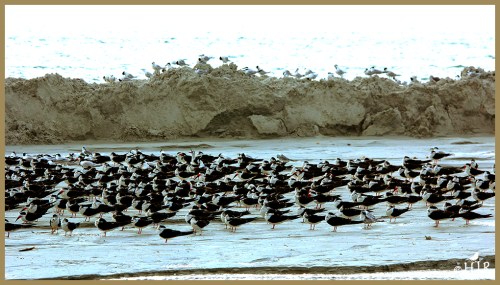
Black Skimmers
© HJ Ruiz – Avian101
Share this:

What’s Up? – WhoDunit?
WhoDunit?…
The past week has been busy for my lawn and backyard and all surrounding areas of our house. Now we are having more hours of sun and a little warmer day. The grassy lawn was treated with anti-weed chemicals and then later on Friday we had the landscaping crew mow and edge all areas. It’s looking nicer now, even when the grass is not green yet.
For the past 2 weeks, I’ve heard the clay saucers that I use as feeders, hit the deck floor, when I look through the window I see no movement of further noise. Almost every night, one or two saucers were broken to pieces. Also, the plastic container with the suet-seeds mix, was found on the floor with most of the content eaten and a real mess (suet is made with animal fat)
Then I opted to nail the container down. It worked only partially, the container remained in place but the content was almost gone and the mess got bigger. I installed small brass brackets to fasten the saucers . The saucer’s problem returned with more of them broken. I bought same size saucers made of plastic and screwed them to the deck’s handrail. This did the work!
One more thing, I was experimenting of trying peanut butter to see if the woodpeckers might want to stop by and maybe stay for a while. I already have Downy Woodpeckers but they love the suet. So, I placed a clay saucer with lots of peanut butter, I used the brass brackets to hold it fasten. Next day the saucer was gone, I found it on top of some hedges. Totally clean!
What kind of animal could be causing this problem? The following are my findings to help solve the mystery.
- – The raids are always after 10:30 pm.
- – The animal eats seeds of several kinds, suet, peanut butter.
- – It must have some kind of hands or paws, able to grip and pull objects.
- – It’s obvious that loved the peanut butter, the saucer looked as it was licked!
We do not have any raccoons where we live. We have owls in the area, but, I don’t think they are able to lick a saucer or go for seeds having many rodents or reptiles in the woods. The squirrels do not forage at late night, they get more options during the day.
What animal could be causing this problem?
Week’s Photo Gallery


Eating Lunch With…
Field Sparrow
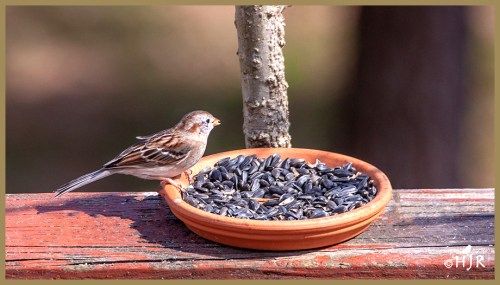
Field Sparrow
© HJ Ruiz – Avian101
Share this:

Read Past Reviews

Book # 69
Quote from the Author
“A good chuckle is healthy, it helps you break the monotony of a serious life.” ~ H.J. Ruiz


You must be logged in to post a comment.