
Bird’s ID – Ruddy Turnstone
Ruddy Turnstone
The Ruddy Turnstone (Arenaria interpres) is a small wading bird, one of two species of turnstone in the genus Arenaria. The scientific name is from Latin. The genus name arenaria derives from arenarius, “inhabiting sand, from arena, “sand”. It is now classified in the sandpiper family Scolopacidae but was formerly sometimes placed in the plover family Charadriidae. It is a highly migratory bird, breeding in northern parts of Eurasia and North America and flying south to winter on coastlines almost worldwide. It is the only species of turnstone in much of its range and is often known simply as turnstone.
It is a fairly small and stocky bird, 22–24 cm (8.7–9.4 in) long with a wingspan of 50–57 cm (20–22 in) and a weight of 85–150 g (3.0–5.3 oz). The dark, wedge-shaped bill is 2–2.5 cm (0.79–0.98 in) long and slightly upturned. The legs are fairly short at 3.5 cm (1.4 in) and are bright orange.
In all seasons, the plumage is dominated by a harlequin-like pattern of black and white. Breeding birds have reddish-brown upper parts with black markings. The head is mainly white with black streaks on the crown and a black pattern on the face. The breast is mainly black apart from a white patch on the sides. The rest of the underparts are white. In flight it reveals a white wingbar, white patch near the base of the wing and white lower back, rump and tail with dark bands on the uppertail-coverts and near the tip of the tail. The female is slightly duller than the male and has a browner head with more streaking.
In the Americas, the species winters on coastlines from Washington and Massachusetts southwards to the southern tip of South America although it is scarce in southern parts of Chile and Argentina and is only an unconfirmed vagrant in the Falkland Islands. In Europe, it winters in western regions from Iceland, Norway and Denmark southwards. Only small numbers are found on Mediterranean coasts. In Africa, it is common all the way down to South Africa with good numbers on many offshore islands. In Asia, it is widespread in the south with birds wintering as far north as southern China and Japan (mainly in the Ryukyu Islands). It occurs south to Tasmania and New Zealand and is present on many Pacific islands. Some non-breeding birds remain year round in many parts of the wintering range, with some of those birds still taking on breeding plumage in the spring and summer.
The ruddy turnstone has a varied diet including carrion, eggs and plant material but it feeds mainly on invertebrates. Insects are particularly important in the breeding season. At other times it also takes crustaceans, mollusks and worms. It often flips over stones and other objects to get at prey items hiding underneath; this behaviour is the origin of the name “turnstone”. It usually forages in flocks.
Photo Gallery


© HJ Ruiz – Avian101
Share this:

Photo Capture # 72 – Snowy Egret
Snowy Egret

Snowy Egret
© HJ Ruiz- Avian101
Share this:

Bird’s ID – Eastern Kingbird
Eastern Kingbird
The Eastern Kingbird (Tyrannus tyrannus) is a large tyrant flycatcher native to North America.
Adults are grey-black on the upperparts with light underparts; they have a long black tail with a white end and long pointed wings. They have a red patch on their crown, seldom seen. They are of average size for a kingbird, at 19–23 cm (7.5–9.1 in), 33–38 cm (13–15 in) across the wings and weighing 33–55 g (1.2–1.9 oz).
The call is a high-pitched, buzzing and unmusical chirp, frequently compared to an electric fence.
Some eastern kingbirds place their nests in the open while others hide nests very well. Eastern kingbirds in Southern British Columbia can nest in open fields; in shrubs over open water; high in tall trees and even in the tops of small stumps. Both male and female participate in nest defense, but females may stay on well-hidden nests longer than females with open nests who may leave nests earlier to chase away predators. Those pairs nesting in the open may be able to see predators coming earlier and rely on aggressive behavior to protect their young.
The aggressive behavior of eastern kingbirds has been shown to keep ravens and crows from finding experimental nests placed near kingbird nests. Similar experimental nests placed far from the kingbird nests were found far more often by crows and ravens. They can also recognize and remove cowbird eggs from their nests. Still, blue jays, American crows, squirrels, and tree-climbing snakes are on occasion nest predators. American kestrels are probable predators of adults.
Eastern kingbirds wait on an open perch and fly out to catch insects in flight, sometimes hovering to pick food off vegetation. They also eat berries and fruit, mainly in their wintering areas.
Photo Gallery


© HJ Ruiz – Avian101
Share this:

Photo Capture # 71 – Mourning Dove
Mourning Dove
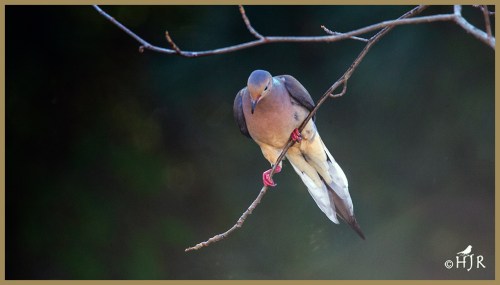
Mourning Dove
© HJ Ruiz – Avian101
Share this:


Read Past Reviews

Book # 69

Quote from the Author
“A good chuckle is healthy, it helps you break the monotony of a serious life.” ~ H.J. Ruiz


You must be logged in to post a comment.