
Bird’s ID – Roseate Spoonbill
Roseate Spoonbill
The Roseate Spoonbill (Platalea ajaja) – sometimes placed in its own genus Ajaja – is a gregarious wading bird of the ibis and spoonbill family, Threskiornithidae. It is a resident breeder in South America mostly east of the Andes, and in coastal regions of the Caribbean, Central America, Mexico, the Gulf Coast of the United States, and from central Florida’s Atlantic coast.
he roseate spoonbill is 71–86 cm (28–34 in) long, with a 120–133 cm (47–52 in) wingspan and a body mass of 1.2–1.8 kg (2.6–4.0 lb). The tarsus measures 9.7–12.4 cm (3.8–4.9 in), the culmen measures 14.5–18 cm (5.7–7.1 in) and the wing measures 32.3–37.5 cm (12.7–14.8 in) and thus the legs, bill, neck and spatulate bill all appear elongated. Adults have a bare greenish head (“golden buff” when breeding) and a white neck, back and breast (with a tuft of pink feathers in the center when breeding), and are otherwise a deep pink. The bill is grey. There is no significant sexual dimorphism.
The roseate spoonbill nests in shrubs or trees, often mangroves, laying two to five eggs, which are whitish with brown markings. Immature birds have white, feathered heads, and the pink of the plumage is paler. The bill is yellowish or pinkish.
Photo Gallery


© HJ Ruiz – Avian101
Share this:

Photo Capture # 84 – Tufted Titmouse
Tufted Titmouse
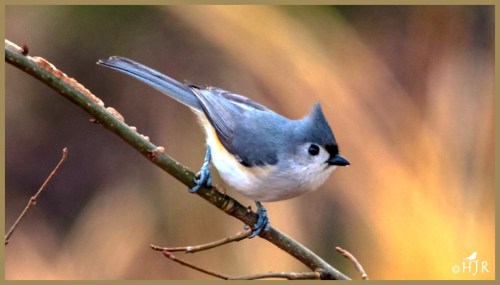
Tufted Titmouse
© HJ Ruiz – Avian101
Share this:

Bird’s ID – Osprey
Osprey
The Osprey (Pandion haliaetus) is a diurnal, fish-eating bird of prey with a cosmopolitan range. It is a large raptor, reaching more than 60 cm (24 in) in length and 180 cm (71 in) across the wings. It is brown on the upperparts and predominantly greyish on the head and underparts.
The osprey tolerates a wide variety of habitats, nesting in any location near a body of water providing an adequate food supply. It is found on all continents except Antarctica, although in South America it occurs only as a non-breeding migrant.
The osprey is 0.9–2.1 kg (2.0–4.6 lb) in weight and 50–66 cm (20–26 in) in length with a 127–180 cm (50–71 in) wingspan. It is, thus, of similar size to the largest members of the Buteo or Falco genera. The subspecies are fairly close in size, with the nominate subspecies averaging 1.53 kg (3.4 lb), P. h. carolinensis averaging 1.7 kg (3.7 lb) and P. h. cristatus averaging 1.25 kg (2.8 lb). The wing chord measures 38 to 52 cm (15 to 20 in), the tail measures 16.5 to 24 cm (6.5 to 9.4 in) and the tarsus is 5.2–6.6 cm (2.0–2.6 in)
The upper parts are a deep, glossy brown, while the breast is white and sometimes streaked with brown, and the underparts are pure white. The head is white with a dark mask across the eyes, reaching to the sides of the neck. The irises of the eyes are golden to brown, and the transparent nictitating membrane is pale blue. The bill is black, with a blue cere, and the feet are white with black talons. A short tail and long, narrow wings with four long, finger-like feathers, and a shorter fifth, give it a very distinctive appearance.
The sexes appear fairly similar, but the adult male can be distinguished from the female by its slimmer body and narrower wings. The breast band of the male is also weaker than that of the female, or is non-existent, and the underwing coverts of the male are more uniformly pale. It is straightforward to determine the sex in a breeding pair, but harder with individual birds.
One of only six land-birds with a cosmopolitan distribution. The osprey is the second most widely distributed raptor species, after the peregrine falcon. It has a worldwide distribution and is found in temperate and tropical regions of all continents except Antarctica. In North America it breeds from Alaska and Newfoundland south to the Gulf Coast and Florida, wintering further south from the southern United States through to Argentina. It is found in summer throughout Europe north into Ireland, Scandinavia, Finland and Scotland, England, and Wales though not Iceland, and winters in North Africa. In Australia it is mainly sedentary and found patchily around the coastline, though it is a non-breeding visitor to eastern Victoria and Tasmania.
Photo Gallery


© HJ Ruiz – Avian101
Share this:

Photo Capture # 83 – House Finch
House Finch (M)
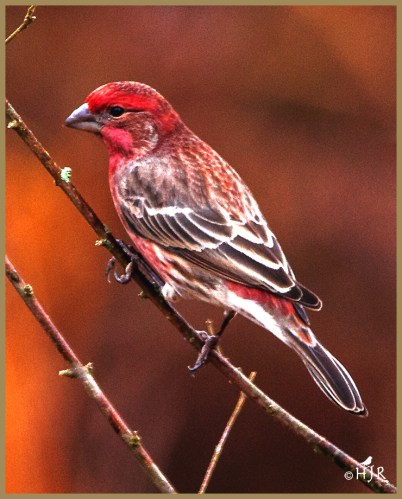
House Finch (M)
© HJ Ruiz – Avian101
Share this:

Read Past Reviews

Book # 69
Quote from the Author
“A good chuckle is healthy, it helps you break the monotony of a serious life.” ~ H.J. Ruiz


You must be logged in to post a comment.