
Red Gallery – Northern Cardinal
Quoting my friend’s comments…
“Always look forward to Saturdays, I wonder why? ~ Susan Poozan
Photo Gallery
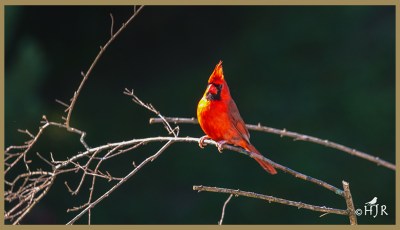
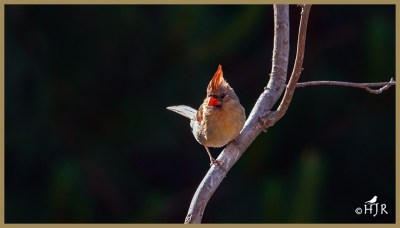
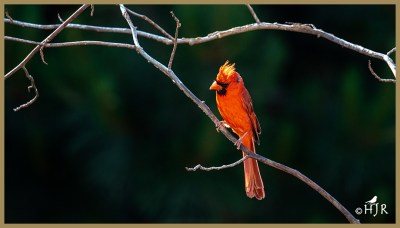

© HJ Ruiz – Avian101
Share this:

Bird’s ID – Black Vulture
Black Vulture
The Black Vulture (Coragyps atratus), also known as the American black vulture, is a bird in the New World vulture family whose range extends from the southeastern United States to Central Chile and Uruguay in South America. Although a common and widespread species, it has a somewhat more restricted distribution than its compatriot, the turkey vulture, which breeds well into Canada and south to Tierra del Fuego. It is the only extant member of the genus Coragyps, which is in the family Cathartidae. Despite the similar name and appearance, this species is unrelated to the Eurasian black vulture, an Old World vulture in the family Accipitridae (which includes eagles, hawks, kites, and harriers). It inhabits relatively open areas which provide scattered forests or shrublands. With a wingspan of 1.5 m (4.9 ft), the black vulture is a large bird though relatively small for a vulture. It has black plumage, a featherless, grayish-black head and neck, and a short, hooked beak.
The black vulture is a scavenger and feeds on carrion, but will also eat eggs or kill newborn animals. In areas populated by humans, it also feeds at garbage dumps. It finds its meals either by using its keen eyesight or by following other (New World) vultures, which possess a keen sense of smell. Lacking a syrinx—the vocal organ of birds—its only vocalizations are grunts or low hisses. It lays its eggs in caves or hollow trees or on the bare ground, and generally raises two chicks each year, which it feeds by regurgitation. In the United States, the vulture receives legal protection under the Migratory Bird Treaty Act of 1918. This vulture also appeared in Mayan codices.
The black vulture is a fairly large bird of prey, measuring 56–74 cm (22–29 in) in length, with a 1.33–1.67 m (52–66 in) wingspan. Weight for black vultures from North America and the Andes ranges from 1.6 to 3 kg (3.5 to 6.6 lb) but in the smaller vultures of the tropical lowlands it is 1.18–1.94 kg (2.6–4.3 lb). 50 vultures in Texas were found to average 2.15 kg (4.7 lb) while 119 birds in Venezuela were found to average 1.64 kg (3.6 lb). The extended wing bone measures 38.6–45 cm (15.2–17.7 in), the shortish tail measures 16–21 cm (6.3–8.3 in) and the relatively long tarsus measures 7–8.5 cm (2.8–3.3 in). Its plumage is mainly glossy black. The head and neck are featherless and the skin is dark gray and wrinkled. The iris of the eye is brown and has a single incomplete row of eyelashes on the upper lid and two rows on the lower lid. The legs are grayish white, while the two front toes of the foot are long and have small webs at their bases. The feet are flat, relatively weak, and are poorly adapted to grasping; the talons are also not designed for grasping, as they are relatively blunt.
The nostrils are not divided by a septum, but rather are perforate; from the side one can see through the beak.The wings are broad but relatively short. The bases of the primary feathers are white, producing a white patch on the underside of the wing’s edge, which is visible in flight. The tail is short and square, barely reaching past the edge of the folded wings. The subspecies differ in size according to Bergmann’s rule, and the amount of white underwing coloration also varies.
Like other birds with scavenging habits, the black vulture presents resistance to pathogenic microorganisms and their toxins. Many mechanisms may explain this resistance. Anti-microbial agents may be secreted by the liver or gastric epithelium, or produced by microorganisms of the normal microbiota of the species.
Photo Gallery


© HJ Ruiz – Avian101
Share this:

Photo Capture # 99 – Red-shouldered Hawk
Red- shouldered Hawk
“I see you…”
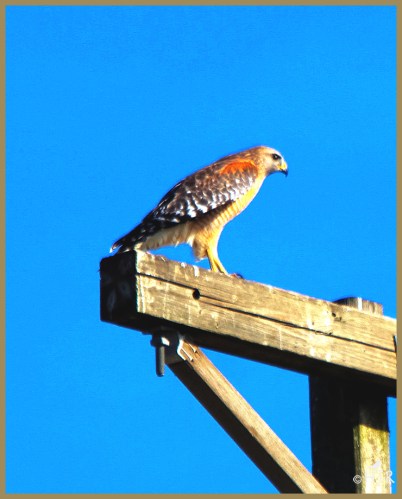
Red-shouldered Hawk – “I see you…”
© HJ Ruiz – Avian101
Share this:

Bird’s ID – Great Grebe
Great Grebe
The Great Grebe (Podiceps major) is the largest species of grebe in the world. A disjunct population exists in northwestern Peru, while the main distribution is from extreme southeastern Brazil to Patagonia and central Chile.
This is a very large grebe, with proportions more like a goose or a cormorant then a typical grebe. They range in length from 67–80 cm (26-32 inches) and usually weigh about 1600 grams (3.5 lb), but can scale to at least 2 kg (4.4 lb). They are buffy-rufous on the neck and chest, blackish on the back and have a whitish belly. The head is sooty gray with a reddish-brown eye. Due to its size and unique coloration, the great grebe is unlikely to be confused with any other bird, including other grebes.
The great grebe lives on a diet mostly of fish, sometimes over 11 cm (4.3 inches) long, but usually smaller. Prey competition can occasionally occur with the neotropic cormorant over fish, but that species (in spite of smaller body size) usually takes larger fish. Also insects, crustaceans and mollusks are taken. The diet can switch to almost half crabs during the wintertime along the coasts, and these birds can also take the young of other waterbirds, especially coots.
fter living in groups numbering up to the hundreds, these birds move inland to breed. Most populations lay their eggs from October to January, becoming later further south. In the isolated Peru population, nesting occurs in September & October, with a possible second clutch in January or February. They are moderately social when breeding, occasionally forming colonies. Three to five eggs (sometimes six) are laid.
Photo Gallery


© HJ Ruiz – Avian101
Share this:

Read Past Reviews

Book # 69

Quote from the Author
“A good chuckle is healthy, it helps you break the monotony of a serious life.” ~ H.J. Ruiz


You must be logged in to post a comment.