Red Gallery – Northern Cardinal
Northern Cardinal
Photo Gallery



© HJ Ruiz – Avian101
Share this:

Bird’s ID – Inca Tern
Inca Tern
The Inca Tern (Larosterna inca) is a tern in the family Laridae. It is the only member of the genus Larosterna.
This uniquely plumaged bird breeds on the coasts of Peru and Chile and is restricted to the Humboldt Current. It is an erratic, rare visitor to the southwest coast of Ecuador. It can be identified by its dark grey body, white mustache on both sides of its head, and red-orange beak and feet.
The Inca tern is a large tern, approximately 40 cm (16 in) long. Sexes are similar; the adult is mostly slate-grey with white restricted to the facial plumes and the trailing edges of the wings. The large bill and legs are dark red. Immature birds are purple-brown and gradually develop facial plumes.
The Inca tern breeds on rocky cliffs. It nests in a hollow or burrow or sometimes the old nest of a Humboldt penguin, and lays one or two eggs. The eggs are incubated for about 4 weeks, and the chicks leave the nest after 7 weeks.
The Inca tern feeds primarily on small fish, such as anchovies. The species spots its prey from the air, diving into the water to grab meals with its pointed beak. Its call is a cat-like mew.
Photo Gallery


© HJ Ruiz – Avian101
Share this:

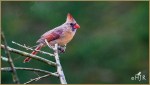
Photo Capture # 123 – Dark-eyed Junco
Dark-eyed Junco
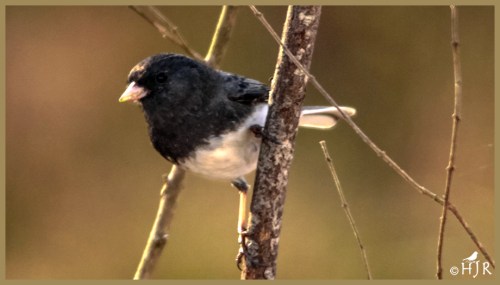
Dark-eyed Junco
© HJ Ruiz – Avian101
Share this:

Bird’s ID – Tricolored Heron
Tricolored Heron
The Tricolored Heron (Egretta tricolor), formerly known as the Louisiana Heron, is a small species of heron that is native to coastal parts of the Americas. In the Atlantic region in ranges from the northeastern United States, south along the coast, through the Mexican Gulf and the Caribbean, to northern South America as far south as Brazil. In the Pacific region, it ranges from Peru to California, but it is only a non-breeding visitor to the far north.
Tricolored herons breed in swamps and other coastal habitats. It nests in colonies, often with other herons, usually on platforms of sticks in trees or shrubs. In each clutch, 3–7 eggs are typically laid.
This species measures from 56 to 76 cm (22 to 30 in) long and has a wingspan of 96 cm (38 in). The slightly larger male heron weighs 415 g (14.6 oz) on average, while the female averages 334 g (11.8 oz). It is a medium-large, long-legged, long-necked heron with a long pointed yellowish or grayish bill with a black tip. The legs and feet are dark.
Adults have a blue-grey head, neck, back, and upper wings, with a white line along the neck. The belly is white. Inbreeding plumage, they have long blue filamentous plumes on the head and neck, and buff ones on the back.
The tricolored heron stalks its prey in shallow or deeper water, often running as it does so. It eats fish, crustaceans, reptiles, and insects.
Photo Gallery


© HJ Ruiz – Avian101
Share this:

Read Past Reviews

Book # 69

Quote from the Author
“A good chuckle is healthy, it helps you break the monotony of a serious life.” ~ H.J. Ruiz
 H.J. Ruiz - Avian101
You must be logged in to post a comment.