
Red Gallery – Northern Cardinal
Photo Gallery for Saturday


© HJ Ruiz – Avian101
Share this:

Bird’s ID – Belcher’s Gull
Belcher’s Gull
Belcher’s Gull (Larus belcheri), also known as the band-tailed gull, is a bird in the family Laridae found along the Pacific coast of South America. It formerly included the very similar Olrog’s gull as a subspecies, but that bird occurs on the Atlantic coast of South America and is now accepted as Larus atlanticus. Belcher’s gull is a medium-sized gull with a blackish mantle, white head and underparts, a black band on the otherwise white tail, and a yellow bill with a red and black tip. Non-breeding adults have a brownish-black head and a white eye-ring. The name of this bird commemorates the British explorer Sir Edward Belcher who performed survey work on the Pacific coast of South America.
Belcher’s gull grows to a length of about 49 centimetres (19 in). The sexes are similar in appearance and in the breeding season, the adult has a white head and very pale grey neck and underparts. The mantle and back are grayish-black and the tail is white with a broad black subterminal band and a white trailing edge. The wing coverts and primaries are black and the secondaries dark grey with white tips. The eye is black, the bill yellow with a distinctive red and black tip, and the legs and feet yellow. Outside the breeding season the head is dark brown with a white ring surrounding the eye. The juvenile is mottled brown and white and attains the adult plumage during its third year. Belcher’s gull can be confused with the slightly larger kelp gull (Larus dominicanus) but that species has a small white tip on its otherwise black wing and lacks the Belcher’s gull’s black band on its tail.
Belcher’s gull is found on the Pacific coast of South America. Its range extends from northern Peru to northern Chile in the area influenced by the Humboldt Current and its habitat includes rocky shores, bays and offshore islands. It ventures several miles offshore to forage and also feeds on rocky shores when the tide is out. It is a non-migratory species.
Belcher’s gull is an omnivore and scavenger. It feeds on fish, crabs, molluscs and carrion, and seasonally on the eggs and nestlings of seabirds. It often associates with Guanay cormorants, pestering them until they regurgitate their prey which it then consumes.
Breeding takes place from December onwards in small colonies of up to one hundred pairs. The nest is a scrape in the sand or among rocks near the high tide line. There are usually three eggs averaging 65 by 45 mm (2.6 by 1.8 in), pale blotched with dark olive markings.
Photo Gallery


© HJ Ruiz – Avian101
Share this:

Photo Capture # 135 – Rock Pigeons
Rock Pigeons
“Look! Red Lamborghini, at the count of three!…One”
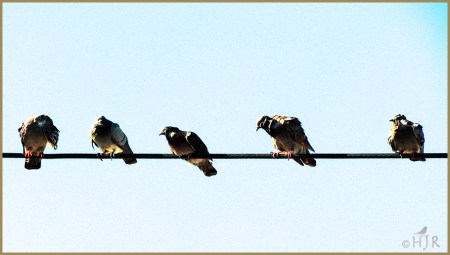
Rock Pigeons –
“Look! Red Lamborghini, at the count of three!…One!”
© HJ Ruiz – Avian101
Share this:

Bird’s ID – Magnificent Frigatebird
Magnificent Frigatebird
The Magnificent Frigatebird (Fregata magnificens) is a seabird of the frigatebird family Fregatidae. It is the largest species of frigatebird. It occurs over tropical and subtropical waters off America, between northern Mexico and norhern Peru on the Pacific coast and between Florida and southern Brazil along the Atlantic coast. There are also populations on the Galápagos Islands in the Pacific and the Cape Verde islands in the Atlantic.
The magnificent frigatebird is a large, lightly built seabird with brownish-black plumage, long narrow wings and a deeply forked tail. The male has a striking red gular sac which it inflates to attract a mate. The female is slightly larger than the male and has a white breast and belly. Frigatebirds feed on fish taken in flight from the ocean’s surface (often flying fish), and sometimes indulge in kleptoparasitism, harassing other birds to force them to regurgitate their food.
The magnificent frigatebird is the largest species of frigatebird. It measures 89–114 cm (35–45 in) in length, has a wingspan of 2.17–2.44 m (7.1–8.0 ft) and weighs 1.1–1.59 kilograms (2.4–3.5 lb). Males are all-black with a scarlet throat pouch that is inflated like a balloon in the breeding season. Although the feathers are black, the scapular feathers produce a purple iridescence when they reflect sunlight, in contrast to the male great frigatebird’s green sheen. Females are black, but have a white breast and lower neck sides, a brown band on the wings, and a blue eye-ring that is diagnostic of the female of the species. Immature birds have a white head and underparts.
The magnificent frigatebird is silent in flight, but makes various rattling sounds at its nest.
It spends days and nights on the wing, with an average ground speed of 10 km/h (6.2 mph), covering up to 223 km (139 mi) before landing. They alternately climb in thermals, to altitudes occasionally as high as 2,500 m (8,200 ft), and descend to near the sea surface. The only other bird known to spend days and nights on the wing is the common swift.
Photo Gallery


© HJ Ruiz – Avian101
Share this:

Read Past Reviews

Book # 69
Quote from the Author
“A good chuckle is healthy, it helps you break the monotony of a serious life.” ~ H.J. Ruiz


You must be logged in to post a comment.