Photography of Birds – Set # 89
Set # 89
Red-bellied Wodpecker

Red-bellied Woodpecker
Red-bellied Woodpeckers depend on dead trees for nesting. Recent studies have shown that these woodpeckers experienced low breeding due to cutting sites of dead trees; however, predators are still of main concern. The juvenile red-bellied woodpecker are ready to fledge its nest at 24 to 26 days of age. Natal dispersal has been observed on juvenile red-bellied woodpeckers. The juvenile red-bellied woodpecker remains approximately 27 weeks in its natal area after fledging. In some cases, the woodpecker may return to its natal area for breeding depending on predation levels and food resources.
Eastern Phoebe

Eastern Phoebe
It often nests on human structures such as bridges and buildings. Nesting activity may start as early as the first days of April. The nest is an open cup with a mud base and lined with moss and grass, built in crevice in a rock or man-made site; two to six eggs are laid. Both parents feed the young and usually raise two broods per year. The eastern phoebe is occasionally host to the nest-parasitic brown-headed cowbird.
© HJ Ruiz – Avian101
Share this:

Photography of Birds – Set # 88
Set # 88
House Finch (Family)
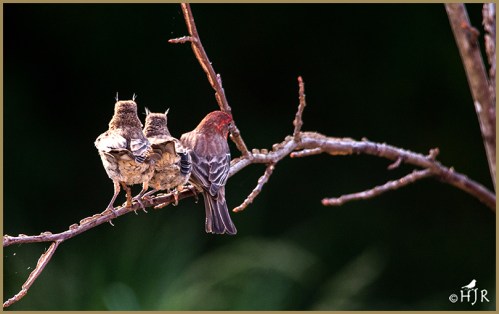
House Finch (Family)
Before flying, the young often climb into adjacent plants, and usually fledge at about 11 to 19 days after hatching. Dandelion seeds are among the preferred seeds fed to the young. Contrary to the way most birds, even ones with herbivorous leanings as adults, tend to feed their nestlings animal matter in order to give them the protein necessary to grow, house finches are one of the few birds who feed their young only plant matter.
European Starling (Family)

European Starling (Family)
Nestlings remain in the nest for three weeks, where they are fed continuously by both parents. Fledglings continue to be fed by their parents for another one or two weeks. A pair can raise up to three broods per year, frequently reusing and relining the same nest, although two broods is typical, or just one north of 48°N. Within two months, most juveniles will have molted and gained their first basic plumage. They acquire their adult plumage the following year. As with other passerines, the nest is kept clean and the chicks’ fecal sacs are removed by the adults.
© HJ Ruiz – Avian101
Share this:

Photography of Birds – Set # 87
Set # 87
Brown-headed Nuthatch

Brown-headed Nuthatch
The bird, like other nuthatches, possesses a sharp black nail-like beak, which it uses to pound open seeds. It is a frequent visitor to feeding stations and is highly fond of sunflower seeds and suet cakes.
Bold and inquisitive, this bird is readily approachable by humans. The bird is frequently observed using a small chip of bark held in its beak as a tool to dig for insects.
White- breasted Nuthatch
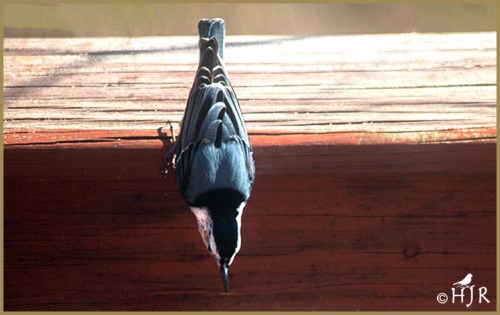
White-breasted Nuthatch
The adult male of the nominate subspecies, S. c. carolinensis, has pale blue-gray upperparts, a glossy black cap (crown of the head), and a black band on the upper back. The wing coverts and flight feathers are very dark gray with paler fringes, and the closed wing is pale gray and black, with a thin white wing bar. The face and the underparts are white. The outer tail feathers are black with broad diagonal white bands across the outer three feathers, a feature readily visible in flight.
© HJ Ruiz – Avian101
Share this:

Red Gallery – Northern Cardinal

Photo Gallery


© HJ Ruiz – Avian101
Share this:

Read Past Reviews

Book # 69
Quote from the Author
“A good chuckle is healthy, it helps you break the monotony of a serious life.” ~ H.J. Ruiz
 H.J. Ruiz - Avian101
You must be logged in to post a comment.