
Framed Memories # 6
-
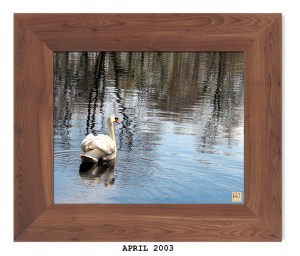
- Mute Swan
-

- Northern Mockingbird
© HJ Ruiz – Avian101
Share this:

Photography of Birds – Set # 94
Set # 94
Tricolored Heron
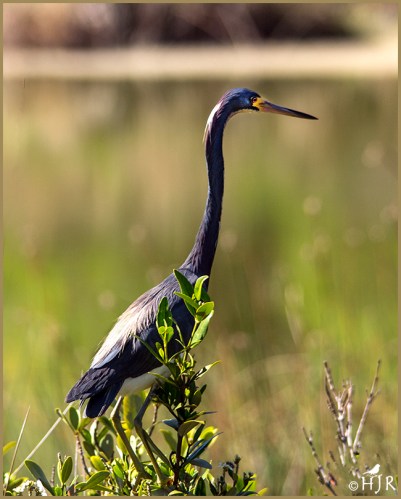
Tricolored Heron
Adults have a blue-grey head, neck, back and upperwings, with a white line along the neck. The belly is white. In breeding plumage, they have long blue filamentous plumes on the head and neck, and buff ones on the back.
The tricolored heron stalks its prey in shallow or deeper water, often running as it does so. It eats fish, crustaceans, reptiles, and insects.
Great Egret

Great Egret
The great egret feeds in shallow water or drier habitats, feeding mainly on fish, frogs, small mammals, and occasionally small reptiles and insects, spearing them with its long, sharp bill most of the time by standing still and allowing the prey to come within its striking distance of its bill, which it uses as a spear. It often waits motionless for prey, or slowly stalks its victim.
© HJ Ruiz – Avian101
Share this:

Photography of Birds – Set # 93
Set # 93
Common Grackle
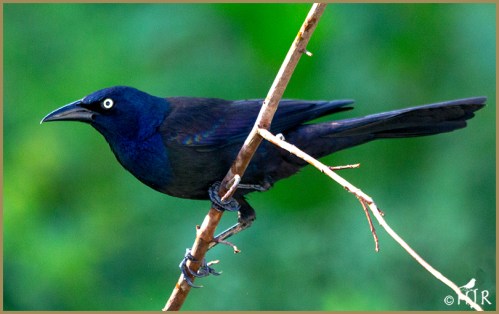
Common Grackle
In the breeding season, males tip their heads back and fluff up feathers to display and keep other males away. This same behavior is used as a defensive posture to attempt to intimidate predators. Male common grackles are less aggressive toward one another, and more cooperative and social, than the larger boat-tailed grackle species.
Red-winged Blackbird (M)
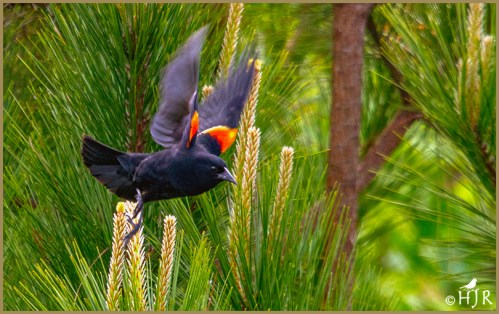
Red-winged Blackbird (M)
Complete replacement of wing feathers takes about eight weeks. However, birds in their first year of age frequently retain some of the under-wing coverts and juvenile tertiary remiges after post-juvenile molting. Of seventy immature males examined during the last week of October, it retained 70% some older lower primary blankets. In most cases where partial replacement of the cover feathers occurs, it is the proximal covers that the bird retains.
© HJ Ruiz – Avian101
Share this:

Photography of Birds – Set # 92
Set # 92
American Goldfinch (M)
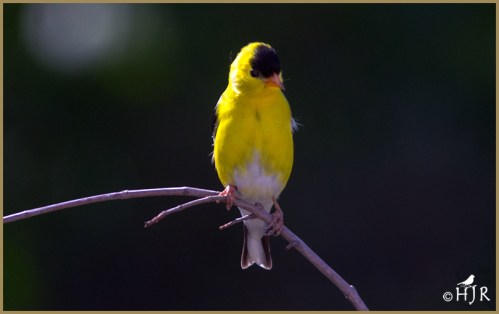
American Goldfinch (M)
The American goldfinch is gregarious during the non-breeding season, when it is often found in large flocks, usually with other finches. The social hierarchy, measured by how many aggressive encounters are won by each individual, tends towards the male being dominant in the non-breeding season. During the breeding season, this finch lives in loose colonies. While the nest is being constructed, the male will act aggressively toward other males who intrude into his territory, driving them away, and the female reacts in the same way toward other females.
Eastern Towhee (M)

Eastern Towhee (M)
Arrival and departure of eastern towhees into summer breeding grounds varies with location. According to a literature review, eastern towhees typically arrive in New York in early April and leave by the middle of November. A review of eastern towhees in New Hampshire describes arrival in late April to May with the majority departing in September. Further south, on the border of Tennessee and North Carolina, migration to high-elevation areas within the Great Smoky Mountains begins as early as March. Eastern towhees typically leave these sites in October.
© HJ Ruiz – Avian101
Share this:

Read Past Reviews

Book # 69
Quote from the Author
“A good chuckle is healthy, it helps you break the monotony of a serious life.” ~ H.J. Ruiz
 H.J. Ruiz - Avian101
You must be logged in to post a comment.