
Photography of Birds – Set # 97
Set # 97
Field Sparrow
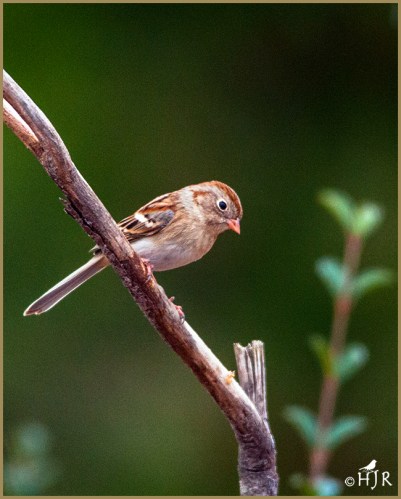
Field Sparrow
The field sparrow is distributed across eastern Canada and the eastern United States, with northern populations migrating southwards to southern United States and Mexico in the fall. The typical habitat of this bird is bushy country with shrubs and grassland. The nest is a cup-shaped construction built on the ground and hidden beneath a bush or clump of grass. The birds forage on the ground or in low vegetation, feeding mainly on seeds and insects.
Lincoln’s Sparrow
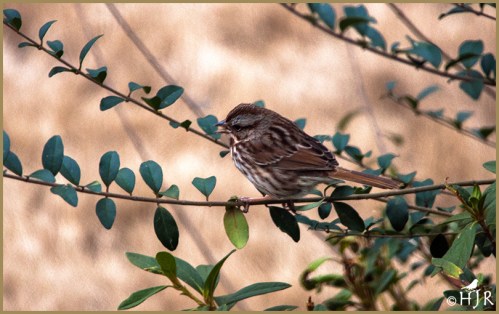
Lincoln’s Sparrow
Their breeding habitat is wet thickets or shrubby bogs across Canada, Alaska, and the northeastern and western United States; this bird is less common in the eastern parts of its range. The nest is a well-concealed shallow open cup on the ground under vegetation.
These birds migrate to the southern United States, Mexico, and northern Central America; they are passage migrants over much of the United States, except in the west.They forage on the ground in dense vegetation, mainly eating insects and seeds.
© HJ Ruiz – Avian101
Share this:

Red Gallery – Northern Cardinal

Photo Gallery


© HJ Ruiz – Avian101
Share this:

Photography of Birds – Set # 96
Set # 96
Mourning Dove
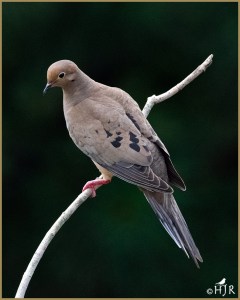
-
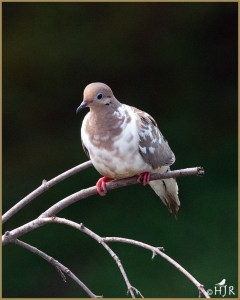
- Leucistic
Leucism (/ˈluːsɪzəm, -kɪz-/) is a term used to describe a wide variety of conditions which result in the partial loss of pigmentation in an animal—which causes white, pale, or patchy coloration of the skin, hair, feathers, scales or cuticles, but not the eyes. It is occasionally spelled leukism. Some genetic conditions that result in a “leucistic” appearance include piebaldism, Waardenburg syndrome, vitiligo, Chédiak–Higashi syndrome, and Melanophilin mutations. Pale patches of skin, feathers, or fur (often referred to as “depigmentation”) can also result from injury. As the term “leucism” is used to refer to conditions with a very wide range of unrelated causes it can not be considered to be a single, specific condition.
© HJ Ruiz – Avian101
Share this:

Photography of Birds – Set # 95
Set # 95
Crested Duck

Crested Duck
The Crested probably originates in the East Indies, with subsequent development in Holland. Crested ducks are seen in seventeenth-century paintings such as those of Melchior d’Hondecoeter and Jan Steen. Paintings as old as 2000 years have depicted images of a bird, resembling a duck with an assortment of feathers on top of its skull. In the United States the breed was described by D.J. Browne in 1853. The white Crested was added to the American Standard of Perfection in 1874; the black variant was added in 1977. The Crested was recognized in the United Kingdom in 1910. In the UK, as in several other European countries, any color is permitted.
Muscovy Duck
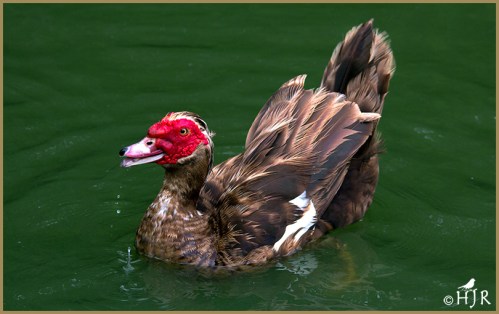
Muscovy Duck
They are large ducks, with the males about 76 cm (30 in) long, and weighing up to 7 kg (15 lb). Females are considerably smaller, and only grow to 3 kg (6.6 lb), roughly half the males’ size. The bird is predominantly black and white, with the back feathers being iridescent and glossy in males, while the females are more drab. The amount of white on the neck and head is variable, as well as the bill, which can be yellow, pink, black, or any mixture of these. They may have white patches or bars on the wings, which become more noticeable during flight. Both sexes have pink or red wattles around the bill, those of the male being larger and more brightly colored.
© HJ Ruiz – Avian101
Share this:

Read Past Reviews

Book # 69

Quote from the Author
“A good chuckle is healthy, it helps you break the monotony of a serious life.” ~ H.J. Ruiz
 H.J. Ruiz - Avian101
You must be logged in to post a comment.