Photography of Birds – Set # 100
Set # 100
Savannah Sparrow
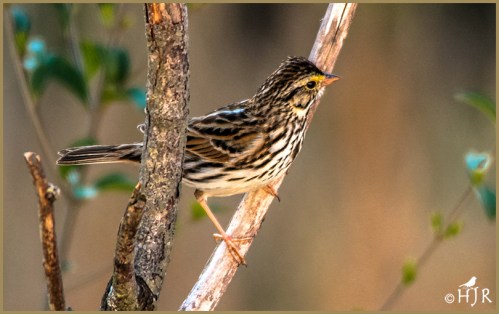
Savannah Sparrow
These birds forage on the ground or in low bushes; particularly in winter they are also found in grazed low-growth grassland. They mainly eat seeds, but also eat insects in the breeding season. They are typically encountered as pairs or family groups in the breeding season, and assemble in flocks for the winter migration. The flight call is a thin seep Sensu lato, the Savannah sparrow is considered a threatened species by the IUCN. The song is mixture of chirps and trills.
Red-winged Blackbird
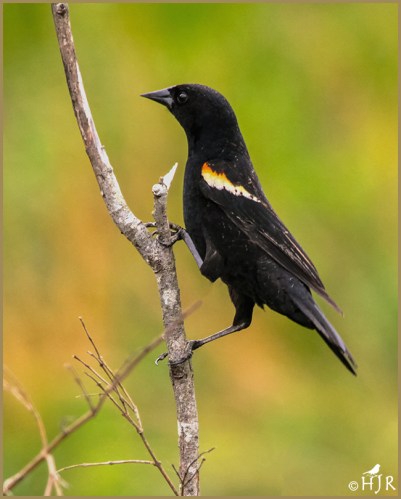
Red-winged Blackbird
The red-winged blackbird is one of 11 species in the genus Agelaius and is included in the family Icteridae, which is made up of passerine birds found in North and South America. The red-winged blackbird was originally described as Oriolus phoeniceus by Linnaeus in his 18th-century work, Systema Naturae, but was later moved with the other American blackbirds to the genus Agelaius (Vieillot, 1816). The genus name is Latin derived from Ancient Greek, agelaios, meaning “belonging to a flock”. The specific epithet, phoeniceus, is from the Latin word meaning “deep red”.
© HJ Ruiz – Avian101
Share this:

Framed Memories – # 7
-
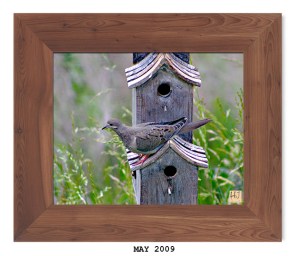
- Mourning Dove
-
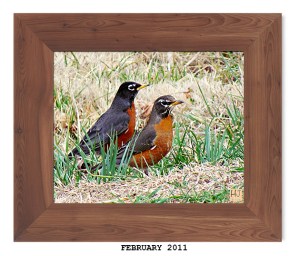
- American Robins
© HJ Ruiz – Avian101
Share this:

Photography of Birds – Set # 99
Set # 99
House Finch (M)

House Finch (M)
House finches forage on the ground or in vegetation normally. They primarily eat grains, seeds and berries, being voracious consumers of weed seeds such as nettle and dandelion; included are incidental small insects such as aphids. They are frequent visitors to bird feeders throughout the year, particularly if stocked with sunflower or nyjer seed, and will congregate at hanging nyjer sock feeders. The house finch is known to damage orchard fruit and consume commercially grown grain, but is generally considered an annoyance rather than a significant pest.
Dark-eyed Junco

Dark-eyed Junco
Juveniles often have pale streaks and may even be mistaken for vesper sparrows (Pooecetes gramineus) until they acquire adult plumage at 2 to 3 months. But junco fledglings’ heads are generally quite uniform in color already, and initially their bills still have conspicuous yellowish edges to the gape, remains of the fleshy wattles that guide the parents when they feed the nestlings.
© HJ Ruiz – Avian101
Share this:

Photography of Birds – Set # 98
Set # 98
Red-winged Blackbird
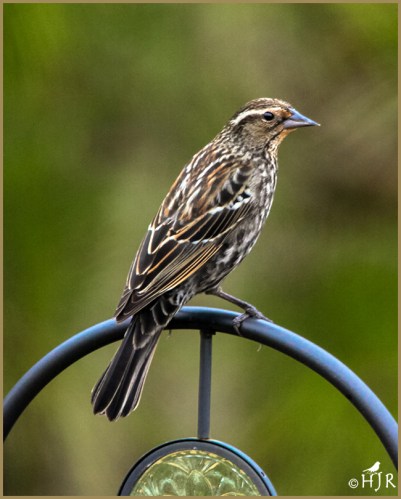
Red-winged Blackbird (F)
The most critical period of feather molting runs from late August to early September. When viewed in flight, they have a misaligned or “moth-eaten” appearance and generally slower and more laborious travel. Their mobility is reduced due to the lack of several remiges or rectrices or these are not entirely renewed. Most of the red-winged blackbird have moved almost entirely by October. By then, some birds have not completed the molt of the feathers of the capital region and the helmsmen of the center of the tail and the internal secondary sprouts have only partially emerged from the pod. Virtually all individuals have completed their molts by mid-October.
Brown-headed Cowbird
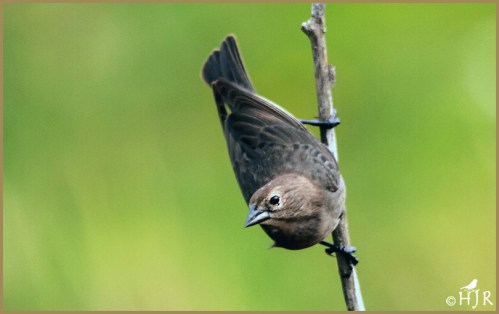
Brown-headed Cowbird (F)
The brown-headed cowbird is an obligate brood parasite: it lays its eggs in the nests of other small passerines (perching birds), particularly those that build cup-like nests. The brown-headed cowbird eggs have been documented in nests of at least 220 host species, including hummingbirds and raptors. The young cowbird is fed by the host parents at the expense of their own young. Brown-headed cowbird females can lay 36 eggs in a season. More than 140 different species of birds are known to have raised young cowbirds. Unlike the common cuckoo, the brown-headed cowbird is not divided into gentes whose eggs imitate those of a particular host.
Some host species, such as the house finch, feed their young a vegetarian diet. This is unsuitable for young brown-headed cowbirds, meaning almost none survive to fledge.
© HJ Ruiz – Avian101
Share this:

Read Past Reviews

Book # 69
Quote from the Author
“A good chuckle is healthy, it helps you break the monotony of a serious life.” ~ H.J. Ruiz
 H.J. Ruiz - Avian101
You must be logged in to post a comment.