Photography of Birds – Set # 103
Set # 103
American Oystercatcher
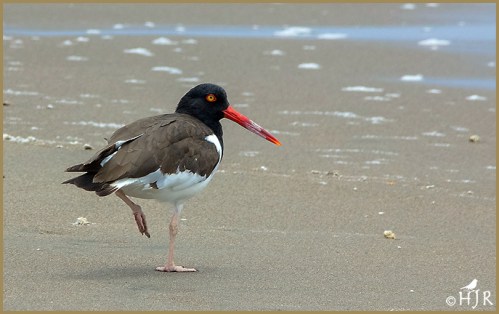
American Oystercatcher
American oystercatchers first breed at an age of 3-4 years.
When courting, the birds will walk together and make a single piping note. This progresses to leaning towards each other, extending and lowering the neck, and running alongside each other while calling. The pair may then burst into flight and fly in a tight formation around their territory.
Killdeer
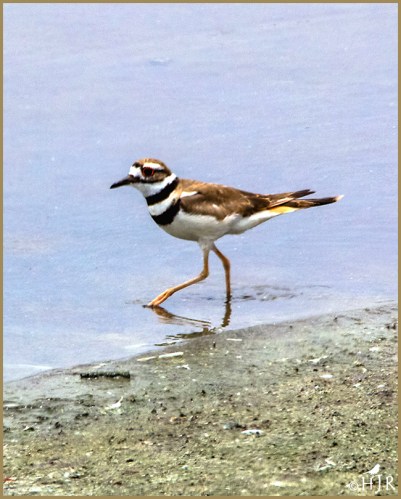
Killdeer
The killdeer feeds primarily on insects (especially beetles and flies), in addition to millipedes, worms, snails, spiders, and some seeds. It opportunistically takes tree frogs and dead minnows. It forages almost exclusively in fields (no matter the tide), especially those with short vegetation and with cattle (which likely shorten the vegetation) and standing water.
© HJ Ruiz – Avian101
Share this:

Photography of Birds – Set # 102
Set # 102
Ruddy Turnstone
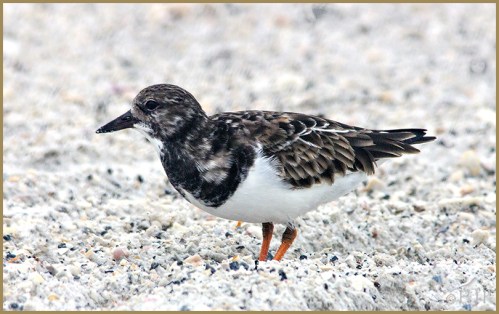
Ruddy Turnstone
Ruddy turnstones engage in a variety of behaviours to locate and capture prey. These behaviors can be placed into six general categories:
-
Routing — The turnstone manipulates piles of seaweed through flicking, bulldozing, and pecking to expose small crustaceans or gastropod molluscs hidden underneath.
-
Turning stones — As suggested by its name, the turnstone flicks stones with its bill to uncover hidden littorinids and gammarid amphipods.
-
Digging — With small flicks of its bill, the turnstone creates holes in the ground substrate (usually sand or mud) and then pecks at the exposed prey – often sand-hoppers or seaweed flies.
-
Probing — The turnstone inserts its bill more than a quarter-length into the ground to get at littorinids and other gastropods.
-
Hammer–probing — The turnstone cracks open its prey’s shell by using its bill as a hammer, and then extracts the animal inside through pecking and probing.
-
Surface pecking — The turnstone uses short, shallow pecks (less than a quarter bill-length) to get at prey at or just below the ground’s surface
Willet
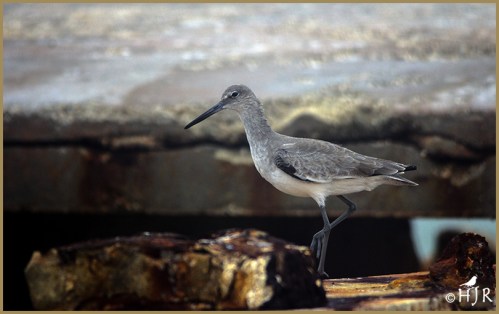
Willet
Willets are flexible in their feeding habits and hunt by walking steadily and pecking prey from the substrate, although they also probe into the mud or silt with their sensitive bill and may actively stalk larger prey in shallow water. A favored prey on the coasts are small fiddler crabs as well as mole crabs, worms, clams and other invertebrates. They have also been known to occasionally eat plant material. Willets also actively hunt more mobile prey such as fish and aquatic insects in the water and will wade up to their bellies to pursue such prey. The sensitive bill means that willets can hunt at night as well as during the day. They are territorial both on the breeding grounds and on the wintering areas but form loose breeding colonies or wintering groups.
© HJ Ruiz – Avian101
Share this:

Red Gallery – Northern Cardinal

Photo Gallery


© HJ Ruiz – Avian101
Share this:

Photography of Birds – Set # 101
Set # 101
West Peruvian Dove
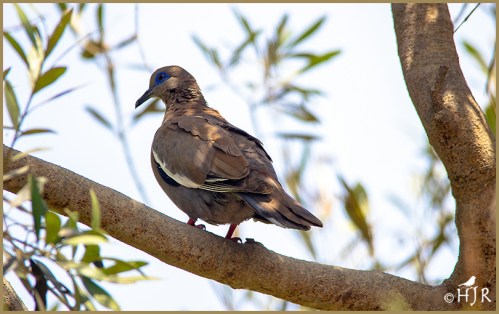
West Peruvian Dove
Specimens are brownish-gray above and gray below, with a bold white wing patch that appears as a brilliant white crescent in flight and is also visible at rest. Adults have a bright blue (almost indigo), featherless patch of skin around each eye. The legs and feet of adults are red, but unlike Z. asiatica, their eyes are brown. Both sexes are similar, but juveniles have a lighter color than adults, they do not have blue eye rings, and their legs and feet are brownish-pink.
Croaking Ground Dove
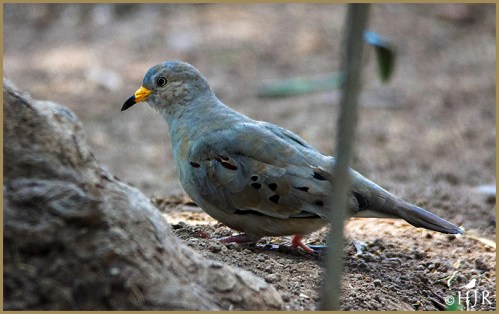
Croaking Ground Dove
It is found in western Ecuador, Peru and far northern Chile. Its natural habitats are subtropical or tropical dry shrubland, subtropical or tropical moist shrubland, subtropical or tropical high-altitude shrubland, and heavily degraded former forest.
© HJ Ruiz – Avian101
Share this:

Read Past Reviews

Book # 69
Quote from the Author
“A good chuckle is healthy, it helps you break the monotony of a serious life.” ~ H.J. Ruiz
 H.J. Ruiz - Avian101
You must be logged in to post a comment.