Photography of Birds – Set # 109
Set # 109
Laughing Gull
Laughing Gull
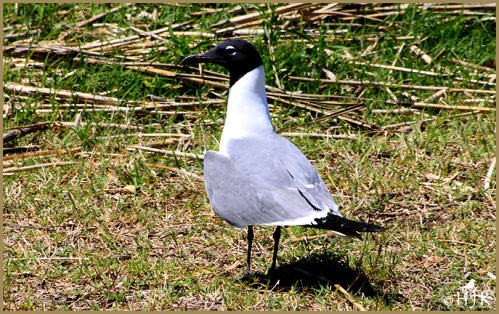
It breeds on the Atlantic coast of North America, the Caribbean, and northern South America. Northernmost populations migrate farther south in winter, and this species occurs as a rare vagrant to western Europe. The laughing gull’s English name is derived from its raucous “kee-agh” call, which sounds like a high-pitched laugh “ha… ha… ha...”.
Laughing gulls breed in coastal marshes and ponds in large colonies. The large nest, made largely from grasses, is constructed on the ground. The three or four greenish eggs are incubated for about three weeks.
Belcher’s Gull
Belcher’s Gull
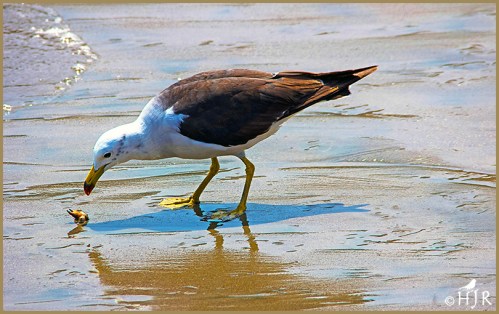
Belcher’s gull grows to a length of about 49 centimetres (19 in). The sexes are similar in appearance and in the breeding season, the adult has a white head and very pale grey neck and underparts. The mantle and back are greyish-black and the tail is white with a broad black subterminal band and a white trailing edge. The wing coverts and primaries are black and the secondaries dark grey with white tips. The eye is black, the bill yellow with a distinctive red and black tip, and the legs and feet yellow. Outside the breeding season the head is dark brown with a white ring surrounding the eye. The juvenile is mottled brown and white and attains the adult plumage during its third year. Belcher’s gull can be confused with the slightly larger kelp gull (Larus dominicanus) but that species has a small white tip on its otherwise black wing and lacks the Belcher’s gull’s black band on its tail.
© HJ Ruiz – Avian101
Share this:

Photography of Birds – Set # 108
Set # 108
Red-headed Woodpecker
Red-headed Woodpecker
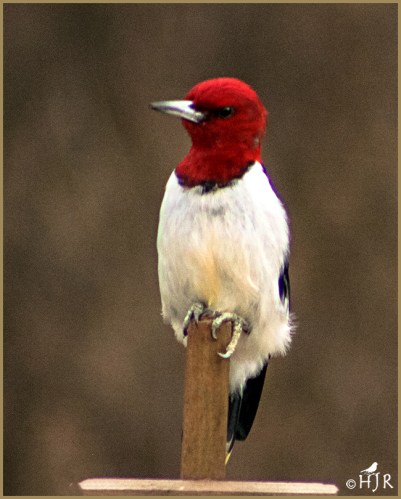
Adults are strikingly tri-colored, with a black back and tail and a red head and neck. Their underparts are mainly white. The wings are black with white secondary remiges. Adult males and females are identical in plumage. Juveniles have very similar markings, but have an all grey head. While red-bellied woodpeckers have some bright red on the backs of their necks and heads, red-headed woodpeckers have a much deeper red that covers their entire heads and necks, as well as a dramatically different overall plumage pattern.
Northern Flicker
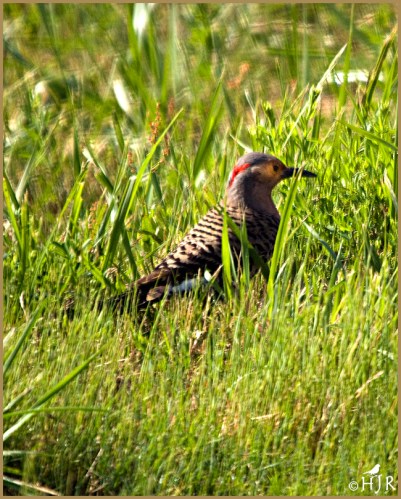
Northern Flicker
According to an article published in Ibis, the availability of food affects the coloration of feathers in nestlings. The article focused on the correlation between melanin spots and carotenoid-based coloration on the wings of nestlings with food stress via indirect manipulation of brood size. The article found that there was a positive correlation between the quality of the nestlings’ diet and T-cell-mediated immune response. T-cell-mediated immune response was found to be positively correlated with brightness of pigmentation in flight feathers, but not related to melanin spot intensity.
© HJ Ruiz – Avian101
Share this:

Photography of Birds – Set # 107
Set # 107
Ruddy Duck
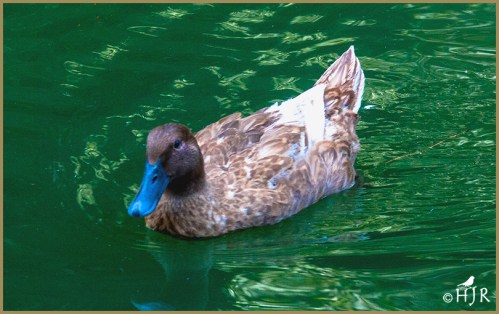
Ruddy Duck
Their breeding habitat is marshy lakes and ponds. They nest in dense marsh vegetation near water. The female builds the nest out of grass, locating it in tall vegetation to hide it from predators. A typical brood contains 5 to 15 ducklings. Pairs form each year.
They are migratory and winter in coastal bays and unfrozen lakes and ponds.
These birds dive and swim underwater. They mainly eat seeds and roots of aquatic plants, aquatic insects and crustaceans.
European Starling
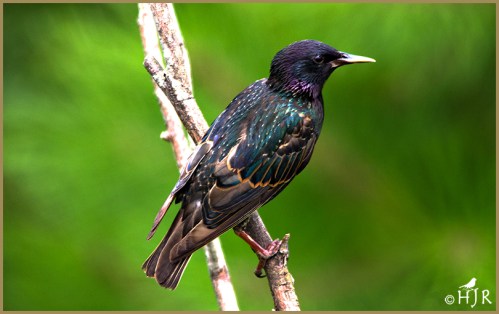
European Starling
The species has declined in numbers in parts of northern and western Europe since the 1980s due to fewer grassland invertebrates being available as food for growing chicks. Despite this, its huge global population is not thought to be declining significantly, so the common starling is classified as being of Least Concern by the International Union for Conservation of Nature.
© HJ Ruiz – Avian101
Share this:

Red Gallery – Northern Cardinal
Photo Gallery


© HJ Ruiz – Avian101
Share this:

Read Past Reviews

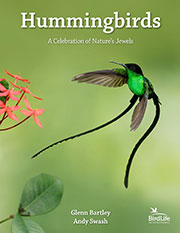
Book # 69
Quote from the Author
“A good chuckle is healthy, it helps you break the monotony of a serious life.” ~ H.J. Ruiz
 H.J. Ruiz - Avian101
You must be logged in to post a comment.